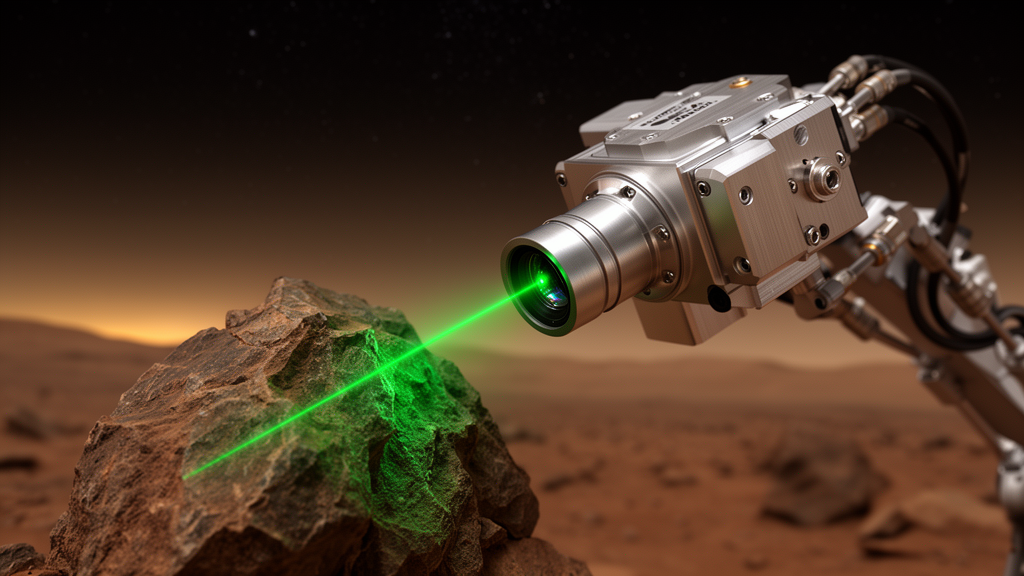
Researchers have successfully implemented and characterized green external-cavity diode lasers in a Littrow configuration tailored specifically for Raman spectroscopy, demonstrating wide wavelength tunability and robust output across eight distinct semiconductor diodes. The experimental evaluation compared six broad-area multi-mode diodes and two transverse single-mode diodes, identifying tuning ranges spanning 8 to 12 nanometers alongside optical output powers exceeding 100 milliwatts. One transverse single-mode diode delivered a maximum power of 45 milliwatts, proving adequate for sensitive spectroscopic detection. Initial Raman measurements conducted at 532 nanometers with a broad-area diode verified the practical viability of the external-cavity architecture for chemical and mineralogical identification.
Frequency-doubled neodymium-doped yttrium aluminum garnet lasers operating at 532 nanometers have dominated green Raman excitation, including deployments on Mars such as SuperCam on Perseverance and continuous-wave sources developed for the ExoMars rover and JAXA’s MMX mission rover IDEFIX. Semiconductor laser diodes offer compelling advantages over solid-state crystals, including electrical-to-optical conversion efficiencies exceeding 30 to 50 percent, operating lifetimes surpassing 10,000 hours, low étendue, and minimal thermal dissipation. Green excitation enables detection of Raman shifts exceeding 4000 inverse centimeters using standard silicon charge-coupled device or complementary metal-oxide-semiconductor detectors. Furthermore, external-cavity tunability supports shifted-excitation Raman difference spectroscopy, which subtracts spectra recorded at two wavelengths separated by roughly one nanometer to eliminate severe background fluorescence.
The experimental Littrow setup collimated diode emission onto a holographic diffraction grating ruled with 2400 grooves per millimeter. Diodes B and H featured an integrated lens within their housing, whereas the other diodes were collimated using external aspheric lenses with focal lengths between 4.5 and 5.5 millimeters, yielding beam widths of 2 to 3 millimeters. In this geometry, the first-order diffracted beam coupled back into the diode for optical feedback, while zeroth-order reflection served as output. To optimize spectral resolution, each diode was oriented with its fast axis aligned along the diffraction plane, illuminating more grating grooves despite p-polarization reducing first-order efficiency. A precision controller stabilized the diode sub-mount temperature within 10 millikelvins. A beamsplitter monitored power on a photodiode while directing remaining light into an in-house spectrometer providing 0.025-nanometer resolution across 505 to 541 nanometers.
To evaluate optical feedback and power scaling, the researchers tested two holographic gratings with reflectivities of 7 percent and 20 percent for p-polarized light around 520 to 530 nanometers using diode A. While the uncoupled free-running diode exhibited the highest electrical-to-optical conversion efficiency, it required the highest threshold current, followed sequentially by the 7 percent and 20 percent gratings. The 20 percent reflectivity grating delivered the lowest threshold current and supported fewer longitudinal modes across the injection current range up to 600 milliamperes. Both external-cavity configurations produced maximum output powers between 250 and 300 milliwatts. Although the free-running diode exceeds 1 watt at elevated currents, operating powers were intentionally restricted to 100 milliwatts. This power range satisfies planetary Raman requirements of 10 to 35 milliwatts while extending operational longevity and providing a safety margin against radiation-induced degradation in space missions.
Spectral measurements confirmed that external optical feedback compressed emission linewidths compared to free-running chips. At 20 degrees Celsius, free-running diode A produced a broad spectrum spanning 527.5 to 529.5 nanometers at 600 milliamperes, displaying a progressive redshift caused by internal heating. When placed in the 20 percent reflectivity cavity at 100 milliwatts, the measured full width at half maximum narrowed to 0.04 nanometers. Accounting for the 0.025-nanometer instrument resolution, the team estimated an upper bound of 0.03 nanometers, or 1 inverse centimeter, for the true linewidth in single-mode operation. This spectral purity surpasses the 6 to 8 inverse centimeter resolution required by planetary instruments like RLS on ExoMars and RAX on MMX. However, when current was increased under fixed grating conditions at 532 nanometers, mode hopping occurred, and secondary emission emerged between 527 and 529 nanometers near 570 milliamperes.
To suppress longitudinal mode hopping across varying currents, the researchers mounted a piezoelectric actuator behind the diffraction grating, permitting fine translation of the external cavity length by roughly 2 micrometers along its surface normal. With active piezo adjustment, diode A remained locked to an individual longitudinal mode across current intervals of approximately 50 milliamperes from threshold up to 600 milliamperes at 20 degrees Celsius. While manual voltage tuning was required at each step, the stabilized cavity sustained single-mode operation for intervals spanning tens of seconds to several minutes. Temperature trials revealed that thermal elevation narrowed the stable current envelope. At 40 degrees Celsius, the current span supporting single-mode operation remained broader than 200 milliamperes, but at 60 degrees Celsius, this window decreased to 50 milliamperes. The investigators noted that longitudinal mode stability degraded primarily at the outermost edges of the diode tuning range.
Systematic characterization of the six broad-area multi-mode diodes, designated alphabetically as A, B, C, E, G, and H, revealed pronounced shared properties alongside critical distinctions. Except for diode E, which is rated at 300 milliwatts, all broad-area diodes possess native manufacturer power ratings exceeding 1 watt, facilitating stable cavity operation at the target 100-milliwatt level. These diodes demonstrated wide tuning envelopes between 10 and 12 nanometers, with diode H attaining the broadest tuning range of 14 nanometers. Furthermore, their tuning profiles exhibited marked asymmetry relative to native emission, providing greater tunability toward longer wavelengths than toward shorter ones. Most crucially for instrument integration, diodes A, G, and H reached the primary target wavelength of 532 nanometers, confirming their immediate suitability for direct insertion into established Raman architectures without requiring redesigns of downstream collection optics or filters.
The two transverse single-mode diodes, labeled D and F, exhibited fundamentally different tuning and modal behaviors compared to broad-area devices. Both single-mode diodes displayed symmetric tuning ranges centered precisely around their nominal emission wavelengths, although their overall tuning bandwidths were narrower. Without piezo adjustment, diode D operated in a single longitudinal mode up to 120 milliamperes, though the oscillating mode hopped as current increased; engaging piezo correction locked emission into a single mode over a 50-milliampere span at 525 nanometers.
Diode G presented unique optical challenges because its native emission centered directly at 532 nanometers exhibited multiple simultaneous longitudinal modes at threshold, rather than the single dominant mode seen in diode A. Initial stabilization proved difficult, yielding a reduced tuning range and a narrow single-mode window of 70 milliamperes under piezo control. The researchers resolved this issue by replacing the original collimating lens, which had a focal length of 4.6 millimeters and a numerical aperture of 0.5, with an aspheric lens having a focal length of 6.24 millimeters and a numerical aperture of 0.42. The longer focal length enlarged the beam diameter, illuminating more grating grooves and producing spectrally narrower feedback into the diode junction. This optical adjustment stabilized single-mode emission, expanded the tuning range, and maintained spectral narrowing to 0.2 nanometers, corresponding to 7 inverse centimeters, which remains fully adequate for planetary mineral identification.
To validate spectroscopic performance, the team conducted Raman measurements using diode A stabilized at 532 nanometers with the 20 percent reflectivity grating and piezo control. Operating at 20 milliwatts excitation power, scattered Raman photons were gathered by an Avantes AvaSpec-Mini spectrometer equipped with a 10-micrometer entrance slit, a 600-groove grating, and a resolution of 0.3 nanometers. Spectra were recorded using an integration period of 10 seconds across 10 accumulations for mineral specimens and polyethylene terephthalate polymer samples. Despite the absence of optical isolators and requiring manual piezo adjustments during acquisition, characteristic Raman vibrational peaks were unambiguously identified across every sample. Experimental checks confirmed that observed laser instabilities occurred independently of sample placement, demonstrating that back-reflections were not the primary driver of modal drift, although incorporating an optical isolator will likely be essential when interrogating highly reflective materials.
The successful implementation of Littrow-configured green external-cavity diode lasers provides a compelling pathway toward miniaturized excitation sources for planetary exploration and space-qualified Raman instrumentation. Reaching stable emission at 532 nanometers ensures direct compatibility with legacy spectrometers and standardized commercial filter sets, eliminating the need for bespoke optical components in upcoming planetary rover payloads. While the prototype complies with space payload volume limits, achieving operational readiness will require replacing manual piezo tuning with an automated feedback controller to eliminate temporal drift and ensure permanent locking. Additionally, integrating refined thermal packaging and compact optical isolators will safeguard modal purity against environmental cycling. Demonstrating narrower intrinsic linewidths than current spaceborne solid-state lasers while delivering broad tunability, these green semiconductor systems establish a foundation for advanced mineralogical probing and shifted-excitation difference spectroscopy on future planetary missions.
Subject of Research: Green external-cavity diode lasers for Raman spectroscopy
Article Title: Green external-cavity diode lasers for Raman spectroscopy: tunability, linewidth, and performance comparison
Article References: Lukaszewski, J., Dietz, E., Schröder, S., Buder, M., & Hübers, H.-W. (2026). Green external-cavity diode lasers for Raman spectroscopy: tunability, linewidth, and performance comparison. Applied Physics B, 132(6), Article 82. https://doi.org/10.1007/s00340-026-08692-3
Image Credits: AI Generated
DOI: 10.1007/s00340-026-08692-3
Keywords: Raman spectroscopy, diode lasers, external-cavity diode laser, Littrow configuration, planetary science, laser spectroscopy, optics, space instrumentation, Green, external-cavity, diode, lasers
News Source: Denise Maddox. (November 11, 2026). Tunable Green Diode Lasers Advance Compact Raman Spectroscopy for Space Exploration. Scienmag.