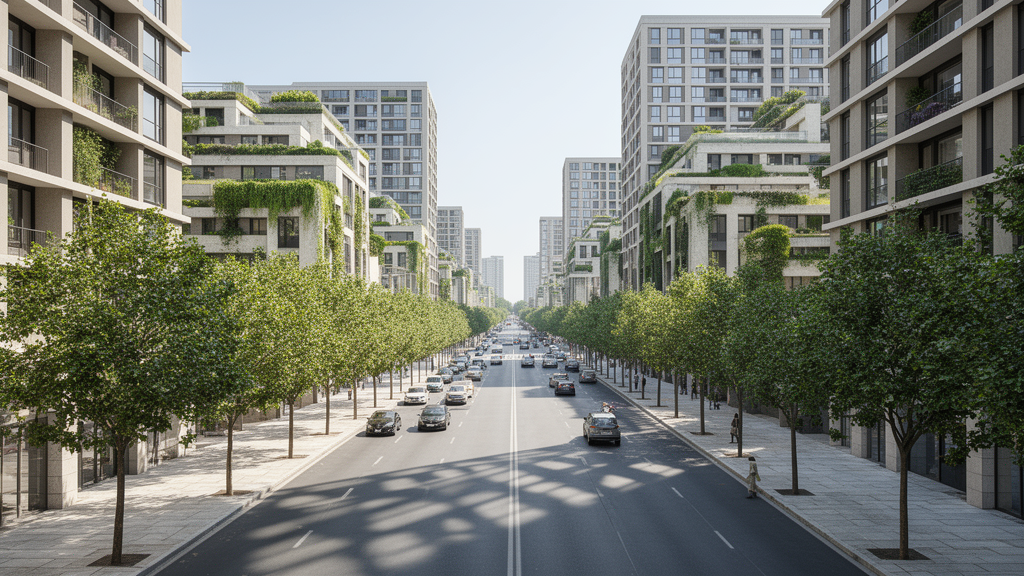
Researchers Sirwan Salimi and Yongmei Lu modeled urban acoustic environments using an innovative voxel-based forward ray tracing framework to examine how distinct block geometries and development intensities alter sound distribution in pedestrian spaces. In contrast, more open, detached layouts facilitated sound scattering into surrounding open areas, substantially curbing street-level accumulation.
Urban noise pollution has emerged as a pervasive public health challenge driven by expanding municipal populations and motor vehicle reliance, with international assessments indicating that major metropolitan centers expose substantial shares of their populations to harmful acoustic environments. Because urban residents spend approximately sixty-eight percent of their time within their homes and immediate neighborhoods, pedestrian corridors serve as the primary setting for everyday physical and social activities. While conventional urban noise assessment methods have historically relied on two-dimensional interpolation maps that overlook vertical gradients or computationally intensive wave-based physics engines that struggle with large-scale urban fabrics, the research team sought a scalable geometric solution capable of capturing intricate three-dimensional acoustic dynamics across diverse neighborhood typologies.
To investigate these acoustic relationships systematically, the investigators developed a three-dimensional forward ray tracing simulation implemented within the Grasshopper plugin for Rhino, combining ray tracing with an image source technique to model specular reflections off architectural surfaces. Architectural boundaries were represented via Non-Uniform Rational B-Splines to accurately calculate surface intersection coordinates and reflection angles. The team segmented the urban street atmosphere into a structured three-dimensional grid of voxels, each measuring two meters by two meters horizontally to approximate human personal space based on typical arm spans, and one meter vertically to account for street-level exposure relevant to both adults and young children. Sound pressure levels calculated across points within each voxel volume were projected onto its base face, indexed hierarchically using an R-Tree spatial algorithm, and averaged as discrete equivalent continuous sound levels across four vertical layers extending four meters above street grade.
The experimental framework evaluated nine synthetic neighborhood scenarios structured around Spacematrix morphological indicators, specifically the Floor Space Index to capture vertical density intensity and the Ground Space Index to measure ground compactness across island-scale block boundaries. The research team modeled three prevailing building typologies—single-structure detached blocks, semi-detached blocks, and enclosed perimeter blocks—across low, medium, and high density tiers, while holding street network geometry and material acoustic parameters uniform across all variations. Depending on the assigned density level, each simulated scenario comprised eighteen to thirty-six blocks populated by a randomized network of ninety-eight vehicle noise sources emitting across three hundred sixty radial directions. This traffic volume was derived from an urban neighborhood population benchmark of forty-five hundred individuals averaging two point one daily trips, with individual vehicular sound power standardized to seventy-five decibels based on localized empirical field measurements.
Before conducting the neighborhood scenario evaluations, the authors completed a validation test comparing their voxel-based ray tracing tool against analytical attenuation calculations from the NoiseTools sound propagation calculator, which implements standard European CNOSSOS-EU and International Organization for Standardization acoustics formulas. Testing point receivers situated at horizontal distances of one, four, and nine meters across four elevation levels under source sound outputs ranging from seventy to one hundred decibels yielded an agreement within plus or minus three decibels, accompanied by a Pearson correlation coefficient of zero point nine eight.
Analysis of the resulting nine neighborhood simulations showed that more than half of the voxel volume in every scenario recorded negligible noise levels below thirty decibels, yet substantial proportions experienced sensible noise between thirty and fifty-five decibels, spanning twenty-five point nine to twenty-six point eight percent in low-density scenarios and rising to twenty-nine point three percent in medium-density configurations. Crucially, impacting noise levels at or above fifty-five decibels—encompassing disturbing, considerable, and harmful acoustic exposures—expanded steadily alongside building densification, covering thirteen point one to fourteen point three percent of street voxels in low-density neighborhoods, sixteen point eight to seventeen point nine percent in mid-density layouts, and eighteen point five to eighteen point nine percent in high-density blocks. In perimeter block layouts, voxels recording between fifty-five and seventy decibels surged by fifty percent from low to high density, demonstrating how architectural densification creates pronounced acoustic concentration zones.
Geometric typology strongly differentiated acoustic performance under identical density assignments, with perimeter block configurations consistently generating higher proportions of elevated sound exposure than detached or semi-detached arrangements. At high density, perimeter blocks recorded eighteen point nine three percent of street space above fifty-five decibels, compared to eighteen point six nine percent for single blocks and eighteen point five zero percent for semi-detached blocks, with high concentrations clustering tightly around intersections and continuous structural facades. Conversely, low-density single-building arrangements exhibited the highest acoustic comfort, maintaining eighty-seven percent of voxel volumes below fifty-five decibels. The authors observed that spatial discontinuities, setbacks, and irregular gaps between freestanding structures promoted sound scattering and dispersion into adjacent open spaces, whereas unbroken perimeter walls trapped acoustic energy within the street corridor, generating intense street-canyon reverberation patterns.
Vertical stratification analysis revealed that street-level noise is intensely concentrated within the lowest two meters of the urban street space across all nine scenarios, directly overlapping the primary zone of human pedestrian activity. The first two voxel layers consistently recorded the most severe noise levels, frequently exceeding seventy decibels. However, vertical decay trajectories diverged markedly across density tiers: low-density configurations demonstrated a continuous and steady attenuation of impacting noise as height increased, whereas medium- and high-density environments sustained elevated proportions of high noise across the first three meters before experiencing a sharp drop at the fourth vertical meter. This vertical retention effect indicates that high-density street canyons retard vertical acoustic dissipation near the ground, keeping sound trapped within pedestrian breathing and activity space.
This vertical disparity was further underscored by examining how density increases disproportionately worsen noise conditions at higher elevations. When comparing low-density perimeter blocks to high-density perimeter blocks, the difference in the proportion of impacting noise voxels was merely zero point twenty-seven percent at the first vertical layer and two point sixty percent at the second layer, but climbed dramatically to eight point ninety-two percent at the third layer and ten point fifty-six percent at the fourth layer four meters above the street.
The investigators emphasized several methodological boundaries inherent to their simulation design, noting that the ray tracing engine modeled specular reflections without accounting for edge diffraction, which may modestly underestimate sound penetration into shielded zones within detached configurations. Furthermore, vehicular noise was represented using omnidirectional, uniform seventy-five decibel point sources without time-varying spectra or vehicle classification distinctions, and the idealized computational models excluded urban vegetation, varied pavement absorptions, and mixed building morphologies.
Subject of Research: Computational modeling of urban street-level noise propagation across building typologies and densities
Article Title: Street-level noise assessment across different urban block typologies: a voxel-based forward ray tracing model
Article References: Salimi, S., & Lu, Y. (2026). Street-level noise assessment across different urban block typologies: a voxel-based forward ray tracing model. Computational Urban Science, 6(1), Article 36. https://doi.org/10.1007/s43762-026-00270-9
Image Credits: AI Generated
DOI: 10.1007/s43762-026-00270-9
Keywords: urban noise pollution, computational urban science, ray tracing, urban design, traffic noise, environmental acoustics, building typology, spacematrix, Street-level, noise, assessment, across
News Source: Denise Maddox. (November 11, 2026). Urban Block Design Shapes Street Noise Levels in Computer Simulation Study. Scienmag.