Credit: The Science Bridge
Ask professors Izumi Fukunaga and Bernd Kuhn about the birth of a new international collaboration between neuroscientists and they will tell you about burgers. Not just any burgers.
"The best burger you've ever had," said Fukunaga.
The two, currently professors at the Okinawa Institute of Science and Technology Graduate University (OIST), first ate the mint-and-spice-packed concoctions a decade ago at the flat of Mazahir Hasan, now a professor at the Achucarro Basque Center for Neuroscience, and the driving force behind a new article, "Building Bridges through Science" in the journal Neuron. At the time, Hasan was a postdoctoral fellow, and already beginning to feel the effects of life as a South Asian man in Germany in the post-9/11 era.
"As a Pakistani living abroad, I have lived my entire life without borders, travelled wherever I wanted to go in a world that I had always imagined as united," Hasan wrote in an email. But after September 11, 2001, that changed, he said. He noticed he was treated differently, in airports, on the street, and even in academia. "My personal view of a united world started to crumble. I was caught in the middle, with roots from the East and my education and life experiences largely from the West."
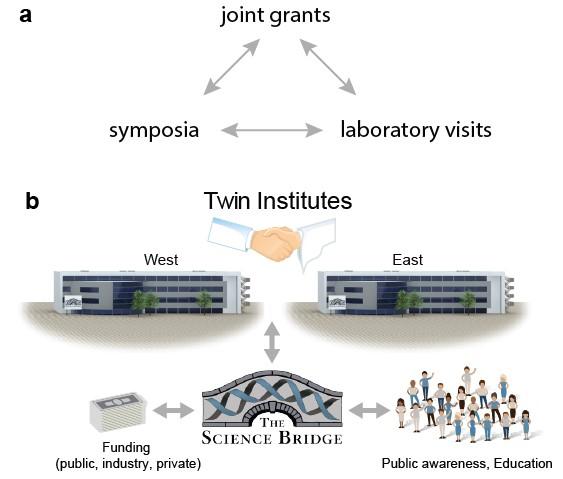
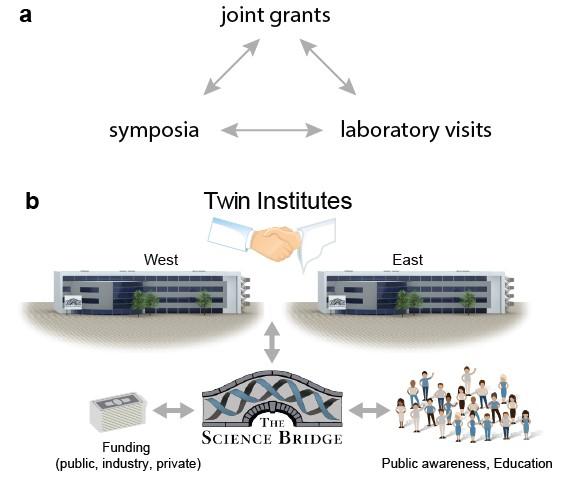
Hasan envisioned a space where scientists from regions like the Middle East and South Asia, who continue to be underrepresented in the international academic community, would be encouraged to participate in scientific discourse and even lead the conversation. Years after he began to talk with colleagues about his vision, these ideas have led to the publication of a paper–and that is just the beginning. The project, The Science Bridge, aims to foster a partnership between Western and Middle Eastern neuroscience communities, with the end goal of creating "Twin Institutes" in those parts of the globe.
"As a scientist, I felt a call to action–we have to build bridges, not walls," Hasan wrote.
His idea has garnered support from colleagues across the world. The paper's 122 authors–which include several Nobel laureates–represent more than 80 research institutions in two dozen countries. Three of its members have connections to OIST: Izumi Fukunaga, Bernd Kuhn, and Torsten Wiesel, formerly the chair of the board of governors, have all been vocal in their enthusiasm for the project.
"In general, the scientific world–East and West and North and South–gets closer and closer together," said Kuhn, "and we at OIST want to be part of this."
The paper's authors envision a working relationship that will allow scientists of different cultures to come together, as they did during the "Golden Age" of Arab and Persian cultures, and share their thoughts, without fear of persecution or punishment. That era (between the 7th and 13th Century, C.E.) saw marked advances in math, science, and medicine, as well as the establishment of what is today the oldest university in the world, the University of Al Karaouine in current-day Morocco.
For decades, collaborations in the sciences have brought researchers together despite the politics of their governments. Today, neuroscience is ideally positioned to unite cultures, the paper's authors posit. They believe that, like food, science is an international language–one that has the power to transcend borders. It is also a deeply needed field of research in a conflict-ridden region.
"I believe the international community at OIST is evidence that science indeed binds together people from all over the world," said Fukunaga. "Neuroscience is a particularly good discipline for an initiative like the Science Bridge, as all countries need solutions to mental illnesses."
Such a collaboration would offer an opportunity to study diseases like Alzheimer's, which affect both cultures, and conditions like post-traumatic stress disorder, which occur more frequently in the Middle East, where many communities have been affected by war and conflict-driven poverty.
"The Science Bridge aims to create a new dimension of collaborative research focused on advancing basic and translational life science," the paper authors write. "We hope that our initiative will open a new chapter in East-West science exchange."
###
Media Contact
Kaoru Natori
[email protected]
81-989-662-389
@oistedu
http://www.oist.jp/
Original Source
https://www.oist.jp/news-center/news/2017/12/8/paper-heralds-new-science-collaboration-middle-east http://dx.doi.org/10.1016/j.neuron.2017.09.028