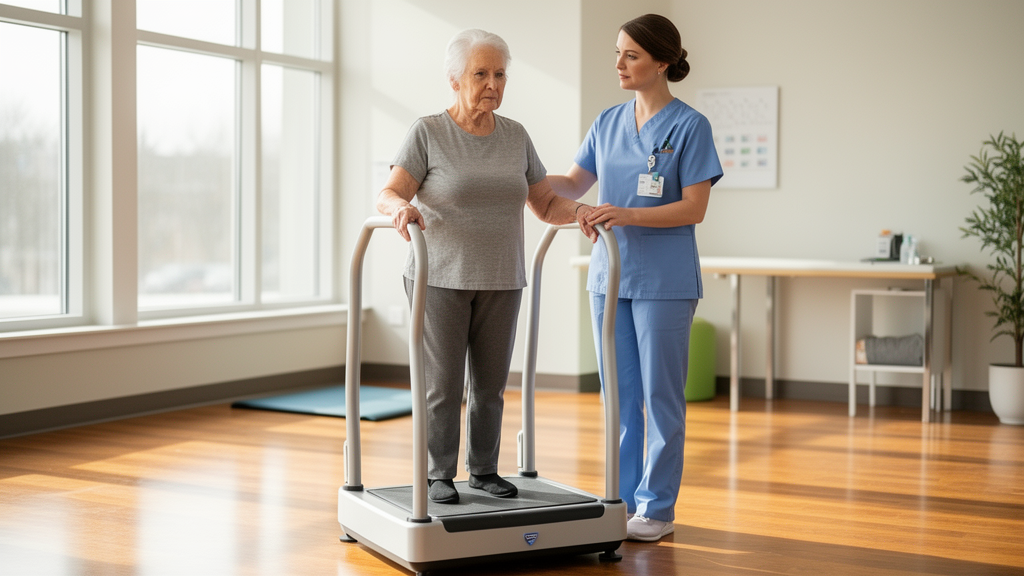
In a systematic review and Bayesian network meta-analysis published in BMC Sports Science, Medicine and Rehabilitation, researchers Wen Yuan, Yang Xu, and Wenjuan Li analyzed the comparative effectiveness of different exercise modalities across major physical recovery domains in adults recovering from stroke. Synthesizing evidence from 52 randomized controlled trials that encompassed 2,329 adult participants in subacute or chronic recovery stages, the authors found that whole-body vibration produced the clearest functional benefit for balance compared with control interventions. On the Berg Balance Scale, whole-body vibration achieved an estimated mean difference of 9.86 points, with a 95 percent credible interval ranging from 4.78 to 14.92. Notably, this balance finding represented the single principal comparison across the entire evaluation supported by moderate-certainty evidence, distinguishing it from all other evaluated exercise interventions.
The clinical rationale for the investigation centers on the foundational role of physical exercise in post-stroke rehabilitation programs. While exercise is widely recognized as a cornerstone of stroke recovery, comparative evidence across distinct exercise modalities and specific functional recovery domains has remained fragmented in the clinical literature.
To gather all eligible evidence on post-stroke physical recovery, the research team performed systematic literature searches across four major biomedical citation databases: PubMed, Embase, Web of Science, and the Cochrane Library. The search captured published studies from database inception through January 22, 2026, targeting randomized controlled trials of exercise-based rehabilitation in adult stroke populations.
The investigators conducted Bayesian random-effects network meta-analyses across four standardized physical outcome measures: the Berg Balance Scale for postural stability, the 6-minute walk test for walking endurance, the 10-meter walk test for gait performance, and the Timed Up and Go test for functional mobility. Treatment effects in these network models were expressed as mean differences or standardized mean differences accompanied by 95 percent credible intervals. For two additional clinical outcomes—activities of daily living measured by the Modified Barthel Index and lower-extremity motor recovery assessed by the Fugl-Meyer Assessment-Lower Extremity—the available trial data did not support reliable network meta-analysis. Consequently, the research team synthesized the findings for those two domains narratively rather than generating quantitative network estimates.
In addition to the moderate-certainty balance gains seen with whole-body vibration, the network analysis identified positive effects across several exercise modalities for walking endurance and functional mobility. When evaluating walking endurance on the 6-minute walk test, four active modalities—aerobic exercise, combined aerobic plus strength training, coordinative training, and standalone strength training—all demonstrated improvements compared with control interventions. However, the network comparisons revealed no conclusive differences among these active exercise modalities, suggesting that no single active regimen held a decisive advantage over the others for walking endurance. For functional mobility assessed by the Timed Up and Go test, strength training was associated with improvement, yielding a mean difference of minus 3.41 seconds with a 95 percent credible interval of minus 5.06 to minus 1.66 seconds.
For gait performance assessed using the 10-meter walk test, favorable effects were observed for aerobic exercise, coordinative training, and strength training, but the authors highlighted substantial methodological instability in these results. The certainty of evidence for the 10-meter walk test was rated as very low due to local inconsistency within the network, potential small-study effects, and marked sensitivity to the inclusion of individual studies. When evaluating the certainty of evidence across the entire review using the GRADE framework, the authors found that robust evidence was exceedingly rare. Out of 40 principal comparisons evaluated, only one comparison was supported by moderate-certainty evidence, whereas 25 comparisons were classified as low certainty and 14 comparisons were graded as very low certainty.
The authors also noted that comparative evidence remained notably limited for broader daily functional independence and lower-extremity motor recovery, as the available trial data for the Modified Barthel Index and the Fugl-Meyer Assessment-Lower Extremity were insufficient to support reliable comparative inference. In their conclusions, the investigators emphasized that the comparative effects of exercise after stroke differ considerably across specific rehabilitation domains. While whole-body vibration showed the most consistent evidence for balance, and multiple exercise modalities improved walking endurance, comparative evidence for gait performance and functional mobility remained substantially less robust. The authors concluded that exercise selection in stroke rehabilitation should be aligned with specific functional recovery targets and individual clinical contexts rather than guided by treatment rankings alone.
Subject of Research: Comparative effectiveness of exercise modalities across stroke rehabilitation domains
Article Title: Effects of different types of exercise in patients with stroke: a network meta-analysis
Article References: Yuan, W., Xu, Y., & Li, W. (2026). Effects of different types of exercise in patients with stroke: a network meta-analysis. BMC Sports Science, Medicine and Rehabilitation. https://doi.org/10.1186/s13102-026-02150-5
Image Credits: AI Generated
DOI: 10.1186/s13102-026-02150-5
Keywords: stroke rehabilitation, subacute stroke, chronic stroke, network meta-analysis, randomized controlled trials, whole-body vibration, Berg Balance Scale, aerobic exercise, strength training, coordinative training, 6-minute walk test, 10-meter walk test, Timed Up and Go test, Modified Barthel Index, Fugl-Meyer Assessment, walking endurance, functional mobility, GRADE assessment
News Source: Cassandra Pierce. (November 11, 2026). Whole-Body Vibration Improves Balance After Stroke in Exercise Network Meta-Analysis. Scienmag.