

• HOME
  • NEWS
  • EXPLORE
    • CAREER
      • Companies
      • Jobs
    • EVENTS
    • iGEM
      • News
      • Team
    • PHOTOS
    • VIDEO
    • WIKI
  • BLOG
  • COMMUNITY
    • FACEBOOK
    • INSTAGRAM
    • TWITTER
Tuesday, January 13, 2026
BIOENGINEER.ORG
No Result
View All Result
  • Login
  • HOME
  • NEWS
  • EXPLORE
    • CAREER
      • Companies
      • Jobs
        • Lecturer
        • PhD Studentship
        • Postdoc
        • Research Assistant
    • EVENTS
    • iGEM
      • News
      • Team
    • PHOTOS
    • VIDEO
    • WIKI
  • BLOG
  • COMMUNITY
    • FACEBOOK
    • INSTAGRAM
    • TWITTER
  • HOME
  • NEWS
  • EXPLORE
    • CAREER
      • Companies
      • Jobs
        • Lecturer
        • PhD Studentship
        • Postdoc
        • Research Assistant
    • EVENTS
    • iGEM
      • News
      • Team
    • PHOTOS
    • VIDEO
    • WIKI
  • BLOG
  • COMMUNITY
    • FACEBOOK
    • INSTAGRAM
    • TWITTER
No Result
View All Result
Bioengineer.org
No Result
View All Result
Home NEWS Science News Neuroscience

The smart mouse with the half-human brain

Bioengineer by Bioengineer
December 4, 2014
in Neuroscience
Reading Time: 1 min read
0
Share on FacebookShare on TwitterShare on LinkedinShare on RedditShare on Telegram

What would Stuart Little make of it? Mice have been created whose brains are half human. As a result, the animals are smarter than their siblings.
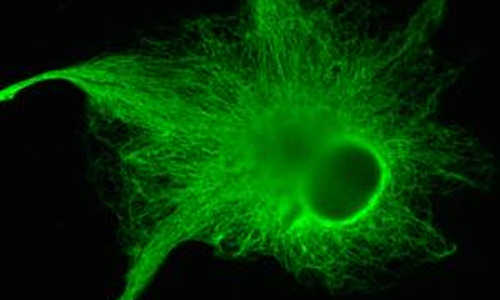
neuron-smart-mouse

Researchers at the University of Rochester Medical Center in New York extracted immature glial cells from donated human fetuses. They injected them into mouse pups where they developed into astrocytes, a star-shaped type of glial cell. Within a year, the mouse glial cells had been completely usurped by the human interlopers. The 300,000 human cells each mouse received multiplied until they numbered 12 million, displacing the native cells.

“We could see the human cells taking over the whole space,” says Goldman. “It seemed like the mouse counterparts were fleeing to the margins.”

Astrocytes are vital for conscious thought, because they help to strengthen the connections between neurons, called synapses. Their tendrils (see image) are involved in coordinating the transmission of electrical signals across synapses.

Human astrocytes are 10 to 20 times the size of mouse astrocytes and carry 100 times as many tendrils. This means they can coordinate all the neural signals in an area far more adeptly than mouse astrocytes can. “It’s like ramping up the power of your computer,” says says Steve Goldman of the University of Rochester Medical Center in New York.

Story Source:

The above story is based on materials provided by Newscientist.

more info: http://www.newscientist.com/article/dn26639-the-smart-mouse-with-the-halfhuman-brain.html#.VICE9tLGpfh
Share12Tweet8Share2ShareShareShare2

Related Posts

Redox biomarker could predict progression of epilepsy

October 5, 2016

Neural membrane’s structural instability may trigger multiple sclerosis

October 5, 2016

Scientists find new path in brain to ease depression

October 5, 2016

Key players responsible for learning and memory formation uncovered

October 3, 2016
Please login to join discussion

POPULAR NEWS

  • Enhancing Spiritual Care Education in Nursing Programs

    154 shares
    Share 62 Tweet 39
  • PTSD, Depression, Anxiety in Childhood Cancer Survivors, Parents

    146 shares
    Share 58 Tweet 37
  • Robotic Ureteral Reconstruction: A Novel Approach

    71 shares
    Share 28 Tweet 18
  • Study Reveals Lipid Accumulation in ME/CFS Cells

    51 shares
    Share 20 Tweet 13

About

We bring you the latest biotechnology news from best research centers and universities around the world. Check our website.

Follow us

Recent News

Moral Blindness in Critical Care Nurses Explored

Income and Insurance Impact on Migraine Treatment Insights

Strong Clustering of Health-Related Social Needs Revealed

Subscribe to Blog via Email

Enter your email address to subscribe to this blog and receive notifications of new posts by email.

Join 71 other subscribers
  • Contact Us

Bioengineer.org © Copyright 2023 All Rights Reserved.

Welcome Back!

Login to your account below

Forgotten Password?

Retrieve your password

Please enter your username or email address to reset your password.

Log In
No Result
View All Result
  • Homepages
    • Home Page 1
    • Home Page 2
  • News
  • National
  • Business
  • Health
  • Lifestyle
  • Science

Bioengineer.org © Copyright 2023 All Rights Reserved.
