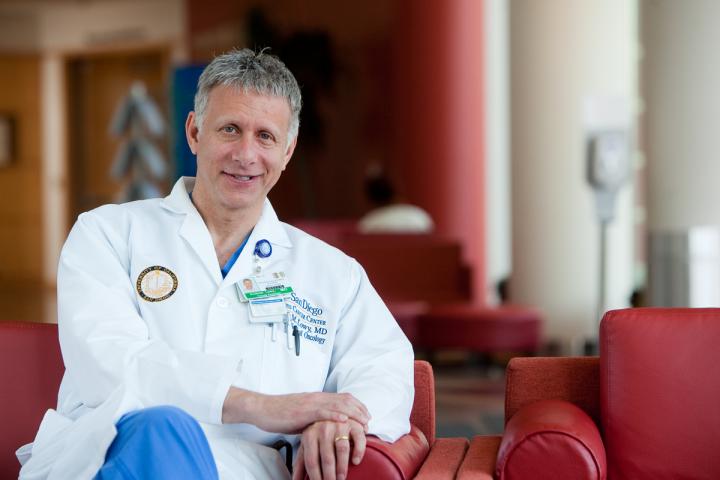
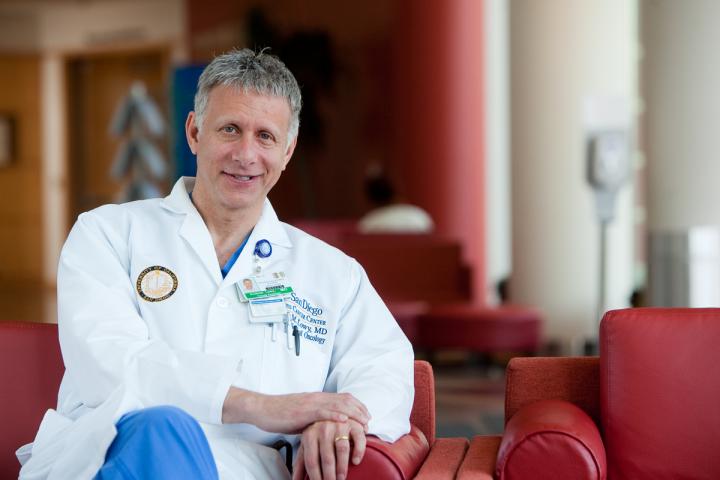
In an effort to advance research on one of the deadliest forms of cancer, University of California, San Diego School of Medicine researchers Andrew Lowy, MD, and Tannishtha Reya, PhD, have been recruited for their expertise in preclinical modeling, clinical trials and stem cell biology to join a "dream team" of international pancreatic cancer researchers.
The three-year, $12-million effort, sponsored by Stand Up To Cancer, Cancer Research UK and The Lustgarten Foundation, will pursue a three-pronged strategy to better understand and reset so-called "super-enhancers" that may be abnormally active in pancreatic tumors. Super-enhancers are bits of DNA that can cause over-expression of genetic signals, fueling cancer cell growth.
"What's unique about the grant is that it's a different approach to the disease," said Lowy, chief of the Division of Surgical Oncology at Moores Cancer Center at UC San Diego Health. "The idea being that you can reprogram pancreatic cancer cells to a different state so they can be less aggressive or you can create new vulnerabilities that can be exploited with combination drug therapies."
One prong of the dream team will develop new technologies to analyze pancreatic tumor super-enhancers to better understand how they exploit normal regenerative processes. A second prong will investigate how pancreatic cancer cells obtain nutrients from nearby normal cells while evading detection by the immune system. A third prong will involve clinical trials with a new class of drugs targeting super-enhancers. The trials are slated to begin in the first year of funding.
Leading the international effort are Daniel D. Von Hoff, MD, physician-in-chief at the Translational Genomics Research Institute in Phoenix; Gerard I. Evan, PhD, professor and chair of the Department of Biochemistry at University of Cambridge and Ronald M. Evans, PhD, director of the Gene Expression Laboratory at the Salk Institute for Biological Studies and an adjunct professor at UC San Diego.
Lowy and Reya have already begun laying the foundation needed for the collaborative research. Lowy has developed ways to make tumors more sensitive to chemotherapy drugs and his work with preclinical modeling will allow for simultaneous testing of treatments in a clinical trial setting.
Reya, professor in the departments of Pharmacology and Medicine, studies how stem cell signals can be subverted to drive cancer progression and therapy resistance. She has developed models that allow detection of therapy-resistant cells, which can often trigger relapse and recurrence. With Lowy and others, Reya will use these models to test therapies that may be able to eradicate drug-resistant cancer cells and help ensure a more durable disease remission. The dream team approach, said Reya, provides "a remarkable opportunity to integrate the molecular understanding of the signals that drive pancreatic cancer growth with development of new therapies targeting these signals."
Pancreatic cancer is a rare disease, making up only two percent of all new cancer cases, but it is the fourth leading cause of cancer death in the United States. According to the National Cancer Institute (NCI), approximately 30 percent of patients have locally advanced disease and 50 percent have disease that has already spread.
Surgery is the only treatment option, but because of metastasis less than 20 percent of patients are candidates for this treatment and even when surgery is successful, it only provides long-term, disease-free survival in 3 to 4 percent of patients. Part of the problem is that the causes of pancreatic cancer are not well understood and science has been unable to apply advances in cancer therapy to pancreatic cancer.
"Pancreatic cancer is a recalcitrant disease," said Scott Lippman, MD, director of Moores Cancer Center. "It can be beat, but it will require a massive global team effort, from bench to bedside and back. This dream team represents that effort and we are excited to be part of it."
###