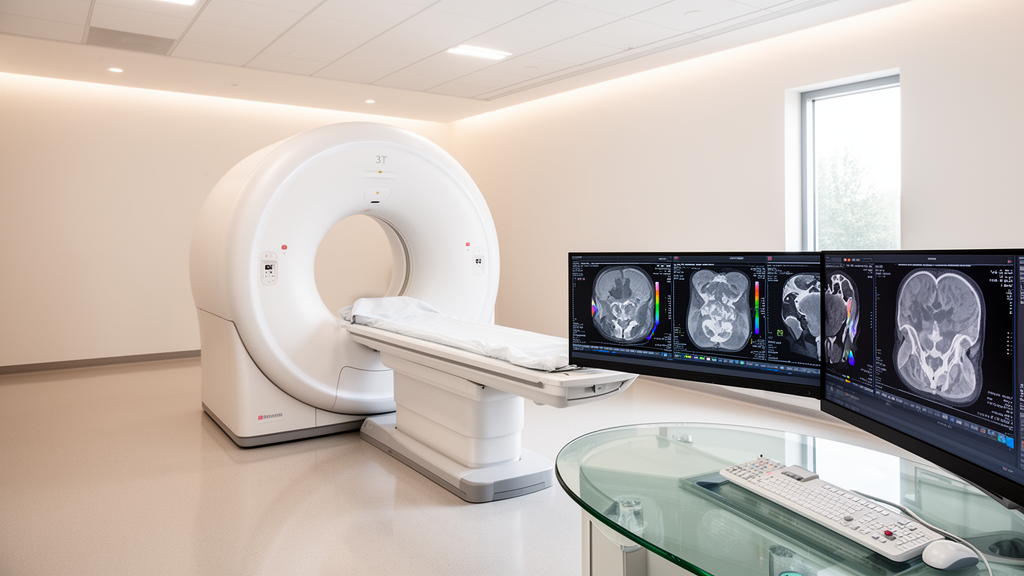
A preliminary prospective study evaluating 3.0-Tesla magnetic resonance imaging has demonstrated the feasibility of glucose chemical exchange saturation transfer (glucoCEST) MRI for detecting bladder cancer and serving as a potential noninvasive molecular imaging biomarker of altered tumor glucose metabolism. The investigation systematically evaluated imaging acquisition parameters in controlled phantom experiments before applying a phantom-optimized protocol to a pilot clinical cohort consisting of patients with histopathologically confirmed bladder cancer and healthy volunteers.
The research objective focused on optimizing glucoCEST MRI acquisition parameters specifically for bladder imaging at a magnetic field strength of 3.0 T using phantom experiments, while evaluating preliminary clinical feasibility. The researchers sought to determine whether the technique could serve as a noninvasive molecular imaging biomarker capable of characterizing altered tumor glucose metabolism and identifying bladder cancer within a clinical setting.
To systematically characterize CEST signal dependencies, the investigators scanned D-glucose phantoms across a range of glucose concentrations from 6.5 to 100 mmol/L and across three distinct pH levels of 6.4, 7.4, and 8.4 using a 3.0 T scanner. Acquisition parameters were optimized by systematically adjusting the saturation amplitude between 0.5 and 2 µT, varying the saturation duration from 1 to 3 seconds, and comparing one and two excitations.
The phantom experiments revealed that the B0-corrected magnetization transfer ratio asymmetry, measured at 1.2 ppm, increased with higher glucose concentrations but decreased as pH levels increased. Based on these observations, the researchers determined that an acquisition configuration using a saturation power of 2.0 µT, a saturation duration of 1 second, and a single excitation (NEX = 1) produced an optimal CEST signal while maintaining an acceptable scan time.
Following optimization, the single-shot fast spin echo CEST protocol was prospectively implemented in a clinical cohort comprising 20 healthy volunteers and 20 patients with histopathologically confirmed bladder cancer. For each participant, regions of interest were delineated to measure the B0-corrected magnetization transfer ratio asymmetry at 1.2 ppm within bladder tumors, the normal bladder walls of cancer patients, and the bladder walls of healthy controls.
The clinical measurements showed that bladder tumors had significantly higher magnetization transfer ratio asymmetry values, recording 2.25% [3.18%], compared with -4.30% [0.68%] in the bladder walls of healthy volunteers and -3.98% [0.73%] in the normal bladder walls of bladder cancer patients. Statistical evaluation using the Kruskal-Wallis test followed by Dunn’s post-hoc analysis with Bonferroni correction established that these tumor elevations were statistically significant at P < 0.05, whereas no statistically significant difference was detected between healthy volunteer bladder walls and normal bladder walls in cancer patients (P = 0.231), supporting the preliminary feasibility of 3.0 T glucoCEST MRI for bladder cancer detection.
Subject of Research: GlucoCEST MRI feasibility for bladder cancer detection at 3.0 T
Article Title: A preliminary study of the feasibility of glucose chemical exchange saturation transfer MRI at 3T for bladder cancer
Article References: Li, J., Li, Y., Su, W., Zhang, Z., Xu, Y., Wu, P.-Y., Wang, P., Wang, F., & Shen, A. (2026). A preliminary study of the feasibility of glucose chemical exchange saturation transfer MRI at 3T for bladder cancer. BMC Medical Imaging. https://doi.org/10.1186/s12880-026-02987-9
Image Credits: AI Generated
DOI: 10.1186/s12880-026-02987-9
Keywords: glucoCEST MRI, bladder cancer, molecular imaging, 3.0 T MRI, glucose metabolism, chemical exchange saturation transfer, biomarkers, diagnostic imaging, preliminary, feasibility, glucose, chemical
News Source: Nathaniel Bowman. (November 10, 2026). Pilot Study Evaluates 3T GlucoCEST MRI for Bladder Cancer Detection. Scienmag.