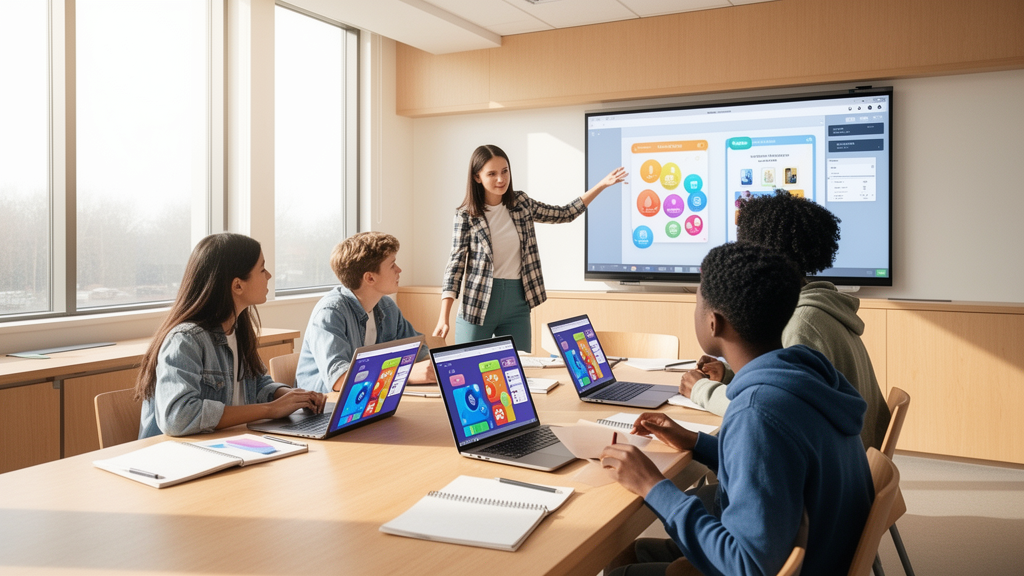
A multi-method study investigating international higher education collaboration across Germany, Israel, and Hungary found that student teachers engaging in joint online coursework transitioned from viewing artificial intelligence as an instrumental utility toward understanding its pedagogical and ethical complexities. The investigation followed participants across two successive academic cohorts as they evaluated emerging digital software, designed educational tasks, and addressed cross-cultural communication challenges. Rather than demonstrating an uncritical embrace of automated systems, the findings showed that direct, hands-on experimentation with artificial intelligence tools, combined with sustained intercultural group work, prompted future educators to prioritize human pedagogical oversight, active verification, and intentional instructional scaffolding over automated shortcuts.
The study was designed around the Cooperation Online in Teaching Between Germany, Israel, and Hungary initiative, known as the CoGIH Project. Organized across five higher education institutions, the nine-week program sought to examine how collaborative cross-cultural learning in an artificial intelligence-supported setting affects intercultural awareness, technological attitudes, and evolving professional identities. The participating institutions comprised the Department of English and American Studies at the University of Kassel in Germany, a German university of education, Kibbutzim College of Education Technology and the Arts in Israel, Achva Academic College in Israel, and the University of Miskolc in Hungary. The research aimed to address an existing gap in educational scholarship, where the pedagogical integration of artificial intelligence, online collaborative learning, and multilingual intercultural competence had previously been investigated primarily in isolation rather than at their practical intersection.
To guide the curricular design and analytical framework, the researchers merged three distinct pedagogical models into an integrated theoretical approach termed the CoGIH Three Model Integration. The first framework, the TEC Model developed by the TEC Center in Israel, structures trust-building across multicultural groups by staging digital communication progressively from asynchronous exchanges to synchronous interactions and multimodal formats. The second, the LMR-Plus Model, defines three interchangeable roles that learners adopt during collaborative inquiry: learner, moderator or facilitator, and researcher, thereby cultivating metacognitive, organizational, and diagnostic skills. The third component, the Human GPS Model, applies the metaphor of satellite triangulation to intercultural learning, confronting participants with at least three distinct viewpoints to generate productive cognitive conflict, dismantle cultural generalizations, and foster decentralized cultural and linguistic awareness.
The empirical sample included a total of 113 higher education students enrolled across the 2024 and 2025 cohorts, representing pre-service teachers, in-service educators, and students preparing for educational administration. Of the total enrolled participants, 91 responded to the comprehensive course questionnaires. Demographic data indicated that the respondent sample comprised 7 were from an Israeli university, 29 from an Israeli college of education, 20 from a German university, 13 from a German university of education, and 13 from a Hungarian university, while 9 did not specify their institutional affiliation. Among the 82 participants who answered the gender question, 57 identified as female and 25 identified as male. Linguistic backgrounds reflected the program’s diversity: 31 respondents reported speaking German, 22 reported Hebrew, 13 reported Hungarian, 6 reported English, and 5 reported Arabic, alongside speakers of Russian, Albanian, Persian, and Spanish, with participants speaking an average of 1.25 languages beyond their primary language of instruction. Furthermore, among the 78 students who completed the baseline self-rated English proficiency measure, which used a 5-point scale, the mean score was 3.74, with 41 rating themselves at level 4, 24 at level 3, 10 at level 5, 3 at level 2, and none reporting beginner status.
The collaborative coursework combined plenary lectures, instructor-moderated breakout sessions, and independent cross-national group activities over nine weeks. Groups of students were tasked with conducting a multi-week criteria-based analysis of a specific artificial intelligence application and co-creating a results-based educational website. The analytical criteria distributed among group members examined ten dimensions: open versus subscription access, target group suitability, protection of minors and vulnerable populations, scope of interaction, curricular alignment, technological barriers, user-friendliness, multilingual capabilities, cultural representation and bias, and added educational value. In addition, student groups developed a multilingual instructional task targeted at school settings and recorded a collaborative video presentation summarizing their evaluations for an international student conference held during the final synchronous session.
Data collection utilized an entry and exit questionnaire battery combining qualitative open-ended prompts with validated Likert scales and a semantic differential instrument. Intercultural competence was evaluated using the 13-item Transcultural Competence Scale on a 5-point scale, demonstrating high internal consistency with Cronbach’s alpha of 0.88. Attitudes toward technology and artificial intelligence were assessed using an adapted 18-item scale with an alpha of 0.89. Course design was measured using a 16-item polarity profile featuring opposing adjective pairs on a 7-point scale, while overall satisfaction was measured using a validated 5-item scale with an alpha of 0.87. Self-perceived English proficiency was evaluated using a single 5-point indicator. Because rigorous institutional anonymity protections prevented individual participant tracking across surveys for all but 17 of the 91 respondents, the authors restricted quantitative evaluations to aggregate descriptive statistics and cross-sectional bivariate Pearson correlation analyses rather than within-subject inferential comparisons.
Statistical analysis of the survey responses identified significant positive associations among several key experiential variables. The strongest observed relationship emerged between general course satisfaction and participants’ emotional evaluation of the course design on the polarity profile, yielding a Pearson correlation coefficient of r = 0.52 (p < 0.05). Attitudes toward technology and artificial intelligence were positively correlated with measured intercultural competence at r = 0.44 (p < 0.01), and with positive course design ratings at r = 0.35 (p < 0.05). Furthermore, self-perceived English proficiency showed statistically significant positive correlations with general satisfaction (r = 0.31, p < 0.05) and with course design evaluations (r = 0.25, p < 0.05). In contrast, associations between intercultural competence and general satisfaction (r = 0.07) or English proficiency (r = 0.09) were not statistically significant, and technology attitudes exhibited a weak non-significant negative association with general satisfaction (r = -0.22).
The qualitative analysis comprised an inductive thematic coding of participants’ open-ended reflections gathered before and after the program, segmenting texts into distinct meaning units. Across the intercultural competence domain, statements reflecting general curiosity shifted slightly from 38 before the course to 32 afterward, while initial stereotypical cultural generalizations declined from 44 to 24 statements. In contrast, statements describing concrete collaborative challenges increased substantially from 28 at baseline to 75 at course completion. Rather than remaining at the level of abstract cultural archetypes, students’ post-course reflections documented practical hurdles including finding meeting times across schedules, balancing uneven group contributions, and navigating subtle semantic differences in non-native English communication.
In the domain of technology perceptions, the qualitative distribution showed an increase in statements addressing informed and controlled artificial intelligence usage, rising from 20 before the course to 39 after completion. Concurrently, descriptions of artificial intelligence as a purely technical instrument for content generation or administrative efficiency declined from 54 statements to 36, shifting toward conceptualizations of artificial intelligence as a pedagogical resource supporting differentiated instruction and learner engagement. Mentions of ethical and educational challenges rose from 13 to 31 statements, highlighting concerns regarding student overreliance, factual accuracy, potential algorithmic bias, and the necessity of explicit teacher guidance. Meanwhile, reflections on professional identity development remained comparatively modest in overall volume, showing 7 pre-course and 8 post-course statements on teacher identity, 7 pre-course and 8 post-course statements on professional skill framing, and a stable 7 statements regarding the classroom integration of artificial intelligence.
Reflecting on the collaborative outputs, the researchers observed that while artificial intelligence supported creative task design and language experimentation, practical implementation revealed persistent limitations. Analysis of the group projects revealed recurrent weaknesses in visual coherence, limited depth of critical reflection, and translation errors in multilingual outputs where digital tools struggled with nuanced idioms or heritage languages. Participant feedback gathered across 91 responses highlighted four main recommendations for future program iterations: establishing more structured instruction and centralized communication from the start, ensuring balanced multinational group composition with at least two peers per country, optimizing the efficiency and schedule of synchronous meetings, and considering baseline language requirements. The authors concluded that while artificial intelligence offers valuable support for interactive learning, it cannot substitute for authentic teacher mediation and rigorous critical evaluation.
Subject of Research: Higher education student teachers' integration of artificial intelligence and intercultural collaboration across three countries
Article Title: Global classrooms: a tri-national study on AI integration by higher education students
Article References: Finkbeiner, C., Shonfeld, M., Avidov-Ungar, O., Mamont, Z., Nagy, E., & Hesse, Y. (2026). Global classrooms: a tri-national study on AI integration by higher education students. Frontiers in Computer Science, 8, Article 1909806. https://doi.org/10.3389/fcomp.2026.1909806
Image Credits: AI Generated
DOI: 10.3389/fcomp.2026.1909806
Keywords: artificial intelligence, teacher education, online collaborative learning, intercultural competence, multilingualism, higher education, educational technology, pedagogy, Global, classrooms, tri-national, integration
News Source: Blake Davidson. (November 10, 2026). Tri-National Study Explores How Student Teachers Integrate Artificial Intelligence in Classrooms. Scienmag.