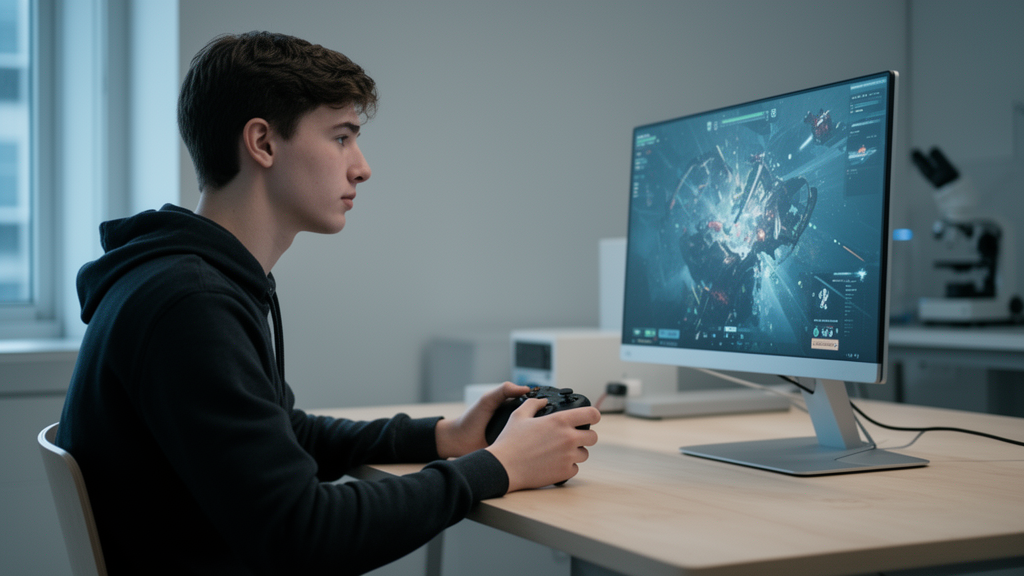
In a response to a critical letter regarding their previous research, the authors of a study on anodal transcranial direct current stimulation (a-tDCS) and motor learning identified a significant confounding variable that may have obscured their primary findings. This disparity in experience appears to be a key differentiator in the acquisition of motor skills during a videogame-based task, potentially explaining the lack of statistically significant treatment effects observed in the original analysis.
The original study, conducted by Blake and colleagues, aimed to investigate the impact of a-tDCS on motor learning in a guitar-playing task. The research team recruited a group of young, healthy adults from a single university setting, with an average age of 22.0 years and a standard deviation of 3.1 years. However, the authors now acknowledge that their primary concern was achieving population-level demographic homogeneity to reduce variability, specifically by recruiting individuals with some level of gaming experience. This strategy was intended to create a cleaner model for studying the interventional effects of a-tDCS, rather than isolating the effects of prior experience.
Upon further examination of the data, the researchers discovered that the amount of weekly gaming experience varied significantly between the male and female participants. When the data from the a-tDCS and sham groups were combined, male participants averaged 6.54 hours per week of gaming, with a standard deviation of 4.81 hours. In contrast, female participants averaged only 1 hour per week, with a standard deviation of 1.57 hours. This stark difference in prior exposure to similar tasks meant that the groups were not balanced in terms of skill baseline, a factor the authors had not anticipated until after the dataset was collected.
The distribution of gaming experience across the 40 total subjects revealed a skewed pattern. Twelve subjects reported no weekly gaming experience, eight reported 0–1 hours, five reported 1–3 hours, seven reported 3–6 hours, five reported 6–10 hours, and three reported more than 10 hours per week. This imbalance resulted in female participants hitting approximately 10% fewer notes than male participants in their initial trial. Although the females improved overall, this performance gap persisted in their final trial, suggesting that prior experience played a substantial role in the observed learning trajectories.
The authors address a critique from Dr. Rudroff, who argued that the lack of statistically significant findings in the original study should not be interpreted as evidence that a-tDCS does not influence motor learning. Dr. Rudroff suggested that the results were statistically indeterminate, noting that the study failed to show differences using null hypothesis statistical testing and also failed to show similarities using two one-sided t-tests (TOST) equivalence analysis. The authors concede that the results were inconclusive due to the observed variability, which ruled out both meaningful and trivial effects. They describe the data as being in a statistical no-man’s-land, a state where the high variability prevents clear conclusions about the efficacy of the intervention.
Recognizing that this high variability is likely to be present in any future studies using similar paradigms, the authors propose two paths forward. The first option is to move on to a different research question or study paradigm. The second option, which the authors favor, is to implement strategies to reduce the inherent variability in the study task. They suggest that a more robust design would involve recruiting a larger number of male and female subjects and using stratified randomization based on gaming experience. This approach would ensure that the groups are balanced for prior practice not only across the treatment conditions (a-tDCS versus sham) but also across sexes, allowing for a more accurate assessment of the treatment effect.
The authors emphasize that adding gaming experience as a covariate in a post-hoc analysis of the current data would inflate type I error rates, making it a theoretically unsound approach. Instead, they advocate for a prospective design where gaming experience is controlled for during the recruitment and randomization phases. This would allow researchers to determine the true impact of a-tDCS on learning, separate from the effects of previous gaming experience. The current study design lacked sufficient total subjects to further parse the data into sex-specific subgroups, limiting the ability to analyze the interaction between sex, experience, and treatment.
In their concluding remarks, the authors frame the findings not as a failure, but as a valuable lesson in research methodology. They acknowledge that several factors contributing to variability became apparent only after the examination of the study findings. The correspondence highlights the reality of research in both statistical and neurobiological domains, where exploratory investigations often reveal unexpected confounders. By identifying gaming experience as a critical variable, the authors hope to guide future studies toward more rigorous designs that can better isolate the effects of neuromodulation on motor skill acquisition.
Subject of Research: The impact of prior gaming experience on sex differences in motor skill acquisition during a-tDCS intervention
Article Title: Gaming experience between sexes might be the key differentiator in motor skill acquisition of a videogame task in adults
Article References: Riley, Z. A., McCallion, Q., & Poston, B. (2026). Gaming experience between sexes might be the key differentiator in motor skill acquisition of a videogame task in adults. Physiological Reports, 14(21), Article e71166. https://doi.org/10.14814/phy2.71166
Image Credits: AI Generated
DOI: 10.14814/phy2.71166
Keywords: motor learning, a-tDCS, sex differences, gaming experience, neuroscience, statistical variability, research methodology, videogame task, Gaming, experience, between, sexes
News Source: Drew Townsend. (November 10, 2026). Gaming Experience May Explain Sex Differences in Motor Learning. Scienmag.