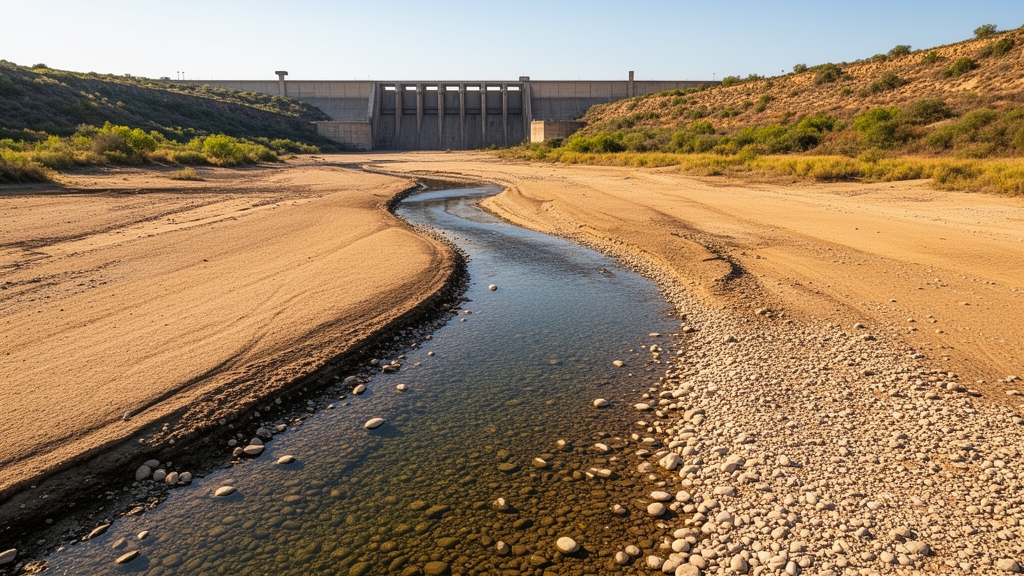
Researchers from the Indian Institute of Technology Gandhinagar (IITGN) have documented a fivefold reduction in surface water availability across the Ravi River floodplain following the operational commencement of the Ranjit Sagar reservoir in 2001. The study, published in Next Sustainability, utilized three decades of river discharge data and satellite imagery to examine hydrological and morphological changes in the river system. By comparing conditions before and after the reservoir began regulating flow, the team identified significant shifts in water extent, vegetation patterns, and human activity within the downstream floodplain. The findings underscore the complex interactions between reservoir operations, sediment transport, and ecosystem dynamics in dryland regions.
The Ranjit Sagar Dam, one of the highest earth-fill dams in the country, was constructed on the Ravi to serve multiple purposes including irrigation, hydropower generation, and controlled water availability. While such infrastructure provides essential services, it fundamentally alters the natural rhythm of the river. Dr Indra Mani Tripathi, the first author of the study and a Postdoctoral Research Associate in Earth Sciences at IITGN, noted that in dryland regions, communities and ecosystems often depend on seasonal flows. Even relatively small changes in water volume can have profound impacts on biodiversity, water availability, and overall ecosystem functioning in these sensitive environments.
To quantify these changes, the researchers analyzed daily river discharge data spanning from 1980 to 2019. Daily river discharge is defined as the volume of water that flows through a specific point in the river over a 24-hour period. The team specifically selected April and May, the pre-monsoon months, for their analysis to avoid the confounding effects of additional water releases from the reservoir during the monsoon season. The data revealed a substantial decline in median discharge, which fell from 296 cubic metres per second during the 1980–2000 period to 221 cubic metres per second during the 2001–2019 period.
Complementing the discharge data, the researchers employed satellite imagery to track changes in surface water extent and vegetation across the floodplain. Satellite images from 1992 and 1998 depicted a more prominent and extensive water network across the floodplain. In contrast, imagery from 2003, 2009, and 2019 showed that these features became much less apparent following the construction and operation of the reservoir. The estimated mean surface-water area declined sharply from 17.35 square kilometres to 3.46 square kilometres, indicating a fivefold reduction in available surface water. Although this reduction may have implications for agriculture and other land uses, the study explicitly noted that such impacts were not directly assessed within the scope of the research.
Professor Vikrant Jain, a Professor in the Department of Earth Sciences at IITGN and Head of the Department, explained the physical mechanisms behind these changes. He stated that a sustained change in flow impacts the river’s ability to transport sediment, which in turn leads to changes in river morphology and floodplain processes. Over time, these alterations can influence the connection between the river and its floodplain. Reservoirs often trap sediment that would otherwise move downstream, resulting in a sediment-starved river. With less sediment and a different flow regime, downstream channels can respond by eroding, narrowing, deepening, or otherwise changing their shape, further altering the landscape and hydrological connectivity.
An interesting counterintuitive finding emerged regarding vegetation patterns. The researchers observed an increase in vegetation in parts of the floodplain where the active water area became smaller. Professor Pranab Kumar Mohapatra from the Department of Civil Engineering at IITGN explained that in a floodplain, the periodic movement of water and sediment helps keep some areas dynamic. When these processes become less frequent due to reduced flow and sediment transport, vegetation can establish more easily. This potentially makes some parts of the floodplain more stable but also less connected to the active channel.
The study also investigated the impacts of sand mining and other human activities on the river and its floodplain. Using high-resolution imagery, such as Google Earth, the researchers identified features such as artificial pits and areas where the river pathway had changed. These changes were not uniform across the floodplain, indicating that local human activities interact with broader hydrological changes in complex ways. The combination of reduced flow, sediment starvation, and direct extraction of sand creates a multifaceted challenge for maintaining the health of the river system.
Dr Ankit Modi, a former Research Associate at IITGN and currently an Assistant Professor in the Civil Engineering Department at Gujarat Technical University, emphasized the need for an integrated approach to river management. He stated that effective river management needs to consider several factors together, including changes in flow, sediment movement, land use, and sand extraction. Understanding these interactions provides an opportunity to identify where interventions can help maintain a healthy balance between human use and natural river processes.
The findings of the study align with broader policy frameworks and international goals. In India, the results are consistent with the Central Water Commission’s guidelines on maintaining longitudinal connectivity through dams, which address sediment and fish connectivity and discuss reservoir sediment-management strategies to reduce downstream sediment-starvation effects. The study also aligns with India’s National Water Mission, which aims to conserve water, reduce wastage, and ensure equitable distribution through integrated water-resources development and management. Globally, the research supports aspects of the UN Sustainable Development Goal 6, which focuses on the sustainable management of water and integrated water resources, as well as the restoration of water-related ecosystems such as rivers and wetlands.
Dr Shanti Shwarup Mahto, a PhD alumnus in Earth Sciences from IITGN and an Assistant Professor at the Central University of Jharkhand, placed the Ravi River study in a global context. He noted that the Ravi is part of a much larger global story, where rivers around the world are being modified by dams, sediment extraction, land-use change, and climate variability. By placing the Ravi alongside examples from major river systems such as the Colorado, Mekong, Murray, and Yangtze, the study contributes to a growing body of knowledge on how these factors interact. The more information available on these interactions, the better equipped water managers are to balance infrastructure needs with the preservation of river processes that support healthy floodplains and ecosystems.
The research team included Dr Aamer Majid Bhat, a Postdoctoral Research Associate, and Bhanu Parmar, a Junior Research Fellow, both from the Department of Civil Engineering at IITGN. The researchers acknowledged financial assistance from the Ministry of Education, Ministry of Science and Technology, and Ministry of Earth Sciences, Government of India. The study highlights the importance of long-term monitoring and integrated management strategies for rivers impacted by large-scale infrastructure.
This study serves as a critical case study for understanding the downstream impacts of reservoir regulation in dryland regions. By combining long-term hydrological data with remote sensing techniques, the researchers provided a comprehensive view of how the Ravi River and its floodplain have evolved over the past three decades. The findings call for careful consideration of river processes and morphology in the planning and operation of reservoirs to ensure long-term sustainable water management.
Subject of Research: Hydrological and morphological changes in the Ravi River floodplain following reservoir regulation
Article Title: Reservoir, human activity impact Ravi River’s surface water availability by fivefold
Article References: Reservoir, human activity impact Ravi River’s surface water availability by fivefold. Original publication (Bibliographic details unavailable.)
Image Credits: AI Generated
DOI: Not provided
Keywords: Ravi River, Ranjit Sagar Reservoir, Surface Water, River Morphology, Satellite Imagery, Sediment Transport, Floodplain Ecology, Water Management, IIT Gandhinagar, Hydrology, Reservoir, human
News Source: Violet Maxwell. (November 10, 2026). Ravi River Surface Water Dropped Fivefold After Reservoir. Scienmag.