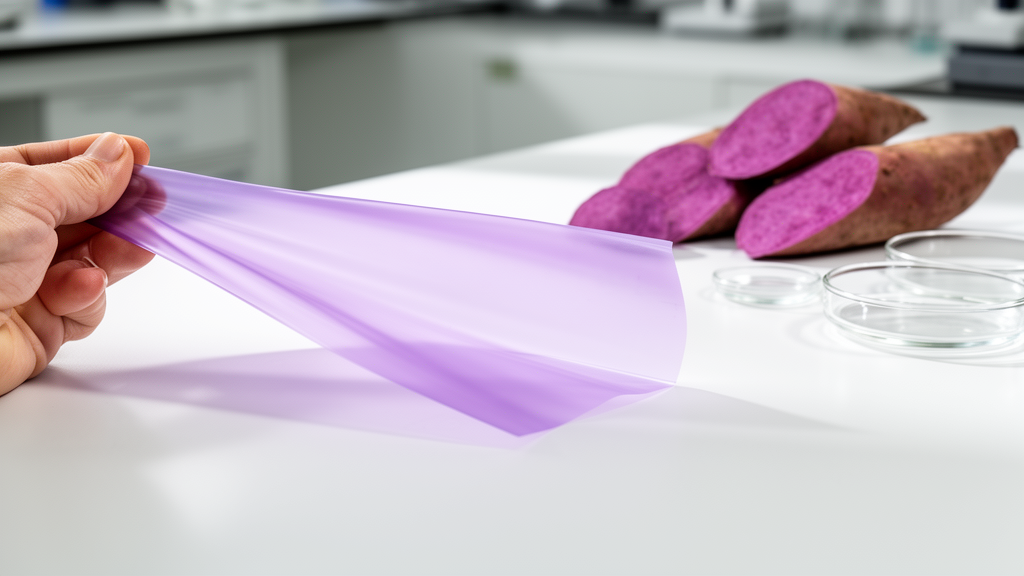
Published in Discover Food, the study aimed to analyze the effect of purple yam (Dioscorea alata L.) starch modification through repeated autoclaving–cooling cycles and different starch concentrations on the characteristics of edible films, as well as to determine the best treatment combination.
The study employed a factorial Completely Randomized Design to test two primary factors: starch modification and starch concentration. The modification factor included three levels: native starch, starch subjected to one autoclaving-cooling cycle, and starch subjected to two cycles. The concentration factor comprised three levels: 5%, 6%, and 7% starch solutions. With three replications for each combination, the experimental design generated 27 distinct experimental units.
The extraction yield of the native purple yam starch was recorded at 48.98%. After modification, the percentage of starch mass retained was 90.13% after one cycle and 98.16% after two cycles. The pH of the starch increased from a native value of 5.80 to a range of 6.81 to 6.89 following modification. Water content also varied, decreasing from 8.72 ± 0.87% in native starch to 7.51 ± 0.16% after one cycle, before rising slightly to 8.75 ± 0.30% after two cycles. Additionally, crude fiber content increased from 5.22 ± 0.01% to 6.56 ± 0.01% after modification.
Morphological analysis using Scanning Electron Microscopy (SEM) provided visual evidence of the structural changes induced by the thermal treatment. The SEM images revealed progressive granule disruption as the number of autoclaving-cooling cycles increased. This disruption translated into the physical structure of the edible films, which exhibited denser, more homogeneous, and crack-free surfaces.
Colorimetric analysis indicated that the modification process affected the color parameters of both the starch and the resulting films. In the starch, lightness (L*) decreased from 67.49 to 65.59, while the redness (a*) increased from 5.95 to 6.39, and the yellowness (b*) increased from 13.20 to 14.35. The edible films displayed a different color profile, with L* values ranging from 71.96 to 77.47, a* values from 3.56 to 5.17, and b* values from 14.78 to 18.91. These variations were influenced by the interaction between starch concentration and modification cycles.
A key finding of the study was the increase in anthocyanin content following modification. In the starch, anthocyanin levels rose from 3.17 mg C3G/g dry starch in the native state to 5.82–5.86 mg C3G/g dry starch after modification. In the edible films, the anthocyanin content was higher, increasing from 8.07 mg C3G/g dry film to 11.10–11.12 mg C3G/g dry film. The increased anthocyanin content indicates the potential of the films for bioactive and intelligent packaging applications. However, the researchers noted that antioxidant activity, pH-response behavior, food freshness monitoring capabilities, migration, and storage stability were not experimentally evaluated in this specific study.
The functional properties of the edible films were also assessed, with particular attention to barrier and mechanical characteristics. The films maintained a stable thickness ranging from 0.20 to 0.24 mm across the different treatments. The films showed variable transparency and solubility. A notable improvement was observed in the water vapor transmission rate (WVTR), which was reduced to 3.69 g/m²/h, indicating enhanced moisture barrier properties. The compression force of the films also increased, suggesting improved mechanical strength. Furthermore, the crude fiber content in the edible films increased up to 4.70%, while pH values remained relatively stable, ranging from 5.72 to 6.17.
The study concludes that repeated autoclaving-cooling modification of purple yam starch improves several physicochemical, barrier, mechanical, and anthocyanin-related properties of edible films.
Subject of Research: Physicochemical and bioactive properties of edible films developed from repeatedly autoclaved–cooled purple yam (Dioscorea alata L.) starch
Article Title: Physicochemical and bioactive properties of edible films developed from repeatedly autoclaved–cooled purple yam (Dioscorea alata L.) starch
Article References: Yumeina, D., Fatima, S., Mursalim, Salim, I., Muhidong, J., Hutabarat, O. S., & Hasizah, A. (2026). Physicochemical and bioactive properties of edible films developed from repeatedly autoclaved–cooled purple yam (Dioscorea alata L.) starch. Discover Food. https://doi.org/10.1007/s44187-026-01288-y
Image Credits: AI Generated
DOI: 10.1007/s44187-026-01288-y
Keywords: Physicochemical, bioactive, properties, edible, films, developed, repeatedly, autoclaved, cooled, purple, Dioscorea, alata
News Source: Alan Morgan. (November 10, 2026). Purple Yam Starch Films Show Improved Barrier Properties. Scienmag.