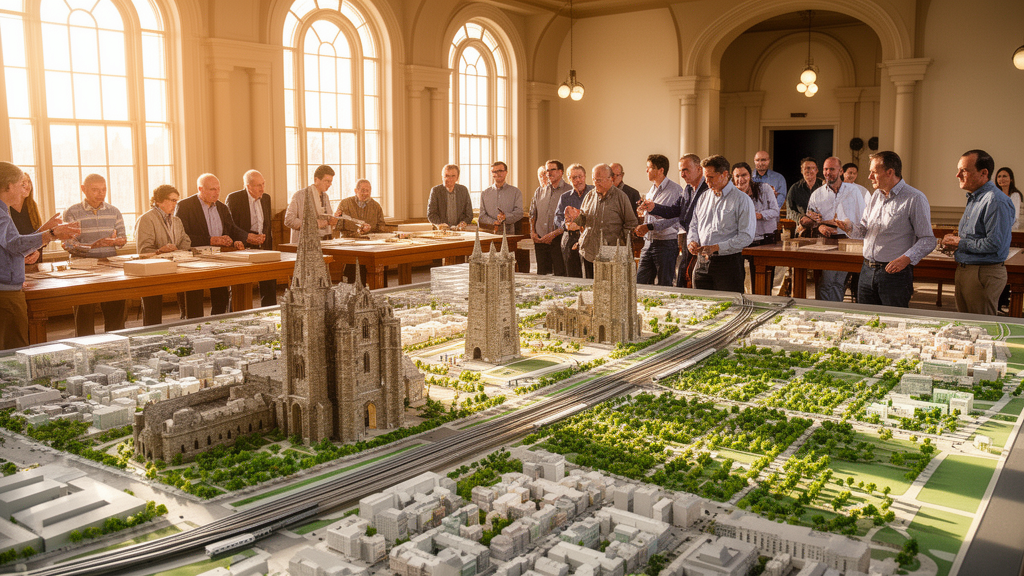
Francesco Bandarin and Michael Turner propose a conceptual framework known as Metropolitan Heritage to address the limitations of current conservation models in the face of rapid urban expansion. Published in the journal Built Heritage, the paper argues that the dominant spatial, demographic, and economic form of human settlement has shifted to metropolitan regions, exposing operational gaps in heritage frameworks that remain largely centred on the city. The authors suggest that this shift requires more than a simple spatial enlargement of heritage; it calls for a reconsideration of the conceptual foundations of how heritage is understood and managed within complex territorial systems.
The central premise of the study is that the 2011 UNESCO Recommendation on the Historic Urban Landscape (HUL) marked a decisive shift in heritage thinking by extending conservation beyond isolated monuments and historic centres to embrace the broader urban context. However, the authors contend that metropolitan regions operate according to a different spatial logic than traditional cities. They are characterised by networks rather than centres, functional relationships rather than administrative boundaries, and continuous interactions among cultural, natural, social, and infrastructural systems. This distinction is fundamental to the proposed framework, which seeks to interpret heritage as a dynamic process rather than a static collection of protected assets.
Metropolitan Heritage is defined in the paper as a dynamic system of relationships linking culture and nature, urban and rural territories, infrastructures, ecological processes, and multiple identities across metropolitan regions. The authors emphasize that this is an interpretative framework rather than a new heritage category. It does not replace existing conservation doctrines but extends their underlying logic to the dominant territorial reality of the 21st century. The framework shifts attention from the objects themselves to the territorial processes through which significance is continuously produced, negotiated, and transmitted, recognizing that heritage emerges through interactions among environmental systems, infrastructures, institutions, and communities.
The theoretical underpinnings of Metropolitan Heritage draw on the evolution of heritage theory throughout the 20th century. From the Venice Charter’s emphasis on authenticity and integrity to the 1972 World Heritage Convention’s recognition of urban ensembles and natural environments, conservation theory progressively expanded its scope. The HUL approach introduced a decisive conceptual innovation by shifting attention from individual heritage assets to the relationships that give them meaning. The authors argue that this relational understanding must now be extended from individual sites and landscapes to the metropolitan territory itself, where heritage is generated through the interplay of mobility, ecological systems, economic interdependence, and cultural exchange.
The concept is grounded in the experience of the Heritopolis initiative, established in 2021 within the framework of the UN-Habitat Universities Initiative and MetroHub. Heritopolis serves as a research laboratory for exploring the implications of metropolitan urbanisation for heritage theory and governance through comparative research and international collaboration. The initiative brings together architects, planners, geographers, ecologists, economists, sociologists, and heritage specialists to bridge the fields of heritage conservation and metropolitan governance. Its central premise is that heritage should be considered a strategic dimension of metropolitan development, capable of informing spatial planning, ecological resilience, social cohesion, and territorial identity.
Five interrelated principles characterise the Metropolitan Heritage framework. First, heritage is relational, deriving its significance from connections rather than isolated components. Second, it is territorial, transcending administrative boundaries to integrate cities, suburbs, agricultural landscapes, and ecological corridors into a single functional system. Third, it is adaptive, recognising that metropolitan territories are characterised by permanent transformation driven by demographic change, technological innovation, and climate change. Conservation, therefore, requires managing change while safeguarding cultural continuity, rather than maintaining static conditions. Fourth, heritage is ecological, acknowledging that the traditional distinction between cultural and natural heritage is inadequate at the metropolitan scale, where biodiversity, water systems, and cultural landscapes form a single territorial ecology. Finally, heritage is intergenerational, concerning the transmission of values and the maintenance of territorial systems that enable future generations to inherit culturally meaningful and environmentally resilient places.
The paper highlights the growing interdependence between cultural and natural systems, reinforced by recent climate research that highlights the need for integrated territorial approaches to resilience and adaptation. The authors note that metropolitan regions are not simply larger cities; they represent a new spatial condition of sustainability with urban–rural linkages. This transformation reflects a broader shift in contemporary urban policy, which increasingly recognises metropolitan regions as the primary arena for addressing economic competitiveness, environmental sustainability, and social cohesion. The framework aligns closely with the Sustainable Development Goals, most directly SDG Target 11.4, which commits states to strengthen efforts to protect and safeguard the world’s cultural and natural heritage, and the New Urban Agenda, positioning heritage as a long-term framework for territorial governance.
Heritopolis has undertaken various activities to explore these concepts, including the publication of Working Papers that examine the localisation of the Sustainable Development Goals, the relationship between metropolitan governance and heritage, and the integration of cultural and natural systems. The initiative has held meetings and workshops in cities such as Istanbul, Shanghai, Guadalajara, London, and Mombasa, as well as participating in global forums like the World Urban Forum and the UN-Habitat Assembly. These efforts have sought to identify conceptual principles that can be adapted to diverse metropolitan contexts, moving beyond prescriptive models to address the multiplicities of communities and the complexities of metropolitan life.
The authors argue that the transition from the Historic Urban Landscape to Metropolitan Heritage represents an epistemological rather than a taxonomic shift. It does not diminish the importance of monuments, historic cities, or cultural landscapes but situates them within the wider territorial systems through which their meanings are continually produced, negotiated, and transmitted. Heritage becomes less a collection of protected assets than a strategic resource for understanding and guiding territorial transformation. This perspective carries important implications for governance, providing a conceptual bridge between heritage conservation, spatial planning, and sustainable development. It reinforces the dialogue between the HUL Recommendation, the New Urban Agenda, and the Sustainable Development Goals, positioning heritage as a strategic component of metropolitan governance.
The paper concludes that the metropolitan century requires a different way of thinking about heritage. If the 20th century broadened the range of what societies sought to conserve, the 21st century requires a deeper reflection on why heritage matters and how it contributes to shaping sustainable, resilient, and inclusive metropolitan futures. The authors suggest that if heritage reflects the main features of humankind, and the metropolis will be the dominant shape of built settlement, it will require us to consider the Metropolis as Heritage. This proposal for the next stage in the continuing evolution of heritage theory aims to ensure that heritage theory evolves in parallel with contemporary approaches to metropolitan governance, climate adaptation, and sustainable territorial development, providing a new interpretative paradigm for engaging with the metropolitan condition.
The theoretical architecture of Metropolitan Heritage draws explicitly on philosophical concepts of qualitative multiplicity, distinguishing the metropolitan territory from a mere aggregation of discrete, countable spatial parts. By engaging with the work of Henri Bergson and Gilles Deleuze, the authors conceptualize the metropolis as a fluid constellation where diverse groups and overlapping temporal layers continuously interact. In this view, the city functions as an archipelago, a dynamic network where communities, infrastructures, and memories collide, allowing past and present to interpenetrate within urban identity. This perspective reframes heritage not as a static inventory of protected sites, but as a lived flow of time that resists division without altering its fundamental nature, thereby challenging traditional conservation models that rely on rigid, object-based categorizations.
Soja’s concept of Thirdspace further informs this relational approach, shifting the focus of metropolitan heritage from historical preservation to spatial politics. The authors argue that urban history is not a static timeline but an active force embedded within the lived, social arena where collective memories and identities intersect. This framework urges marginalized communities to reclaim their spatial history as a means to fight for urban justice, positioning heritage as a tool for addressing social inequality and contested narratives. By integrating these philosophical underpinnings, the paper suggests that heritage interpretation must account for the power dynamics inherent in defining the meaning of the metropolis, whose memories are recognized, and how competing narratives are negotiated within the territorial system.
The practical application of these theoretical principles is evident in the rapid expansion of Heritopolis case studies since 2021, marking a transition from abstract elaboration to concrete engagement with real-world challenges. Recent work has focused on the integration of peri-urban landscapes, particularly water and green systems, demonstrating how the framework can be applied to specific environmental and spatial contexts. However, the authors acknowledge a significant limitation: the metropolis dimension has yet to be fully evaluated as an integrative process with institutional synergies. This gap highlights the ongoing difficulty in translating conceptual principles into operational governance structures that can effectively manage the complexity of metropolitan territories.
A bibliographic study referenced in the paper underscores the necessity of a professional mindset rooted in flexibility, interdisciplinarity, and continuous adaptation for effective Historic Urban Landscape practice. The authors argue that prescriptive, checklist-driven methodologies are insufficient for addressing the multiplicities of communities and the dynamic nature of metropolitan change. Instead, the framework requires a strategic dimension of spatial planning that informs decisions concerning mobility, ecological restoration, urban regeneration, housing, infrastructure, and climate adaptation. This approach positions heritage as a resource for increasing the adaptive capacity of metropolitan regions, rather than merely an object of conservation to be protected from change.
The initiative’s activities, documented in Working Papers and various global forums, reflect this commitment to interdisciplinary dialogue. By bringing together architects, planners, geographers, ecologists, economists, and heritage specialists, Heritopolis seeks to bridge the parallel evolution of heritage conservation and metropolitan governance. The resulting research agenda focuses on how cultural and natural systems can be interpreted within a single territorial framework, supporting sustainable metropolitan futures while maintaining continuity with the past. This collaborative effort aims to ensure that heritage theory evolves in parallel with contemporary approaches to metropolitan governance, climate adaptation, and sustainable territorial development, providing a robust interpretative paradigm for the 21st century.
Subject of Research: Heritopolis—from Historic Urban Landscape to Metropolitan Heritage: rethinking heritage for the century of the metropolis
Article Title: Heritopolis—from Historic Urban Landscape to Metropolitan Heritage: rethinking heritage for the century of the metropolis
Article References: Bandarin, F., & Turner, M. (2026). Heritopolis—from Historic Urban Landscape to Metropolitan Heritage: rethinking heritage for the century of the metropolis. Built Heritage, 10(1), Article 82. https://doi.org/10.1186/s43238-026-00326-z
Image Credits: AI Generated
DOI: 10.1186/s43238-026-00326-z
Keywords: Heritopolis, Historic, Urban, Landscape, Metropolitan, Heritage, rethinking, century, metropolis, scientific research
News Source: Courtney Benton. (November 10, 2026). Heritopolis proposes metropolitan heritage framework for urban governance. Scienmag.