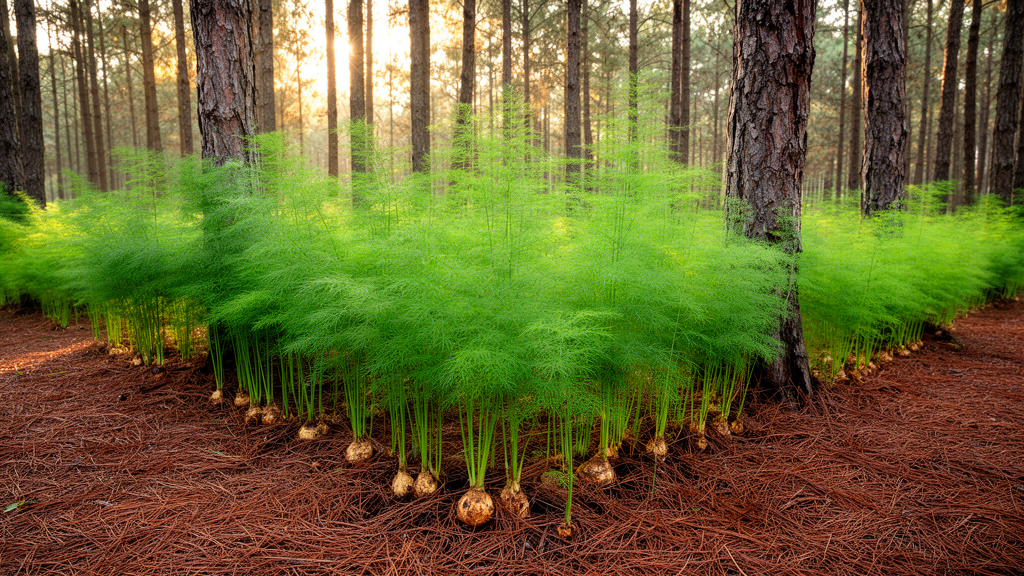
Intercropping the medicinal plant Asparagus cochinchinensis within Pinus massoniana plantations significantly increases total saponin content while decreasing chlorophyll levels, without altering key agronomic traits, according to a comparative metabolomic and hormonal profiling study. Using liquid chromatography-mass spectrometry-based metabolomics alongside targeted hormone profiling, researchers evaluated how understory cultivation influences the biochemical mechanisms of plant adaptation and quality formation under forest canopies.
The research was conducted to address land-use demands for high-quality medicinal herbs by assessing understory intercropping as a sustainable agroforestry strategy. To identify the underlying regulatory processes, the investigators compared plant characteristics, endogenous phytohormones, and rhizosphere metabolites across three distinct soil environments: Pinus massoniana forest soil designated as Soil-A, Asparagus cochinchinensis monoculture soil designated as Soil-B, and intercropped soil designated as Soil-C.
Measurements of plant traits demonstrated that while intercropping did not alter key agronomic traits, it produced a statistically significant increase in total saponin content (P < 0.05) and a statistically significant reduction in chlorophyll levels (P < 0.01). Endogenous phytohormone analysis showed a distinct hormonal profile in the intercropped plants, marked by reduced concentrations of abscisic acid and jasmonic acid, occurring alongside elevated concentrations of salicylic acid, cis-12-oxophytodienoic acid, isopentenyladenosine, and N6-D2-isopentenyladenine.
In the rhizosphere, metabolomic profiling detected 25 differential metabolites, with notable enrichment of trans-cinnamic acid and gibberellin A4 in the intercropping soil (Soil-C). Subsequent Kyoto Encyclopedia of Genes and Genomes pathway analysis demonstrated significant activation of both plant hormone signal transduction and aminobenzoate degradation pathways in the intercropped setting.
The authors concluded that Asparagus cochinchinensis displays morphological-metabolic decoupling during intercropping, defined as maintaining vegetative structural traits while reallocating resources toward secondary metabolite biosynthesis instead of structural expansion, thereby prioritizing medicinal quality over biomass accumulation. The researchers noted that rhizosphere accumulation of trans-cinnamic acid and gibberellin A4 appears to interface with endogenous hormone signaling—specifically involving the salicylic acid pathway and cis-12-oxophytodienoic acid-mediated regulation—which may contribute to enhanced saponin biosynthesis, offering preliminary insights to inform future agroforestry system design.
Subject of Research: Biochemical and hormonal mechanisms in intercropped Asparagus cochinchinensis
Article Title: Integrated analysis of rhizosphere metabolome and hormones reveals regulatory mechanisms in intercropped Asparagus cochinchinensis
Article References: Gao, J.-H., Lv, G., Luo, L.-L., Tang, L., Zhang, M., & Miao, L. (2026). Integrated analysis of rhizosphere metabolome and hormones reveals regulatory mechanisms in intercropped Asparagus cochinchinensis. BMC Plant Biology. https://doi.org/10.1186/s12870-026-10341-y
Image Credits: AI Generated
DOI: 10.1186/s12870-026-10341-y
Keywords: Asparagus cochinchinensis, Pinus massoniana, agroforestry, intercropping, rhizosphere metabolomics, phytohormones, saponins, plant biochemistry, Integrated, analysis, rhizosphere, metabolome
News Source: Drew Townsend. (November 10, 2026). Intercropping Asparagus cochinchinensis Under Pine Trees Increases Saponin Content. Scienmag.