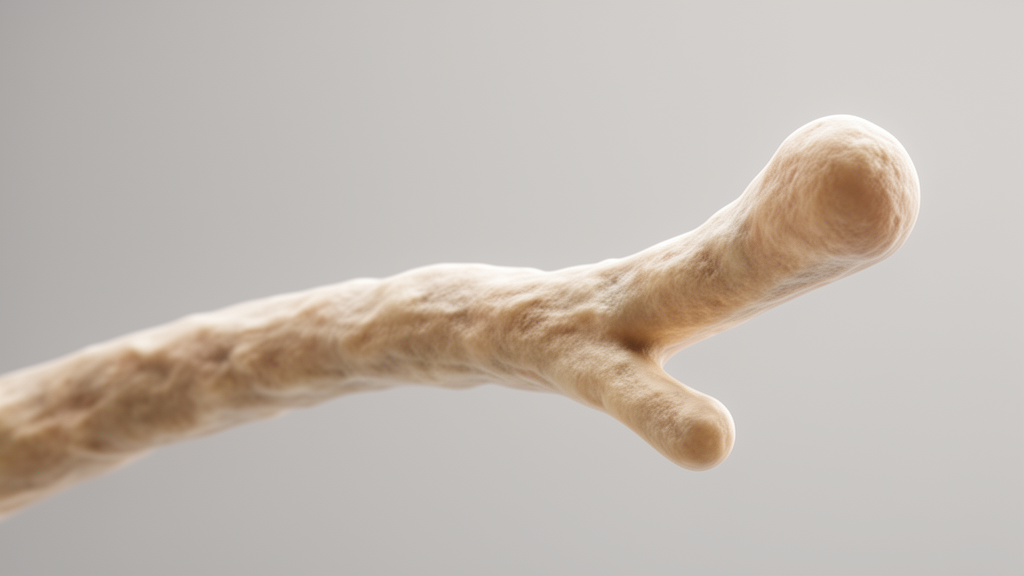
Researchers investigating the filamentous fungus Fusarium venenatum have determined that discrete mutations in a single regulatory gene known as jg4843, an ortholog of the fungal Rho-GTPase activating protein gene LRG1, are directly responsible for the emergence of hyper-branching colonial variants during commercial mycoprotein production. Cultivated on an industrial scale to generate biomass for Quorn meat substitutes, F. venenatum strain A3/5 typically develops a sparsely branched hyphal morphology that imparts a fibrous, meat-like texture to the final food product. However, prolonged cultivation campaigns are consistently disrupted by the spontaneous appearance of mutant strains known as colonial variants, or C-variants. These variants exhibit an excessively compact, densely branched mycelial architecture and a significantly slower radial expansion rate on solid medium. Over continuous cultivation cycles, C-variants outgrow the sparsely branched wild-type population in suspension, causing substantial deterioration of product texture and forcing facilities to terminate operations after four to six weeks. By identifying the exact genetic driver of this morphological transition, the new study establishes the molecular mechanism behind a long-standing industrial challenge and provides a foundational target for stabilizing production strains.
Industrial mycoprotein manufacturing relies on deep-tank continuous-flow fermentation vessels operating under steady-state conditions where all vital nutrients, including glucose, are supplied in sustained excess. Decades of continuous culture research have demonstrated that such prolonged, homogeneous environments impose intense natural selection for cells with accelerated growth rates and shortened doubling times. Previous physiological investigations demonstrated that C-variants isolated from factory fermenters hold clear competitive growth advantages over ancestral wild-type strains under conditions of both nutrient abundance and varied nutrient limitations. Earlier classical genetic studies involving heterokaryon complementation assays indicated that commercial C-variants belonged to a single complementation group governed by recessive alleles, whereas laboratory continuous cultures subjected to specific glucose limitations yielded mutants across three distinct complementation groups. While previous screening efforts identified several broad candidate loci, the precise causative DNA sequence changes remained unverified due to the absence of high-resolution genomic data from commercial isolates. Resolving whether variant emergence stemmed from heterogeneous multi-gene disruptions or a common molecular trigger required systematic whole-genome sequencing of real-world factory samples.
To isolate and characterize the responsible mutations, the research team recovered twelve fungal strains from mixed-culture broth collected at the conclusion of independent commercial fermentation campaigns conducted by Marlow Foods Ltd. in Billingham, United Kingdom. The isolated cohort comprised six distinct C-variant strains, designated Cv1 through Cv6, alongside six post-fermentation wild-type-like strains, designated pfWT1 through pfWT6, which served as crucial controls to account for background mutations that naturally accumulate during continuous mitotic division. When cultured on potato dextrose agar plates at twenty-eight degrees Celsius, wild-type and pfWT colonies displayed typical fluffy mycelial morphology, whereas Cv isolates formed dense, tightly clustered colonies. Microscopic examination confirmed extensive, irregular hyphal branching throughout the Cv mycelium compared to the elongated, sparsely branched filaments of the wild-type controls. Standardized five-day colony radial growth assays revealed that wild-type and five pfWT isolates expanded at approximately eleven millimeters per day, while pfWT1 exhibited a significantly elevated rate of twelve point seven millimeters per day. In contrast, all six initial C-variant isolates exhibited severely stunted radial expansion rates ranging between three and four millimeters per day, showing statistically significant reductions with probability values below zero point zero zero one.
To establish a definitive genomic reference for variant calling, the authors generated a high-quality, chromosome-level reference assembly for the production organism F. venenatum A3/5 by combining long-read Oxford Nanopore sequencing at thirty-seven-fold coverage with high-accuracy Illumina short-read polishing at sixty-six-fold coverage. The finalized gapless genome assembly spanned approximately thirty-eight megabases resolved into four complete chromosomes, ranging from eight to twelve megabases in length, accompanied by a ninety-two point five kilobase circular mitochondrial chromosome. Benchmarking against the Hypocreales lineage database demonstrated high single-copy ortholog completeness, eliminating unplaced contigs and ambiguous sequence gaps present in previous public drafts. Gene prediction pipelines combining transcriptomic evidence identified fourteen thousand two hundred and eleven protein-coding genes across the nuclear chromosomes, averaging one thousand four hundred and eleven base pairs in coding length and two point nine exons per gene. This newly resolved reference established the rigorous baseline needed to detect subtle single-nucleotide polymorphisms and minor insertions or deletions across commercial isolates.
Subsequent whole-genome Illumina sequencing of the first batch of twelve commercial isolates identified a total of twenty-four single-nucleotide polymorphisms across twenty genomic positions, in addition to eight small insertions and deletions. Seven of the eight detected insertions and deletions mapped to repetitive or intergenic regions with low read depth and were excluded from further investigation, whereas one caused a non-frameshift inframe deletion in gene jg4630 in strain pfWT6. The distribution of single-nucleotide variants differed sharply between phenotypes: six mutations occurred across the pfWT cohort, whereas eighteen were detected among the C-variant strains, with no individual variants shared between the two groups. In the post-fermentation wild-type isolates, mutations consisted of three upstream alterations, two synonymous changes, and one missense mutation. Among the C-variants, eleven variants were missense mutations, five occurred in upstream regions, one was synonymous, and one mapped to an intron. Mapping all variants across one-hundred-kilobase windows revealed two notable mutational hotspots: one on chromosome 1 spanning coordinates 4,100,000 to 4,199,999, and another on chromosome 4 between coordinates 7,200,000 and 7,299,999. Strikingly, strain Cv6 contained only a single single-nucleotide polymorphism across its entire nuclear genome, situated precisely within the chromosome 1 hotspot inside the coding sequence of gene jg4843.
Transcriptomic profiling via RNA sequencing conducted during mid-exponential growth across all twelve commercial isolates and the parental wild-type strain provided functional context for these genomic variations. Although overall numbers of differentially expressed genes varied widely among individual strains, principal expression profiles showed minimal overlap between the morphological classes. Gene Ontology analysis demonstrated that differentially expressed transcripts in pfWT isolates were predominantly enriched for RNA binding and processing functions, whereas C-variant transcriptomes exhibited significant functional enrichment for guanosine triphosphate binding and GTPase enzymatic activity. Cross-referencing transcript levels with genomic sequence changes revealed that none of the five mutated genes in pfWT isolates showed statistically altered expression relative to the wild-type. Conversely, significant transcriptional shifts accompanied five of the ten mutated genes in C-variant isolates. Gene jg4843, which encodes a putative Rho-GTPase activating protein, exhibited significant transcriptional downregulation in strains Cv1, Cv2, and Cv3. The expression of jg64, encoding a cellulose-binding domain protein, was strongly upregulated across all C-variants except Cv3. Notably, jg4843 and the chromosome 4 candidate gene jg13054 emerged as the primary genes disrupted across multiple C-variant lineages, with the lone mutation in Cv6 centering attention squarely on jg4843.
To confirm whether the observed genetic patterns were generalizable across broader industrial manufacturing campaigns, the investigators collected and analyzed a second independent batch of commercial samples comprising strains pfWT7 through pfWT12 and Cv7 through Cv12. Radial growth rate assays reaffirmed that all six second-batch pfWT strains expanded at typical rates of nine to eleven millimeters per day, whereas the second-batch C-variants showed significantly depressed growth rates between two and six millimeters per day with probability values below zero point zero zero one. Whole-genome resequencing of this secondary cohort uncovered twenty-nine single-nucleotide polymorphisms and thirteen insertion-deletion events across the twelve genomes. Eight single-nucleotide variants occurred in pfWT strains, consisting of five upstream, two synonymous, and one missense mutation. Twenty-one variants were detected in C-variants, encompassing fourteen missense changes, five upstream modifications, one synonymous change, and one nonsense mutation creating a premature stop codon. Window-based density mapping revealed that the mutational hotspot on chromosome 1 was consistently enriched across the second batch of C-variants, whereas the previously observed locus on chromosome 4 was entirely absent. Crucially, every single C-variant strain in the second cohort harbored a mutation in gene jg4843, demonstrating that disruption of this specific locus is the predominant genetic hallmark of industrial C-variant formation.
Detailed bioinformatic annotation identified jg4843 as the F. venenatum ortholog of LRG1, designated FvLRG1. The encoded protein functions as a GTPase-activating protein that stimulates intrinsic GTP hydrolysis by Rho1, thereby acting as a negative regulator that toggles Rho1 from its active GTP-bound state to its inactive GDP-bound form. In filamentous fungi, Rho1 signaling is indispensable for orchestrating cell wall integrity, beta-glucan synthesis, polarized tip extension, and branching inhibition along subapical hyphal trunks. Domain architecture analysis revealed that FvLRG1 contains three amino-terminal LIM domains spanning residues 95 to 157, 159 to 220, and 465 to 529, alongside a carboxy-terminal RhoGAP catalytic domain spanning residues 795 to 1000. Across both experimental cohorts, eleven out of twelve C-variants carried mutations in FvLRG1, with missense substitutions concentrating within the catalytic RhoGAP domain. Furthermore, strains Cv2 and Cv8 shared an identical single-nucleotide polymorphism twenty-two base pairs upstream of the translational start codon in the five-prime untranslated region, which correlated with suppressed transcript levels. The sole isolate lacking an FvLRG1 mutation, strain Cv3, instead harbored a missense mutation in the ortholog of CLA4, a Cdc42-activated kinase that participates in morphogenetic signaling and whose disruption was accompanied by downregulation of FvLRG1.
To directly verify whether isolated point mutations in FvLRG1 are sufficient on their own to cause hyper-branching, the authors performed targeted gene editing using a CRISPR-Cas9 homology-directed repair system in an unmutated wild-type A3/5 background. Protoplasts were transformed with the expression plasmid pFC332, harboring Aspergillus niger codon-optimized Cas9 and a single guide RNA, paired with synthetic single-stranded donor oligonucleotides that carried either the S952F mutation found in Cv6 and Cv7 or the N958T mutation identified in Cv11. Both donor molecules contained a synonymous edit within the protospacer adjacent motif to prevent cleavage of successfully edited genomic loci. Control transformations using an empty plasmid or Cas9 and guide RNA without repair templates yielded colonies with normal wild-type appearance, standard hyphal branching patterns, and radial growth rates of approximately nine millimeters per day. In contrast, introducing the S952F edit produced the dense C-variant colony morphology, profuse hyphal branching, and stunted radial growth rates of two to three millimeters per day in eight out of ten picked transformants. Similarly, introducing the N958T edit recapitulated the C-variant phenotype in nine out of ten evaluated transformants. Sanger sequencing confirmed precise integration of the expected nucleotide changes, demonstrating unequivocally that a single amino acid substitution within the RhoGAP domain of FvLRG1 is fully sufficient to induce the C-variant state.
In addition to primary FvLRG1 disruptions, secondary missense mutations identified in specific commercial isolates, such as alterations in the opposing Rho-GEF activator ROM1 in Cv8 or metabolic and translational factors like GUF1, BCD1, and MET5 in other strains, likely account for the minor growth-rate variations observed between different C-variant lineages. Likewise, the enhanced growth rate observed in pfWT1, linked to a missense mutation in the stress activator ortholog jg6717, illustrates how background selection operates continuously in fermenter suspension. By establishing that loss of RhoGAP activity in FvLRG1 drives excessive lateral branch initiation through unconstrained Rho1 activation, this research provides the precise molecular foundation needed to engineer genetically robust production strains. Preventing or delaying the selective sweep of FvLRG1 mutants will allow manufacturing campaigns to extend far beyond the standard four-to-six-week threshold, markedly reducing vessel downtime, cutting resource consumption, and enhancing the overall sustainability of alternative protein production.
Subject of Research: Genetic cause of colonial variant morphology in Fusarium venenatum mycoprotein fermentation
Article Title: Mutation of the LRG1 Rho-GAP gene is responsible for the hyper branching C-variant phenotype in the quorn mycoprotein fungus Fusarium venenatum A3/5
Article References: Connell, J., Bates, H. J., Geoghegan, I., Wilson, F., Harrison, R. J., & Price, R. J. (2025). Mutation of the LRG1 Rho-GAP gene is responsible for the hyper branching C-variant phenotype in the quorn mycoprotein fungus Fusarium venenatum A3/5. Fungal Biology and Biotechnology, 12(1), Article 3. https://doi.org/10.1186/s40694-025-00195-8
Image Credits: AI Generated
DOI: 10.1186/s40694-025-00195-8
Keywords: Fusarium venenatum, Quorn, Mycoprotein, LRG1, Rho-GAP, CRISPR-Cas9, Fungal Genetics, Industrial Fermentation, Mutation, gene, responsible, hyper
News Source: Juliet Wilcox. (November 9, 2026). Scientists Identify Single Gene Mutation Causing Quorn Fungus Branching Defect. Scienmag.