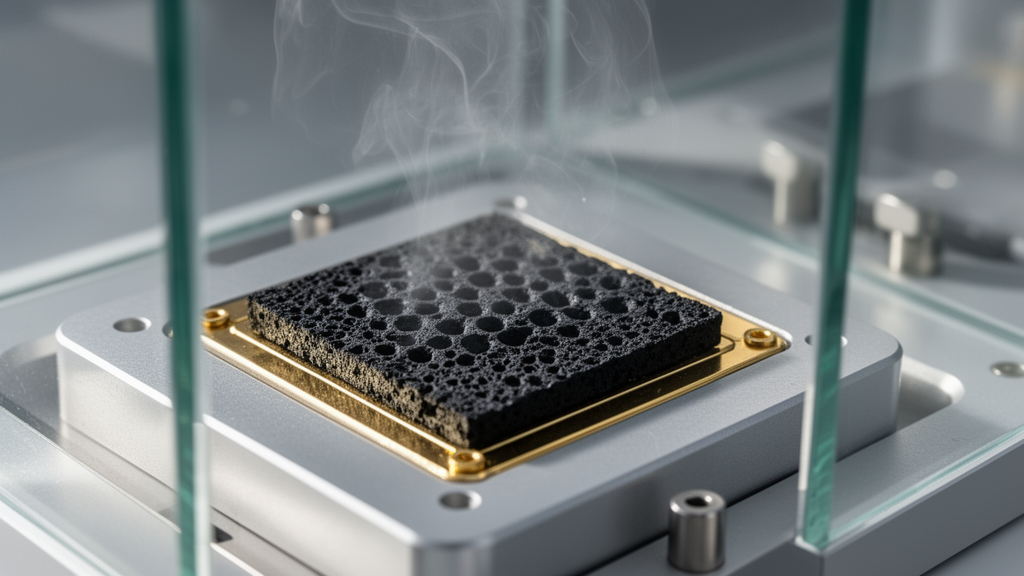
A laboratory study has demonstrated that precisely controlling the acid hydrolysis duration of nanocellulose derived from agricultural lavender straw produces biochar gas sensors with exceptional room-temperature sensitivity toward ethylene glycol vapor. Materials synthesized at an optimal three-hour hydrolysis duration, designated as CLN-3, achieved an electrical sensing response of 17,576.67 percent alongside a calculated detection limit of 0.36 parts per million and stable operation across forty days of testing. In contrast to conventional ethylene glycol detection platforms that require high operating temperatures, the biochar sensor operates under an applied direct-current bias of four volts at twenty-five degrees Celsius. The research team established that three hours of hydrolysis balances cellulose crystal preservation and amorphous phase removal, establishing an open mesoporous network with a specific surface area of 46.36 square meters per gram alongside an optimized ratio of surface chemisorbed oxygen to oxygen vacancies that governs room-temperature catalytic oxidation.
Developing reliable room-temperature detection methods for ethylene glycol carries practical urgency across chemical processing, automotive maintenance, and environmental health monitoring. Ethylene glycol is a polar organic solvent characterized by a boiling point of 197.3 degrees Celsius, widely utilized in polyester manufacturing and commercial antifreeze formulations. Although volatile organic compound detection frequently relies on porous carbon materials, synthesizing sensitive frameworks from biomass requires precursors that retain structural resilience during thermal decomposition. The investigators selected lavender straw harvested as agricultural waste from Huocheng County in Xinjiang due to its fibrous morphology, balanced cellulose-to-lignin composition, and naturally occurring calcium concentration. Inductively coupled plasma mass spectrometry revealed an intrinsic calcium fraction of approximately 0.98 weight percent, avoiding external catalyst additions and establishing an ideal framework for self-doped sensing materials.
The synthesis pathway utilized a binary organic acid hydrolysis system consisting of oxalic acid and glacial acetic acid blended in an equal one-to-one mass ratio at ninety degrees Celsius. Precursor purification removed extraneous components while the synergistic acid mixture governed sequential cleavage of glycosidic chains within lavender stem fibers over periods spanning one to five hours. Oxalic acid preferentially removed hemicellulose and lignin while preserving crystalline cellulose domains, and acetic acid promoted the generation of structural edge defects and specific oxygen vacancies during subsequent thermal treatment. The resulting nanocellulose precursors, designated LN-1 through LN-5, were isolated by freeze-drying before pyrolytic carbonization. Thermogravimetric analysis identified 450 degrees Celsius as the optimal carbonization temperature to yield the final porous biochar series, designated as CLN-X, where the suffix numeral corresponds to pretreatment duration.
Structural monitoring of the pristine nanocellulose precursors revealed that crystalline order follows a distinct non-monotonic trajectory as hydrolysis proceeds from one to five hours. Transmission electron microscopy confirmed that a one-hour treatment yielded surface roughening on large fiber bundles, whereas three hours of treatment achieved complete precursor dissociation into uniform nanofibers displaying well-ordered mesoporous arrangements. Extending hydrolysis to four and five hours caused structural fragmentation and particle agglomeration. X-ray diffraction patterns confirmed characteristic cellulose I peaks whose (002) diffraction intensity peaked in the three-hour precursor, corresponding to a maximum relative crystallinity index of 80.60 percent and peak thermal stability at 262.8 degrees Celsius. Kinetic modeling using a pseudo-first-order framework revealed two distinct operational stages: an initial selective etching phase between one and three hours with an etching rate constant of 0.0393 reciprocal hours, followed by an over-etching phase from three to five hours displaying a rate constant of 0.0327 reciprocal hours.
Nitrogen physisorption measurements verified that all carbonized biochar samples exhibited type IV adsorption-desorption isotherms characteristic of mesoporous materials, but textural parameters varied dramatically across processing durations. The CLN-3 material exhibited a specific surface area of 46.36 square meters per gram, substantially outperforming surface areas measured for CLN-1 at 23.34, CLN-2 at 16.21, CLN-4 at 14.68, and CLN-5 at 13.44 square meters per gram. Pore size distribution evaluations confirmed that CLN-3 concentrated smaller mesopores into an interwoven, open nanofiber framework. Statistical size analysis conducted through transmission electron microscopy demonstrated that CLN-3 possessed a narrow particle dimension distribution ranging from 12 to 15 nanometers. Under-hydrolyzed precursors failed to develop continuous internal pore channels because of residual amorphous domains, whereas prolonged acid exposure caused excessive structural breakdown, resulting in particle agglomeration, densification, and reduced cumulative pore volume in CLN-4 and CLN-5.
Spectroscopic and crystallographic evaluations of the carbonized materials indicated that macroscopic disorder remained broadly similar despite marked differences in precursor crystallinity. X-ray diffraction patterns of all CLN-X biochars featured nearly identical broad diffraction profiles around twenty-four and forty-three degrees two-theta, corresponding to the (002) and (100) planes of disordered amorphous carbon. Raman spectroscopy corroborated these findings by detecting the characteristic D band near 1350 reciprocal centimeters and the graphitic G band near 1580 reciprocal centimeters. Calculated ID-to-IG intensity ratios fluctuated between 0.55 and 0.74 without displaying a monotonic trend, confirming that precursor crystalline order did not dictate graphitization degree under identical carbonization parameters. Fourier transform infrared spectra showed attenuated peaks at 3400 reciprocal centimeters from residual hydroxyl stretching, near 2900 and 1044 reciprocal centimeters from carbon-hydrogen and carbon-oxygen stretching, and weak vibrations at 1629 and 1450 reciprocal centimeters from residual lignin aromatic rings.
Surface chemical characterization performed through high-resolution X-ray photoelectron spectroscopy clarified how the balance of surface oxygen species evolved under varying acid exposure times. High-resolution carbon 1s spectra identified distinct binding states for carbon-carbon bonds at 284.80 electron volts, carbon-oxygen-carbon bonds at 286.04 electron volts, and carbonyl species at 289.03 electron volts. Deconvolution of oxygen 1s spectra resolved three distinct contributions: oxygen vacancies at 530.38 electron volts, chemisorbed oxygen species at 531.92 electron volts, and surface hydroxyl groups at 535.02 electron volts. As hydrolysis time expanded from one to five hours, oxygen vacancy content rose progressively from 39.67 percent in CLN-1 to 49.92 percent in CLN-5, while hydroxyl levels remained stable between 7 and 14 percent. Crucially, chemisorbed oxygen peaked at 51.8 percent specifically within CLN-3. Calcium 2p spectra revealed doublets at 347.92 and 351.47 electron volts, confirming that naturally occurring calcium persisted as oxidized species such as calcium carbonate or calcium oxide.
Sensor evaluation was conducted at room temperature using a static volumetric testing system with fabricated sensing elements deposited onto interdigitated electrode substrates. The fabrication protocol involved dispersing CLN-X powders in deionized water at a one-to-three mass ratio, drop-casting ten microliters of slurry onto silver-palladium interdigitated electrodes supported on an alumina ceramic plate measuring 13 by 7 by 0.635 millimeters, and drying under ambient conditions for twenty-four hours. Tested under a constant bias of four volts, the CLN-3 sensor produced an electrical response of 17,576.67 percent toward ethylene glycol vapor, far exceeding other samples. Dynamic response and recovery times for 500 parts per million ethylene glycol were recorded at 69.75 seconds and 56.32 seconds, respectively. The sensor demonstrated excellent quantitative linearity across concentrations ranging from 100 to 400 parts per million with an R-squared value of 0.992, allowing determination of a 0.36 parts per million detection limit.
The material demonstrated pronounced selectivity toward ethylene glycol when benchmarked against other volatile substances and reducing compounds under identical room-temperature test parameters. While CLN-3 recorded a 17,576.67 percent signal enhancement when exposed to ethylene glycol, its response toward hydrogen peroxide reached only 78.39 percent, formaldehyde produced 533.75 percent, and hydrazine yielded 467.40 percent, alongside minimal interference from ammonia, aniline, methanol, ethanol, and acetone. Extended stability evaluations revealed that CLN-3 maintained consistent baseline and peak current signals over forty days of continuous monitoring with negligible performance deterioration, alongside ten consecutive exposure cycles without attenuation. Catalytic oxidation of ethylene glycol by chemisorbed oxygen releases conduction electrons, lowering junction barriers. In-situ Fourier transform infrared spectroscopy confirmed this pathway via characteristic absorption features at 3465, 2973, and 2350 reciprocal centimeters.
First-principles density functional theory calculations and environmental moisture tests contextualized the material performance and operational boundaries of the CLN-3 sensor. Computational models using the VASP package demonstrated that intrinsic calcium doping increased oxygen adsorption energy from negative 0.03351 electron volts to negative 0.07062 electron volts, while ethylene glycol adsorption shifted from negative 0.13674 electron volts to negative 0.39508 electron volts on oxygen-pre-adsorbed surfaces. Density of states calculations showed calcium doping introduces hybrid states near the Fermi level overlapping with carbon and oxygen orbitals. Static humidity tests from 33 to 85 percent relative humidity indicated that proton dissociation at low humidity gave way to Grotthuss proton hopping at higher humidity, causing signal fluctuations at 75 and 85 percent relative humidity. In application tests with commercial antifreeze containing approximately fifty percent ethylene glycol across one to five milliliter volumes, the integrated sensor successfully detected target vapors at twenty-five degrees Celsius, though real-world deployment requires field calibration.
Subject of Research: Nanocellulose-derived biochar gas sensors for room-temperature ethylene glycol detection
Article Title: Hydrolysis time-controlled pore and defect engineering in nanocellulose-derived biochar for enhanced ethylene glycol sensing
Article References: Gong, Y., Liang, C., Sun, Q., Hu, P., Li, Y., Cheng, J., Liu, C., Gao, B., Zhuo, H., & Wu, Z. (2026). Hydrolysis time-controlled pore and defect engineering in nanocellulose-derived biochar for enhanced ethylene glycol sensing. Biochar, 8(1), Article 110. https://doi.org/10.1007/s42773-026-00624-w
Image Credits: AI Generated
DOI: 10.1007/s42773-026-00624-w
Keywords: Biochar, Nanocellulose, Gas Sensors, Ethylene Glycol, Lavender Straw, Defect Engineering, Room-Temperature Sensing, Calcium Doping, Hydrolysis, time-controlled, pore, defect
News Source: Alan Morgan. (November 9, 2026). Engineered Lavender Biochar Enables Sensitive Room-Temperature Ethylene Glycol Detection. Scienmag.