A retrospective dendrochronological investigation examining more than a century of forest growth has revealed that early-life intrinsic water-use efficiency is at best a modest predictor of mature tree size in sessile oak stands and fails to forecast long-term tree survival or crown health. Published in the journal Annals of Forest Science, the research team analyzed radial growth chronologies and stable carbon isotope compositions from entire populations of sessile oak, scientifically known as Quercus petraea, across two mature high forest stands in France characterized by contrasting environmental constraints and silvicultural histories. Forest ecologists have long hypothesized that individual trees exhibiting higher intrinsic water-use efficiency, defined as the ratio of net carbon assimilation rate to stomatal conductance for water vapor, would secure a persistent competitive advantage under increasing atmospheric dryness. However, the comprehensive reconstruction demonstrated that while physiological diversity in water-use efficiency remained remarkably stable across a century of stand development, an individual tree’s early water-use efficiency conferred only limited and context-dependent benefits on cumulative adult dimensions, leaving adult survival and recent health outcomes largely decoupled from juvenile isotopic performance.
The investigation evaluated two contrasting experimental high forest plots exceeding one hundred years of age, designated as the Blois and Harth study sites, alongside a reference common-garden trial established at Sillegny. The Blois site represents a dense, unthinned sessile oak high forest situated within the species’ ecological optimum in central France, specifically within the state forest of Blois on a Luvisol-Stagnosol soil with a favorable available water holding capacity of 215 millimeters. Initiated following the 1925 growing season in an even-aged stand regenerated naturally around 1889, the Blois experimental plot was thinned only once in 1927, reducing stem density by 18.3 percent from 3691 to 3015 trees per hectare, before being left unmanaged to undergo natural competition-induced mortality. By 2020, stem density in the central study plot had dropped to 388 trees per hectare while stand basal area reached 43 square meters per hectare, corresponding to a Relative Density Index of 0.984 at the maximum theoretical size-density boundary. At Blois, intense competition for canopy light exposure served as the primary selective environmental filter governing tree growth trajectories.
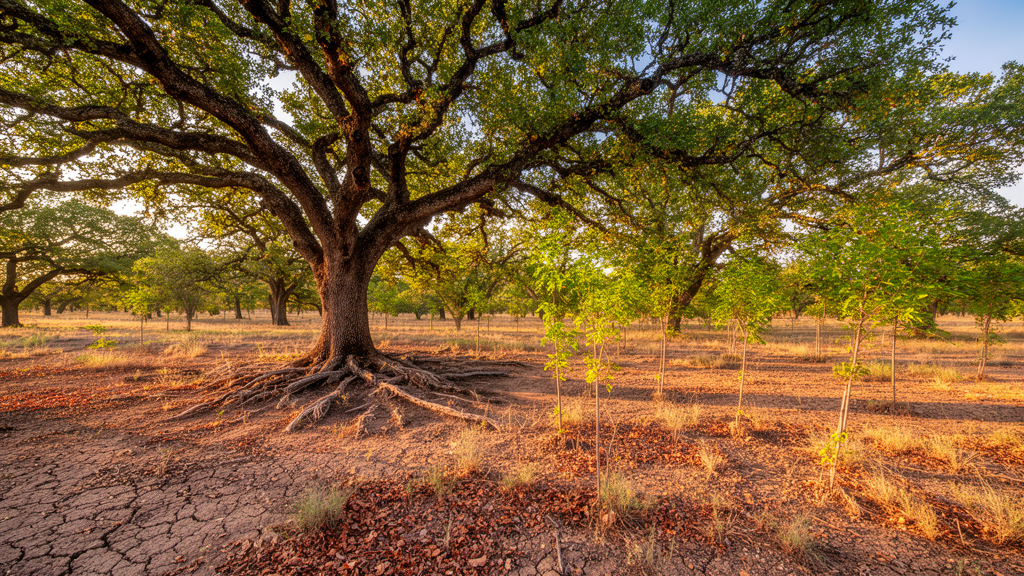
In sharp contrast to the dense canopy conditions at Blois, the Harth site in northeastern France represents a low-density managed oak stand subjected to chronic soil water deficits and recurrent dieback. Situated in the southern Harth state forest on alluvial Rhine deposits, the stand grows on a drought-prone Fersialsol soil packed with coarse gravel and stones, yielding an effective water holding capacity of only 87 millimeters. Because the regional water table lies far beyond root reach at depths of 10 to 15 meters and the dry continental climate of the Alsace Plain frequently suppresses precipitation relative to evaporative demand, soil moisture limitation represents the governing constraint. Historically converted from a coppice-with-standards regime to high forest, the Harth stand retains a bimodal age distribution where a minority cohort reached breast height around 1860 while the majority did so around 1890. Timber extractions, firewood harvests, and sanitary fellings following severe oak decline episodes in the mid-1990s maintained a low stem density, recorded at 169 trees per hectare with a basal area of 21 square meters per hectare in 2021.
To establish an unbiased baseline for early-life physiological variability without the confounding effects of century-long mortality, the researchers incorporated comparative data from four sessile oak populations grown in the Sillegny common garden. In natural mature stands, trees that perish during juvenile and intermediate stages are lost from retrospective dendrochronological sampling, introducing potential survivor bias that could theoretically compress the observed phenotypic variance. In the Sillegny plantation, four provenances designated Allogny, Pontigny, Serqueux, and Bussières provided isotopic measurements collected at ten years of age across 57 to 64 trees per population under homogeneous pedoclimatic conditions. Because these planted trees experienced minimal competitive mortality, they retained the entire natural range of social hierarchy positions from dominant to suppressed. Comparing the standard deviations and coefficients of variation between the mature stands and the young common garden enabled the researchers to test whether competitive self-thinning or environmental filtering systematically narrowed functional diversity in water-use traits over a hundred years of development.
The methodological framework rested on complete stand coring combined with annual ring stable carbon isotope analysis across all living and recently standing dead oaks within the designated study boundaries. Increment cores were extracted at breast height from 104 trees at Blois in autumn 2020 and 102 trees at Harth in May 2021, and core surfaces were prepared by microtome before scanning at 2400 dots per inch for precise ring-width measurement and cross-dating. Annual basal area increment and diameter trajectories were reconstructed back to initial establishment years using Bakker’s geometric formulation. To assess early-life intrinsic water-use efficiency, the researchers isolated wood from three specific annual rings per tree corresponding to an early adult phase when trees were approximately 30 to 40 years old at breast height, deliberately excluding the first twenty juvenile rings. For each tree, selected annual rings spanned contrasting May-to-July moisture conditions represented by the Standardised Precipitation-Evapotranspiration Index, capturing one drought season alongside two antecedent or subsequent moist seasons.
Stable carbon isotope composition was measured on whole wood powder using an elemental analyzer coupled to an isotope ratio mass spectrometer, expressing values relative to the Vienna Pee Dee Belemnite standard. Annual intrinsic water-use efficiency in micromoles of carbon dioxide assimilated per mole of water vapor transpired was calculated using Farquhar’s formulation adjusted for leaf-to-wood discrimination, integrating atmospheric carbon dioxide concentrations and isotopic shifts. For every tree, the values from the three contrasting years were averaged to determine mean early-life intrinsic water-use efficiency, while the absolute numerical difference between the maximum and minimum annual values defined the individual’s drought-induced plasticity. Statistical associations between these physiological metrics and mature tree performance—including final tree diameter, Vertex hypsometer height measurements, social dominance classes, crown dieback ratings from zero to five, and post-2020 mortality events—were evaluated using reduced major axis regressions, one-way analyses of variance, and false discovery rate corrections.
The isotopic measurements demonstrated that inter-individual variability in intrinsic water-use efficiency did not contract over a century of competitive filtering and severe mortality. The within-stand phenotypic range of early-life efficiency spanned approximately 40 micromoles of carbon dioxide per mole of water at both experimental forest sites, mirroring the variation observed among individuals in the young Sillegny reference trials. The variability in drought plasticity displayed higher dispersion at Blois with a coefficient of variation of 47.5 percent compared to 32.2 percent at Harth. Crucially, early-life efficiency was not correlated with juvenile stem diameter in either forest, indicating that early functional differences in gas exchange were not simply an artifact of initial stem size or juvenile biomass advantages.
When assessing cumulative growth over a century of maturity, early-life water-use efficiency proved to be only a modest predictor whose predictive strength depended directly on stand density and resource limitations. In the light-competitive Blois forest, early efficiency showed only a marginally significant correlation with adult stem diameter in 2020, explaining less than four percent of the variance, and exhibited no correlation with mature tree height. Dominant trees identified in 1966 possessed a 4 percent higher early efficiency than codominant neighbors, yet initial diameter and physiological efficiency largely lost their predictive influence over subsequent decades as intense overstorey competition rearranged growth hierarchies. Conversely, in the open, drought-stressed Harth stand, early efficiency exhibited stronger, highly significant positive associations with both adult diameter and total height in 2021, accounting for roughly 12 percent and 11 percent of total variation, with suppressed trees exhibiting 9 percent lower early efficiency than dominant individuals.
Temporal correlation analyses across the century-long chronologies showed that relationships between early water efficiency and annual basal area growth shifted dynamically in response to canopy disturbances and drought crises. At Blois, significant correlations between early efficiency and annual growth appeared only during isolated historical windows, specifically from 1926 to 1928 and during the mid-1940s, both coinciding with localized canopy openings and stem density reductions.
Most significantly for forest conservation and silviculture, neither early-life water-use efficiency nor its drought plasticity conferred any measurable protection against tree health decline or mortality. In the water-limited Harth plot, where ongoing drought-induced dieback caused 24 oak deaths between 2021 and 2024, surviving trees and dead individuals exhibited statistically indistinguishable early efficiency distributions, and crown dieback severity classes showed nearly identical mean values across all damage categories. Furthermore, early physiological plasticity to drought showed no relationship with long-term growth, competitive dominance, or survival at either study site. The researchers concluded that while individual diversity in water-use traits naturally persists in mature oak populations despite heavy self-thinning, selecting trees based solely on juvenile water-use efficiency cannot reliably enhance stand drought resilience or guarantee adult survival, underscoring that structural management through thinning remains the primary mechanism for directing stand development.
Subject of Research: Predictive capacity of early-life intrinsic water-use efficiency for adult oak growth and survival
Article Title: Is intrinsic water-use efficiency an early predictor of adult growth in sessile oak (Quercus petraea Matt. Liebl) high forest stands?
Article References: Rabarijaona, A., Brendel, O., Ningre, F., Bréda, N., & Ponton, S. (2026). Is intrinsic water-use efficiency an early predictor of adult growth in sessile oak (Quercus petraea Matt. Liebl) high forest stands?. Annals of Forest Science, 83(1), Article 56. https://doi.org/10.1186/s13595-026-01378-y
Image Credits: AI Generated
DOI: 10.1186/s13595-026-01378-y
Keywords: Quercus petraea, sessile oak, water-use efficiency, dendrochronology, tree rings, carbon isotopes, forest ecology, drought resilience, silviculture, tree mortality, intrinsic, water-use
News Source: Alan Morgan. (November 9, 2026). Early Water Efficiency Fails to Predict Long-Term Oak Tree Survival. Scienmag.