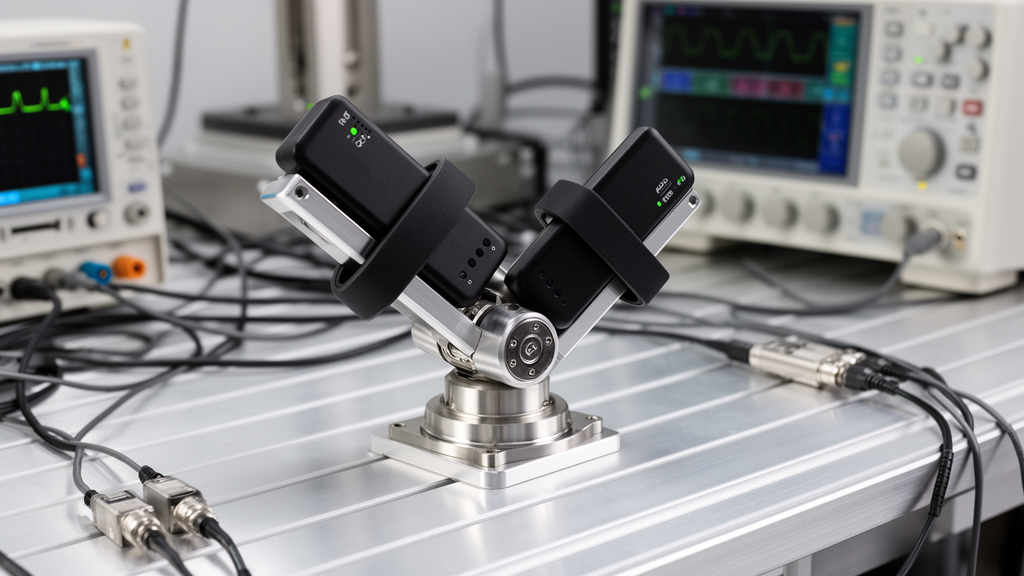
A four-node wireless inertial measurement unit (IMU) network employing relative orientation quaternions and a master-driven slotted transmission protocol achieved high joint-angle accuracy on a mechanical bench rig, according to an investigation by Trung Thanh Nguyen, Cuong Manh Do, and Dong Phu Dao from Hanoi University of Science and Technology.
Wearable IMU systems provide an affordable alternative to optical motion capture for measuring lower-limb movement in sports, physical activity, and rehabilitation outside laboratory settings. However, kinematic measurements obtained from these wearable sensor networks have been historically constrained by two persistent problems: the reference-frame dependence that occurs when joint angles are computed by differencing Euler angles from separate sensors, and frame-level desynchronisation resulting from unscheduled wireless transmissions.
To remove dependence on a common global heading, the researchers calculated joint angles using the relative orientation quaternion between adjacent body segments. While this quaternion-based approach avoids the need for a shared heading reference, a mathematical singularity re-emerges whenever an angle sequence is extracted from the orientation. Under the bench evaluation setup, the reported joint angle was itself that singular rotation, reaching an end-range magnitude of 88.4 degrees.
To resolve the wireless desynchronisation problem, data transport was reorganised into a deterministic, master-driven slotted communication protocol operating over ESP-NOW. Under this scheme, a hardware-timer broadcast trigger transmits a shared sequence number and timestamp to all participating units. Each node replies after an assigned fixed per-node slot delay of 1.2 + 2.5k milliseconds, and serialisation tasks were moved out of the receive callback routine.
Communication performance was tested across paired 300-second recording trials comparing the slotted protocol against a queue-based baseline. The proposed slotted architecture increased the complete-frame reception rate from 97.20% to 99.99% while simultaneously raising the trigger rate from 20 Hz to 50 Hz. In addition, the protocol reduced duplicate data packets from 16.13% to 0.31% and suppressed median per-second latency jitter from 26.5–35.5 milliseconds down to 3.4–4.9 milliseconds.
Joint-angle accuracy was verified on a mechanical test rig against a reference optical encoder providing 600 pulses per revolution, with no data gathered from human subjects. Across three tested IMU pairs, the root-mean-square errors relative to the encoder were 1.12, 0.79, and 0.86 degrees, with corresponding biases of +0.70, +0.52, and +0.46 degrees, and 95% limits of agreement within 3.4 degrees. Cross-correlation analysis identified an end-to-end transport latency of 44 milliseconds; compensating for this delay left the measurement bias unchanged while halving the standard deviation of the difference.
The authors reported a notable limitation in the timing architecture: while the transmission scheduling creates a deterministic transport layer, it does not govern sensor data acquisition. Because the individual nodes sample on independent free-running loops, their data acquisition instants within a single frame differed by a median skew of 9.0 milliseconds. This acquisition-time skew presents a functional boundary that limits accurate joint-angle tracking during high-speed movements despite the accuracy of the stationary bench estimation chain.
Conducted within the School of Mechanical Engineering and the School of Engineering Pedagogy at Hanoi University of Science and Technology, the research was published in Frontiers in Sports and Active Living under the section for Sports Science, Technology and Engineering.
Subject of Research: Wireless inertial measurement unit system for lower-limb joint-angle tracking
Article Title: A quaternion-based, transmission-scheduled multi-IMU system for low-cost lower-limb joint-angle measurement: bench validation against an encoder up to the Cardan singularity, and wireless protocol benchmarking
Article References: Nguyen, T. T., Do, C. M., Dao, D. P., & Bui, T. N. (2026). A quaternion-based, transmission-scheduled multi-IMU system for low-cost lower-limb joint-angle measurement: bench validation against an encoder up to the Cardan singularity, and wireless protocol benchmarking. Frontiers in Sports and Active Living, 8, Article 1973846. https://doi.org/10.3389/fspor.2026.1973846
Image Credits: AI Generated
DOI: 10.3389/fspor.2026.1973846
Keywords: wearable sensors, inertial measurement units, joint angle measurement, quaternions, wireless synchronisation, ESP-NOW protocol, sports biomechanics, gait analysis, quaternion-based, transmission-scheduled, multi-IMU, system
News Source: Ophelia Keating. (November 9, 2026). Slotted Wireless IMU Network Demonstrates High Joint Angle Accuracy on Bench. Scienmag.