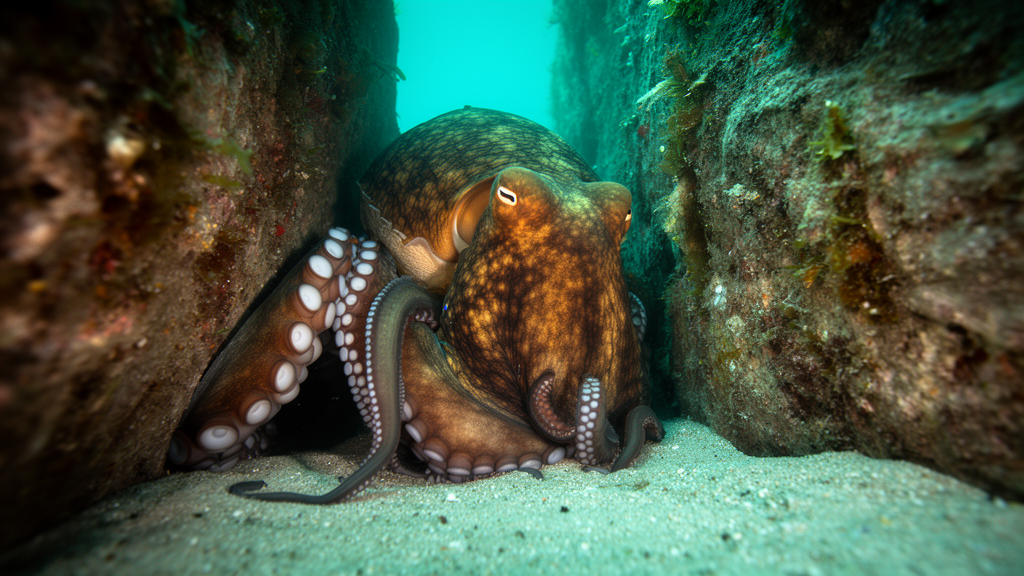
Young common octopuses dynamically alter their physical strategies to maneuver through confined spaces depending on the exact dimensions of an opening, according to an experimental study published in the Journal of Experimental Biology. Octopuses are celebrated for an extraordinary degree of behavioral and physical versatility, capable of walking across the seabed on their eight arms, jetting swiftly through open water, manipulating complex tools, and squeezing through unimaginably tight spaces. Because their flexible structures allow them to alter body shape almost like water flowing through a gap, an octopus is not strictly limited by its overall physical size. However, despite their widely recognized physical elasticity, scientists previously lacked detailed information explaining exactly how an octopus manages to negotiate apertures that are substantially smaller than its body diameter and its bulbous mantle.
To investigate this mechanical puzzle, an international research team composed of Michael Kuba from the University of Naples Federico II in Italy, Tamar Gutnick and Daniel Abed-Navandi from the Haus des Meeres-Aqua Terra Zoo in Austria, and Wenci Xin from the National University of Singapore conducted controlled laboratory experiments using animals. The researchers tested both young common octopuses, scientifically known as Octopus vulgaris, and Mayan octopuses, known as Octopus maya, by offering them constricted holes through which they could extricate themselves. Their primary finding demonstrated that common octopuses do not rely on an invariant mechanical approach; instead, they employ distinct multi-step behavioral strategies dictated directly by the relative size of the opening they must pass through.
The experimental setup was specifically calibrated around the anatomical features of each individual animal. Michael Kuba began by measuring the physical distance between the eyes of each subject, which ranged from 15 to 35 millimeters across the study animals. This specific inter-ocular distance provides a dependable indicator of the dimensions of the rigid cartilage sheath encasing the octopus’s central nervous system. Because this stiff protective capsule is incompressible compared to surrounding soft tissues, researchers reasoned that its width could establish the absolute structural boundary for the smallest possible hole an individual octopus can successfully negotiate. Based on these anatomical baseline figures, Xin constructed individual Perspex boxes featuring escape holes of two distinct categories: some openings were crafted to be slightly wider than the measured distance between the animal’s eyes, while others were manufactured to be exactly 5 millimeters smaller than that inter-ocular distance.
By filming the escapologists as they navigated the partitions, the investigators documented that the common octopuses deployed completely different behavioral sequences depending on whether an aperture was spacious or small. When confronted with a relatively spacious opening that exceeded the distance between their eyes, each common octopus followed a continuous sequence. The animal began by thoroughly exploring the hole using its arms before pushing an initial arm through the opening, with the octopus usually selecting one of its two front left arms to lead the way. Following this initial limb, the octopus threaded up to five of its remaining arms through the aperture. To complete the exit, the octopus reached backward with two of the arms that had already crossed the barrier, firmly attached their suckers to the partition wall, and then stiffened and extended those arms to push against the partition. This leveraged pushing action pulled the remaining arms, head, and mantle cleanly through the opening in approximately 20 seconds.
When common octopuses faced the narrower apertures measuring 5 millimeters smaller than their eye spacing, the animals encountered strict physical limits on how many limbs could pass through the hole simultaneously. Confronted with this tighter boundary, the octopuses shifted to an alternative behavioral approach by dividing the final extraction maneuver into two separate stages. Under this smaller-aperture strategy, the octopus first pulled its remaining arms through the constricted hole, and only then did it slightly compress its mantle before dragging it through the barrier. This tactical adjustment surprised the research team, as the scientists had previously hypothesized that common octopuses would invariably follow the same physical approach regardless of the dimensions of the aperture.
In contrast to the flexible adjustments observed in the common octopuses, the Mayan octopuses exhibited entirely different behavioral reactions during the trials. When placed in boxes featuring only the tighter apertures, the Mayan octopuses did not even attempt to negotiate the constricted openings; instead, they remained stationary in the corner of the Perspex box and never investigated the boundary aperture with their arms. However, when the researchers presented Mayan octopuses with a concurrent choice between a small opening and a large opening, the animals initially explored the smaller aperture with their limbs before ultimately abandoning it and choosing to emerge through the larger hole.
Following their determination of how octopuses squeeze through gaps smaller than their bodies, Xin and co-author Cecilia Laschi from the National University of Singapore are working to translate these biological mechanisms into soft-bodied robotic technologies. Contemporary exploration and search-and-rescue robots typically rely on slender, snake-like body profiles to negotiate narrow gaps, an architecture that substantially restricts the payload volume available for sensors and manipulators and thereby diminishes overall operational adaptability. Xin and Laschi are optimistic that developing octopus-inspired robots capable of compressing their bodies and shifting behavioral strategies to pass through tight spaces could introduce a new era in the design of agile machines tasked with navigating disaster rubble and exploring open marine environments.
Subject of Research: Behavioral strategies and mechanics of octopuses squeezing through narrow apertures
Article Title: How octopuses squeeze through too small gaps
Article References: How octopuses squeeze through too small gaps. Original publication (Bibliographic details unavailable.)
Image Credits: AI Generated
DOI: Not provided
Keywords: Octopus vulgaris, Octopus maya, marine biology, biomechanics, animal behavior, soft robotics, Journal of Experimental Biology, octopuses, squeeze, small, gaps, scientific research
News Source: Drew Townsend. (November 9, 2026). Common Octopuses Switch Strategies to Squeeze Through Confining Gaps. Scienmag.