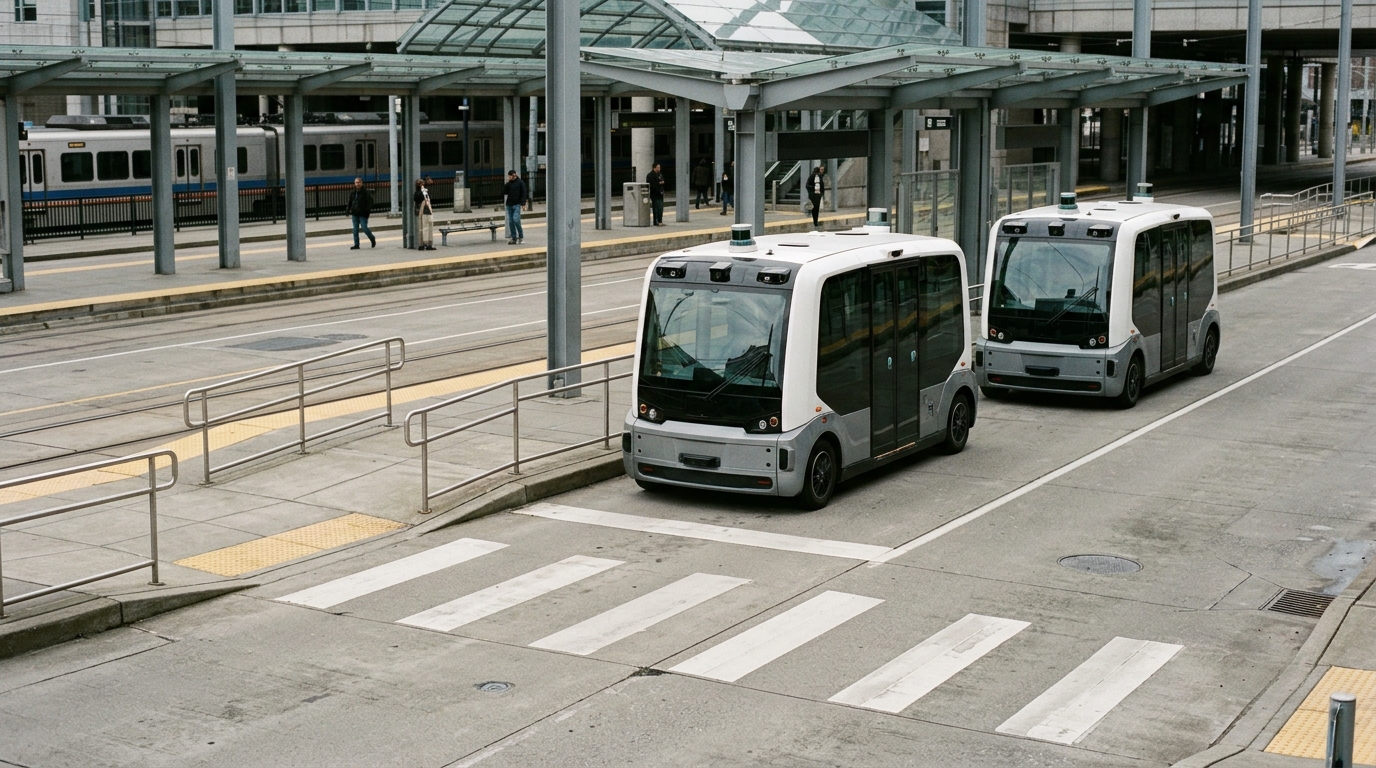
A comprehensive systematic review of forty-five peer-reviewed studies examining modular, autonomous POD-based transportation systems has revealed that current scientific literature remains overwhelmingly concentrated on single-mode road corridors, leaving multimodal network integration and artificial intelligence methodologies largely unexamined. Modular transit systems operate through standardized transport units capable of coupling into platoons, merging into unified vehicles, or detaching to accommodate fluctuating travel demand. While demand-responsive transit has generated an extensive body of literature over recent decades, this analysis represents the first structured, comprehensive synthesis addressing the confluence of vehicular modularity, multimodality across differing infrastructure networks, and co-modality combining human passengers with small parcel deliveries.
The conceptual framework underpinning POD-based transport relies on standardized structural load units that transfer between varied motorized carrier chassis using physical or virtual coupling mechanisms, closely mirroring the containerized logic of intermodal freight networks. Standardizing these modular units enables true multimodality, allowing a single passenger compartment or freight capsule to navigate road networks, attach to rail platforms, or potentially transition to specialized ropeway and waterborne routes without requiring travelers or cargo to disembark. Furthermore, the integration of public passenger services with urban freight distribution introduces co-modality, a strategy designed to resolve persistent municipal transit inefficiencies. Conventional municipal buses and passenger trains routinely maintain fixed timetables and rigid passenger capacities, which frequently causes vehicle capacity and track or roadway infrastructure to sit severely underutilized during non-peak operational hours. Concurrently, rapid e-commerce expansion has complicated inner-city distribution through severe street congestion and municipal access restrictions, creating an operational incentive to utilize spare passenger vehicle space for parcel logistics.
To evaluate the scientific literature governing these advanced vehicle systems, the authors executed a structured multi-phase search protocol across the Scopus academic database. The search strategy utilized three sequential query filters: establishing a core baseline of modular vehicle literature, mandating the incorporation of passenger transit parameters, and applying rigorous subject exclusions alongside precise operational keywords to prevent omission of diverse domain synonyms. Recognizing that database algorithms frequently miss relevant studies due to disparate technical terminology and partial database indexing, the investigators supplemented the initial query outputs through targeted consultations with field experts and systematic snowball sampling across cited references. The resulting synthesis incorporated forty-five peer-reviewed research papers, which were subsequently mapped across a three-dimensional taxonomic framework: transport system infrastructure and network architecture, modular vehicle configuration and demand allocation, and mathematical optimization formulations including system representations and computational solution algorithms.
Regarding transportation infrastructure, the review uncovered an extreme operational imbalance: thirty-seven of the forty-five reviewed publications focused exclusively on road-based vehicular configurations. This heavy concentration stems directly from the spatial flexibility inherent in road networks, which permit autonomous rubber-tired vehicles to dynamically select unrestricted routing paths, alter origins and destinations, and readily decouple unneeded units for prompt depot return or reassignment without adhering to guided tracks. Rail-based systems accounted for only five studies, with research primarily exploring capacity adjustments for metro corridors during asymmetric rush-hour surges, non-stop passenger boarding via detachable modules, and balancing unscheduled walk-in passengers against pre-booked reservations. The remaining infrastructural domains were represented by isolated single papers: Haimerl and colleagues simulated parametric queuing and throughput in a ropeway cable-car system, Moadab and colleagues evaluated an airborne drone parcel delivery system utilizing ground transit for battery recharging, and Miyoshi and colleagues examined an urban waterborne ferry network carrying mixed passenger and cargo demands.
Network design characteristics within the surveyed literature displayed a corresponding bias toward simplified, one-dimensional spatial geometries. Fixed-stop networks dominated the academic field, appearing in twenty-eight separate papers, whereas fourteen studies analyzed flexible routes operating between predetermined stops, and only four papers tackled completely free-roaming networks devoid of predetermined boarding locations. Traditional line-based and single-corridor models simplify mathematical planning by restricting spatial routing, though branched corridors and multi-line intersection frameworks were also explored to demonstrate how modular coupling mitigates station transfer delays and matches line capacity to localized demand surges. More flexible, stop-based autonomous configurations allow vehicles to adjust trajectories to serve individual travel requests dynamically, though at the expense of higher algorithmic complexity. Completely free-roaming systems, investigated by researchers such as Di Febbraro, Sieber, Leffler, and Hatzenbühler, provide maximum convenience by servicing door-to-door requests anywhere across an urban grid, but dramatically increase computational burdens because passenger pick-up locations cannot be aggregated at predictable physical nodes.
In their technical assessment of vehicular modularity, the authors observed that physical mechanical coupling between adjacent transit units represents the dominant design paradigm, appearing in twenty-five of the forty-five reviewed papers. Within this group, seventeen publications integrated internal gangways permitting passenger movement between coupled modules while vehicles remain in motion, effectively eliminating platform transfer delays by enabling en-route redistribution around key roadway intersections. An additional three studies investigated virtual platooning, in which independent vehicles travel in coordinated aerodynamic convoys without physical docking mechanisms, while seventeen papers analyzed modular operations from purely scheduling or capacity perspectives without explicit vehicular linkage mechanisms. Operational evaluations revealed that modular detachment strategies enable non-stop express services, wherein trailing modules split off toward local stations while main carrier vehicles continue along principal transit arterials, allowing public transport fleets to simultaneously reduce travel times and dynamically adapt fleet capacity to volatile en-route passenger counts.
Demand assignment across the surveyed literature illustrated an emerging but incomplete transition toward fully integrated co-modal transportation. While forty-one papers integrated passenger travel flows, only eleven studies incorporated freight or goods transport, which was strictly evaluated as small parcel distribution rather than heavy bulk or intermodal container haulage. Early conceptual analysis highlighted that sharing physical transit infrastructure and autonomous vehicle fleets between commuting citizens and parcel couriers maximizes public vehicle utilization, particularly during off-peak scheduling windows. Empirical and numerical results compiled across the reviewed literature indicated that combined passenger and parcel transit significantly reduces overall required fleet sizes compared to standalone logistics operations, curtails unladen vehicle kilometers traveled, and drives down total system operating expenditures by margins ranging from ten percent to as much as sixty percent in specific municipal deployment models.
Mathematical optimization represents the cornerstone of autonomous modular vehicle deployment, with the literature addressing five principal problem classes: capacity deployment, vehicle routing, load assignment, fleet repositioning, and timetabling. Capacity deployment emerged as the most prevalent operational problem, investigated by thirty-three studies seeking to determine optimal unit counts and modular configurations to meet anticipated passenger density along assigned routes. Routing was analyzed across twenty-one papers, addressing stop-skipping strategies and flexible pick-up sequences across diverse spatial links. Load assignment was evaluated in fifteen studies to determine whether passengers or parcel consignments should be linked to specific modules, including micro-level passenger assignments near intersections to optimize in-vehicle transfers. Timetabling was treated in thirteen papers to coordinate departure intervals and service frequencies, while fifteen studies investigated the empty vehicle repositioning problem, a crucial requirement for rebalancing decoupled autonomous carrier units across asymmetrical urban demand sinks and multimodal transfer hubs.
An analysis of mathematical formulations revealed that optimization objectives are almost evenly split between customer-facing service metrics and transit operator financial costs. Client-oriented objectives appeared in thirty-five papers, minimizing passenger travel duration, terminal wait times, transfer friction between lines, boarding denials, physical crowdedness inside modules, and transit reliability variances. Conversely, broad societal objectives such as equitable geographic transit accessibility and environmental sustainability were never treated as primary objective functions, appearing only as secondary evaluative indicators or constraint checks. Boundary constraints governing these mathematical formulations were heavily concentrated around physical vehicle capacity across forty papers, total available fleet size across twenty-four papers, time-window intervals for parcel or passenger pickup across twelve papers, and explicit maximum passenger waiting time ceilings across six studies.
System representations within the evaluated papers were characterized by a clear division between mathematical analytical representations and iterative simulation frameworks. Analytical formulations appeared in thirty-seven papers, predominantly structuring operational transit challenges as mixed integer linear programs or complex mixed integer non-linear programs. While linear analytical formulations allow commercial solvers to reliably identify provable global optima, non-linear physical interactions, congestion effects, and passenger boarding dynamics frequently compel researchers to linearize mathematical models or transition toward simulation techniques. Nineteen papers utilized simulation models, comprising fifteen mesoscopic models that track individual vehicle choices without demanding micro-level car-following mechanics, three microscopic simulations that model detailed terminal queuing, vehicular docking, and platoon formation, and a single macroscopic model that tracked regional traffic density across urban corridors. Simulations proved uniquely capable of capturing stochastic operational disturbances, unexpected travel demand spikes, and rolling-horizon re-optimization.
Regarding computational solution algorithms, researchers relied almost equally on exact numerical solvers and heuristic procedures, while modern machine learning algorithms remained nearly non-existent. Exact computational methods were implemented in twenty-one studies using commercial software packages including Gurobi, CPLEX, and Lingo, employing rigorous mathematical branching strategies such as Branch and Bound, Dynamic Programming, and Outer Approximation algorithms. However, exact solvers suffered from steep computational exponential growth when expanded beyond small benchmark test cases. To resolve real-world computational bottlenecks, twenty-two studies implemented heuristic algorithms, including Nearest Neighbour heuristics, Artificial Bee Colony swarming, and Adaptive Large Neighbourhood Search. Notably, Adaptive Large Neighbourhood Search consistently identified near-optimal solutions with an optimality gap below zero-point-one percent while utilizing approximately two percent of the computational run time required by exact solver architectures. In stark contrast, only a single paper in the entire review, authored by Tian and colleagues, deployed an artificial intelligence approach, utilizing a convolutional neural network to predict travel demand and guide automated vehicle dispatching.
Synthesizing these findings, Bruijl, Burghout, and Minbashi outlined four urgent strategic priorities for future transportation systems research. First, academic research must overcome its single-mode road bias by examining genuine multimodal modularity, specifically modeling the physical transfer and algorithmic coordination of standardized POD units exchanging between road carriers, regional railways, and complementary urban modes. Second, co-modal autonomous transit models must be expanded beyond isolated corridors to assess multi-purpose vehicle fleets operating across complex two-dimensional metropolitan grids. Third, transit optimization must pivot from static analytical representations toward dynamic mesoscopic simulations and rapid surrogate machine learning models capable of handling real-world stochasticity and rolling time horizons. Finally, the authors emphasized an urgent need to transition toward artificial intelligence frameworks, such as deep reinforcement learning and hybrid heuristics, to achieve robust, scalable, and computationally efficient dispatching for the next generation of modular public transit.
Subject of Research: Systematic review of modeling and optimization methodologies for modular POD-based passenger and freight transportation
Article Title: Review on the modelling of modular POD-based passenger and goods transportation
Article References: Bruijl, I. M., Burghout, W., & Minbashi, N. (2026). Review on the modelling of modular POD-based passenger and goods transportation. European Transport Research Review, 18(1), Article 77. https://doi.org/10.1186/s12544-026-00832-2
Image Credits: AI Generated
DOI: 10.1186/s12544-026-00832-2
Keywords: modular vehicles, autonomous transportation, co-modal transit, multimodal systems, demand responsive transit, vehicle routing problem, transportation modeling, PODS4Rail, Review, modelling, modular, POD-based
News Source: Blake Davidson. (November 8, 2026). Modular Autonomous POD Transport Systems Face Critical Multimodal and Artificial Intelligence Gaps. Scienmag.