Aluminium-steel joints made by three different joining routes corrode at very different rates in salt water, and the difference comes down to what happens at the interface where the two metals meet, according to a study published in Advanced Composites and Hybrid Materials.
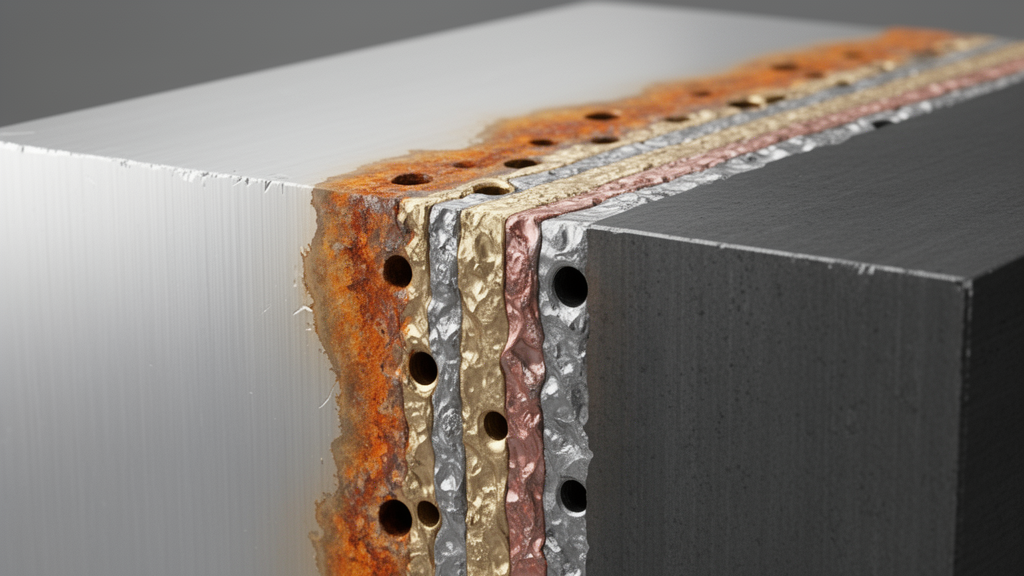
The team found that corrosion in every joint type traces back to the same fundamental mechanism: the aluminium alloy acts as the anode in a galvanic couple formed with the steel, so it dissolves preferentially. Voids in the transition region between the two metals accelerate this process. But the extent of that damage is not fixed by the metals themselves. Instead, the interface’s corrosion behaviour depends heavily on the bonding parameters used, the thickness and morphology of the intermetallic compound layer that forms where the metals meet, and any defects such as cracks or voids within that layer.
In compound casting, where molten aluminium is cast around solid steel to form a solid-liquid joint, the researchers discovered that applying a coating to the mild steel before joining changed the corrosion outcome. Copper-coated steel gave the joint good corrosion resistance, while nickel-coated steel produced the best combination of mechanical strength and corrosion performance together. The study’s highlights note that coating the steel surface before joining helps reduce intermetallic thickness in compound casting, which in turn lowers the corrosion rate.
Magnetic pulse welding, a high-impact solid-state process that joins metals using electromagnetic forces, showed that welding energy matters as much as the method itself. The joint welded at 14.5 kilovolts resisted corrosion better than the one welded at 14 kilovolts. The authors conclude that optimised welding energy and interface integrity are key to minimising corrosion in high-impact solid-state welding processes. Corrosion in magnetic pulse welding depends on the joining parameters, and controlling intermetallic thickness and wave formation at the interface is central to achieving corrosion resistance.
Diffusion bonding, which joins the metals by applying heat and pressure so atoms diffuse across the interface, produced corrosion rates that varied with process parameters and with the effect of the interlayer material placed between the aluminium and steel. Increasing the thickness of the copper interlayer during diffusion bonding enhanced the diffusion of aluminium-copper phases into the aluminium matrix, and this deeper penetration led to a higher corrosion rate.
Scanning electron microscopy paired with energy-dispersive X-ray spectroscopy revealed the physical damage behind the measured corrosion rates. The analysis showed pitting, intergranular corrosion and cracks running through the intermetallic compound layer. The study’s highlights summarise the pattern: corrosion behaviour depends on intermetallic thickness and morphology, and voids and cracks in the intermetallic layer accelerate corrosion.
Whether the joint is made by casting molten aluminium onto coated steel, by magnetic pulse welding at a controlled voltage, or by diffusion bonding with a carefully sized interlayer, the same variables recur: bonding parameters, intermetallic thickness and morphology, and defects within the intermetallic layer. The researchers found that corrosion is mainly due to anodic dissolution of the aluminium alloy driven by the galvanic couple, and that voids in the transition region accelerate the corrosion performance.
Subject of Research: Electrochemical corrosion behaviour of aluminium alloy to mild steel joints fabricated by compound casting, magnetic pulse welding and diffusion bonding
Article Title: Comparative study on the electrochemical corrosion behaviour of Al-Fe joints fabricated via compound casting, magnetic pulse welding, and diffusion bonding
Article References: Kota, P. K., Reddy, B. S., Vignesh, R. V., & Govindaraju, M. (2026). Comparative study on the electrochemical corrosion behaviour of Al-Fe joints fabricated via compound casting, magnetic pulse welding, and diffusion bonding. Advanced Composites and Hybrid Materials. https://doi.org/10.1007/s42114-026-02155-1
Image Credits: AI Generated
DOI: 10.1007/s42114-026-02155-1
Keywords: aluminium-steel joints, compound casting, magnetic pulse welding, diffusion bonding, electrochemical corrosion, intermetallic compounds, galvanic corrosion, AA6061, mild steel, 3.5% NaCl solution, SEM-EDS analysis, coating
News Source: Denise Maddox. (November 8, 2026). Aluminium-steel joints corrode at rates set by bonding method and interface defects. Scienmag.