Researchers at the Ecole Polytechnique Fédérale de Lausanne have developed a molecular sensing architecture that enables the detection of small molecules through conformational DNA recognition, according to a peer-reviewed study published in Nature Chemistry. Led by laboratory head Nako Nakatsuka at the Laboratory of Chemical Nanotechnology within the EPFL School of Engineering, the scientific team redesigned how aptamers, which are short synthetic strands of DNA used in molecular sensors, detect their target compounds. By dividing target capture and signal reporting into two distinct steps, the versatile sensing method establishes a potential pathway toward rapid diagnostic tests for small molecules, including hormones and neurotransmitters.
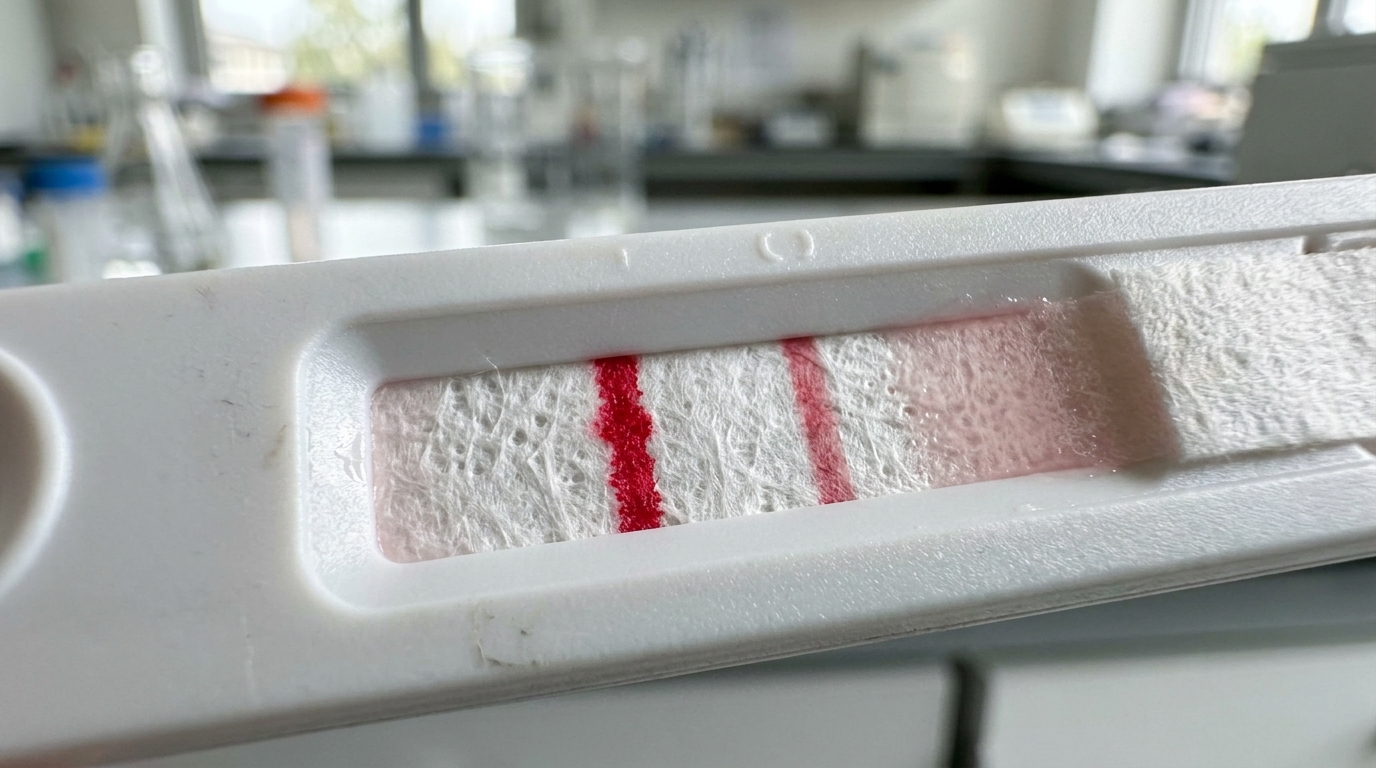
Widespread rapid diagnostic devices, such as at-home COVID tests and home pregnancy tests, rely on sandwich assay technology. When a liquid sample is dripped onto an at-home COVID test strip, it combines with detector antibodies attached to tiny gold particles that bind to viral proteins present in the specimen. As the sample migrates along the strip to the test line, a second antibody anchored to the strip binds to an entirely different site on the viral protein, creating a molecular sandwich. As the gold particles accumulate at the test line, the line turns dark red, making the result visible to the naked eye. Pregnancy tests operate on the same mechanism to detect the hormone human chorionic gonadotropin, or hCG. Because viral proteins and hCG are large molecules, they provide ample surface area for two distinct antibodies to bind simultaneously.
Smaller molecules, such as the hormone testosterone or the neurotransmitter serotonin, do not possess sufficient surface area to accommodate two different binding sites. As a consequence, detecting these smaller targets has historically required substantially more sophisticated analytical technology than the visual readout offered by sandwich assays. Prior to this study, most aptamer-based sensors relied on a single aptamer strand to perform the dual responsibilities of recognizing a target molecule and signaling its presence. Generating a measurable readout from a single aptamer can be especially complex, often requiring specialized laboratory equipment to detect tiny fluorescent or electrical changes that flag binding events.
To overcome this physical constraint, the EPFL researchers devised a two-layer strategy where two aptamers share the detection workload. Instead of requiring two separate binding sites on the small molecule, only one primary aptamer binds directly to the target. An engineered secondary aptamer is then deployed to recognize the three-dimensional shape that the primary aptamer adopts in its target-bound state, rather than binding to the target molecule itself. Because strands of DNA normally identify one another by nucleotide sequence rather than three-dimensional structure, the technique introduces a distinct mode of DNA recognition that adds a secondary layer of reporting on top of initial target capture.
According to Nakatsuka, aptamer-based technologies have gained momentum in recent years, with a growing number of commercial startups relying on them for human health applications. Rather than simply refining existing sensors, the CHEMINA team sought to rethink the molecular recognition architecture itself to address a long-standing gap in small-molecule sensing. Nakatsuka noted that developing a sandwich test for small molecules is only one application of the approach. More broadly, the two-layer aptamer design allows researchers to combine separate recognition steps rather than asking a single aptamer to perform every task alone.
To test the architecture experimentally, the researchers evaluated existing primary aptamers designed to capture four small molecules: serotonin, dopamine, testosterone, and the steroid deoxycorticosterone 21-glucoside, or DOG. The team first allowed the four primary aptamers to bind to their respective targets. They then screened billions of DNA sequences to identify candidates that would bind selectively to the shape of the target-bound primary aptamers rather than the targets themselves. From this extensive screening, the researchers successfully identified functional secondary aptamers for serotonin, testosterone, and DOG. Follow-up tests confirmed that these secondary sequences recognized and bound specifically to primary aptamers that had already captured their targets. As an experimental proof of concept, the team created a lateral flow test that successfully detected serotonin, generating a readout clearly visible to the naked eye.
The study also outlined specific limitations and directions for ongoing research. The researchers were unable to identify a functional secondary aptamer for dopamine and are currently investigating why a corresponding sequence could not be found. In addition, the team is working to improve overall test sensitivity as well as the strength of the aptamers’ binding interactions. Looking beyond diagnostic sensing, the two-layer recognition platform could also be harnessed in molecular computing systems, where conformational binding events act like binary switches to perform simple logic functions. As Nakatsuka highlighted, by allowing aptamers to recognize a molecule’s conformational state rather than simply its chemical identity, the work expands what DNA-based systems can detect and creates a foundation for more complex layers of molecular recognition.
Subject of Research: Conformational aptamer sensing architecture for small-molecule detection
Article Title: A new sensing architecture to detect small molecules
Article References: A new sensing architecture to detect small molecules. Original publication (Bibliographic details unavailable.)
Image Credits: AI Generated
DOI: Not provided
Keywords: aptamers, molecular sensing, small molecules, serotonin, nanotechnology, lateral flow tests, EPFL, chemical biology, sensing, architecture, detect, small
News Source: Bethany Barker. (November 8, 2026). Two-Layer Aptamer Architecture Enables Visual Detection of Small Molecules. Scienmag.