A joint research team from Toyohashi University of Technology, the Institute for Molecular Science, and the Institute of Science Tokyo has developed a spectroscopic method that uses soft X-rays to investigate the precise behavior of water molecules directly adjacent to material surfaces. Led by Yu Kinjo and Professor Ryugo Tero of Toyohashi University of Technology, the experimental study combined thickness-modulated X-ray absorption spectroscopy with numerical data analysis to isolate the elusive spectral signals of interfacial water from the dominant signal of bulk water. Detailed in a peer-reviewed paper published online in Applied Physics Express, the investigation demonstrated that water molecules assume fundamentally different hydrogen-bonding arrangements depending on whether they contact rigid inorganic solids or fluid biomembrane analogs.
Interfacial water, defined as the thin layer of water molecules found immediately adjacent to solid or membrane boundaries, plays an essential role across a multitude of chemical and physical processes. In nature and technological systems alike, water is vital for daily life and biological functions, yet water molecules residing at material boundaries do not behave like ordinary bulk liquid. These boundary-specific characteristics govern critical interfacial phenomena, including the selective adsorption of dissolved molecules onto substrates, heterogeneous chemical reaction kinetics, and the functional dynamics of biological macromolecules.
Despite the recognized importance of interfacial water across materials science and cellular biology, experimentally probing these boundary-layer molecules at the molecular level has long posed an intractable technical challenge. X-ray absorption spectroscopy represents a powerful diagnostic tool for exploring molecular systems because it probes the electronic states of water molecules and their immediate hydrogen-bonding environments by recording how much radiation is absorbed across a continuum of incident photon energies. However, in conventional transmission or absorption measurements, interfacial water accounts for only an extraordinarily minute fraction of the overall liquid volume present in a typical sample volume. Consequently, the weak spectroscopic signature arising from boundary molecules is overwhelmingly masked by the absorption profile of the surrounding bulk water.
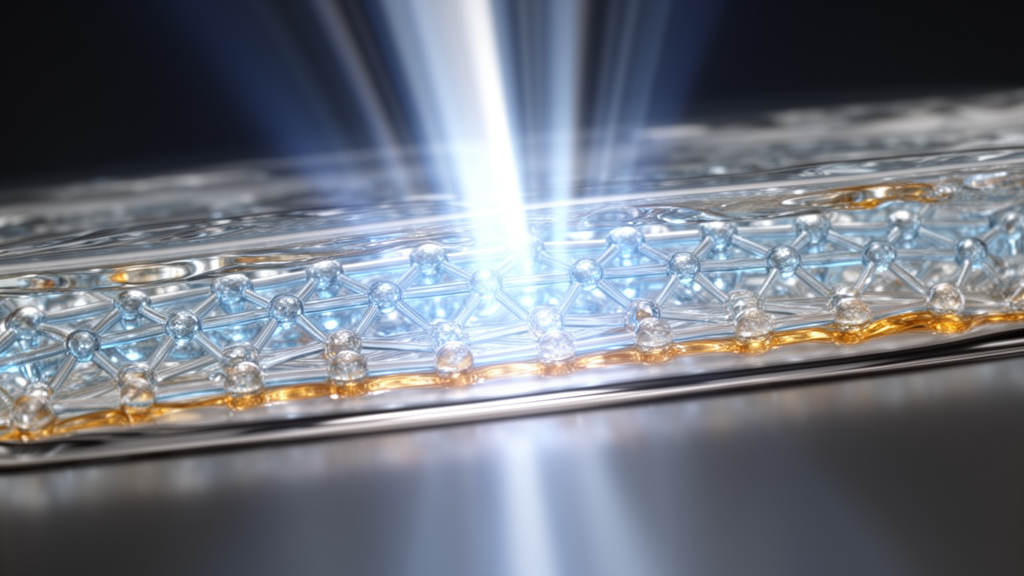
To overcome the longstanding obstacle of bulk-signal dominance, the research team designed an experimental strategy centered on systematically varying the thickness of the liquid sample layer. Using a custom-engineered liquid sample cell, the researchers incrementally altered the path length through which soft X-rays traversed the aqueous medium. The core physical insight underlying this measurement protocol is the geometric disparity between liquid regimes: as the thickness of the sample cell’s liquid layer increases, the quantity of ordinary bulk water scales upward in direct proportion, whereas the quantity of interfacial water bound along the material interface remains virtually constant throughout the adjustment.
Taking advantage of this scaling differential, the researchers recorded an extensive sequence of X-ray absorption spectra across various controlled water-layer thicknesses. Conducting these high-precision measurements required specialized instrumentation capable of delivering tunable soft X-ray radiation, which the team accessed at beamline BL3U of the UVSOR-III synchrotron radiation facility operated by the Institute for Molecular Science. The resulting series of raw transmission spectra captured subtle variations in absorption features that reflected the changing volumetric proportions of bulk liquid relative to the fixed, immobilized boundary population.
Extracting the unmixed interfacial spectrum from the experimental thickness series required advanced computational processing. The research team applied multivariate curve resolution–alternating least squares, a mathematical chemometric method known as MCR-ALS, to the collection of thickness-dependent X-ray absorption datasets. Through this alternating optimization procedure, the numerical algorithm successfully deconstructed the composite spectral data into its pure individual components, clearly deconvoluting the spectrum associated with bulk water from the isolated spectrum belonging strictly to the interfacial water layer.
To evaluate how substrate characteristics influence boundary hydration, the researchers implemented their thickness-modulation method across two contrasting surface systems: the surface oxide layer of inorganic silicon nitride and artificial lipid bilayers deployed as synthetic models of biological membranes.
The deconvoluted spectra revealed pronounced differences in the molecular organization of water molecules interacting with each substrate. Interfacial water situated near the inorganic silicon nitride oxide layer exhibited sharp, distinct spectral features directly correlated with localized interactions with the solid surface and structured hydrogen bonding among the water molecules themselves. These spectral characteristics indicate that water molecules adjacent to the rigid inorganic lattice adopt relatively constrained and ordered structural arrangements, enforced by rigid surface-binding geometries.
In marked contrast, measurements performed in the presence of synthetic lipid bilayers yielded a noticeably smoother interfacial spectral profile while showing an increased relative contribution of interfacial water to the overall spectral signal. These observations demonstrate that water molecules adjacent to flexible, dynamic lipid assemblies experience a much broader diversity of local hydrogen-bonding environments. The fluidity and structural softness inherent to biological membrane mimics prevent the rigid geometric pinning observed on the inorganic oxide, permitting interfacial water to populate a more varied conformational landscape.
By confirming that thickness-modulated soft X-ray absorption spectroscopy paired with MCR-ALS deconvolution can reliably isolate interfacial signals, the authors established a robust analytical framework for interfacial science. Looking forward, the researchers plan to investigate how interfacial water structures adapt across a broader matrix of surface chemistries while integrating molecular dynamics simulations and theoretical electronic calculations to map spectral signatures directly to specific atomic configurations, aiding the future design of functional aqueous materials.
Subject of Research: Soft X-ray absorption spectroscopy of interfacial water at material surfaces
Article Title: Probing water at material surfaces using X-rays
Article References: Probing water at material surfaces using X-rays. Original publication (Bibliographic details unavailable.)
Image Credits: AI Generated
DOI: Not provided
Keywords: interfacial water, bulk water, X-ray absorption spectroscopy, soft X-rays, multivariate curve resolution, MCR-ALS, silicon nitride, lipid bilayers, biological membranes, hydrogen bonding, surface chemistry, Toyohashi University of Technology, Institute for Molecular Science, Institute of Science Tokyo, UVSOR-III synchrotron, Applied Physics Express, spectroscopic analysis
News Source: Bethany Barker. (November 13, 2026). Thickness-Modulated X-Rays Reveal Distinct Interfacial Water Structures at Material Surfaces. Scienmag.