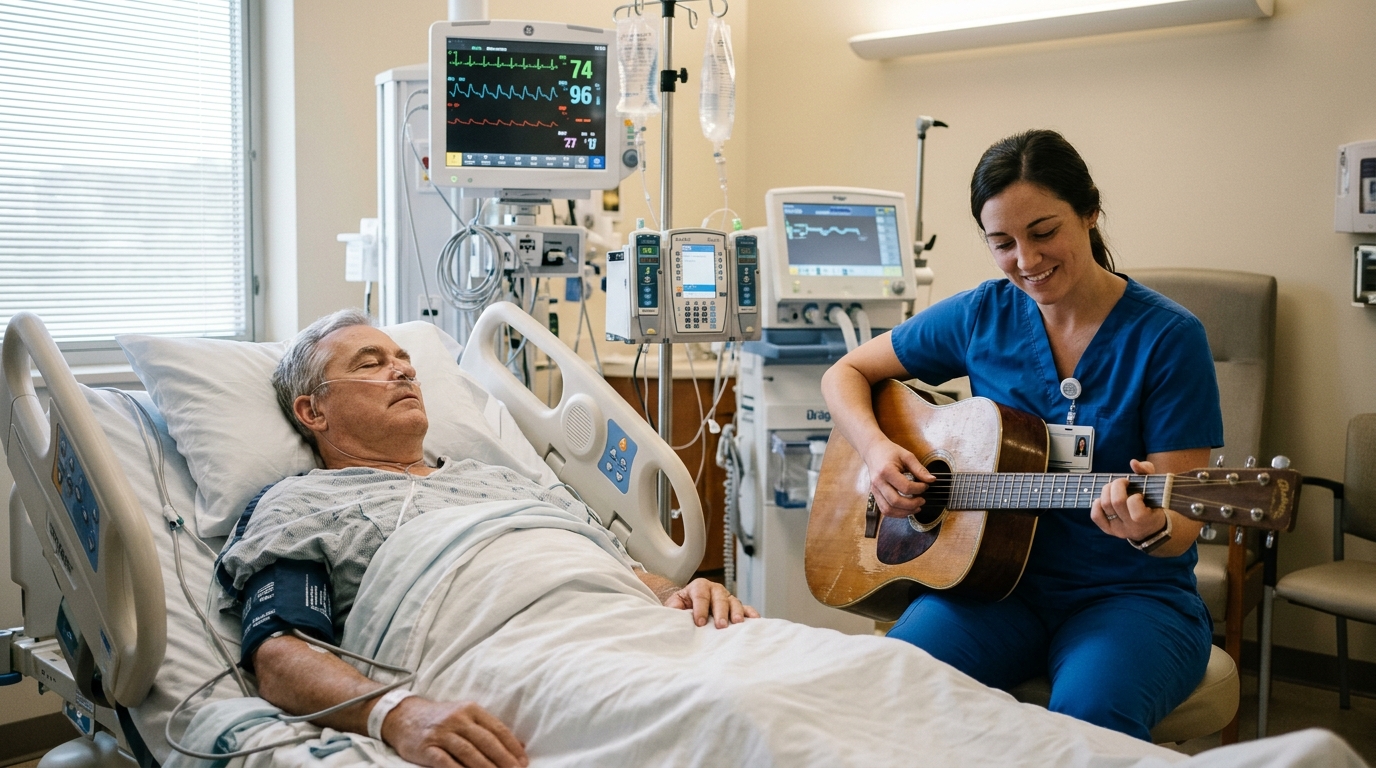
A qualitative study conducted in an adult intensive care unit in Spain has examined how healthcare professionals experience and interpret music therapy delivered to critically ill patients during routine care. The study aimed to understand how nurses, physicians, and nursing assistants perceived the integration of live music therapy into the clinical environment, specifically focusing on patient engagement, support during procedures, and the overall atmosphere of care. The findings suggest that healthcare professionals view music therapy as a complementary approach that contributes to a more humanized and relational ICU environment, although the study did not measure clinical outcomes or professional well-being directly.
The study was conducted in the adult ICU of a second-level hospital in the Community of Madrid, Spain. The unit comprises 18 beds and provides complex monitoring and treatment for critically ill adult patients. The research was part of a broader doctoral program examining patient-directed music therapy from multiple perspectives, including patients, family members, and healthcare professionals. This specific study focused exclusively on the accounts of healthcare professionals who had been present during a patient-directed music therapy session. The intervention involved live, individualized music therapy sessions delivered by a qualified music therapist using voice and/or guitar. Each session was adapted to the patient’s clinical condition, responsiveness, and musical preferences, with family members providing input on musical choices when patients were unable to communicate their preferences.
Fourteen healthcare professionals participated in the study, recruited through purposive sampling. Participants were eligible if they had directly observed the music therapy session or had provided patient care while it was taking place. Each participant completed one individual semi-structured interview conducted 24 to 48 hours after the session they had attended. The interview guide was specifically developed to explore professionals’ observations and interpretations of the patient experience, care interactions, the ICU environment, and their own situated experience while observing or providing care. Recruitment continued until sufficient depth and repetition in the data indicated that no substantially new insights were emerging.
Data were analyzed using Braun and Clarke’s reflexive thematic analysis, an approach primarily inductive in nature. Codes were developed from the healthcare professional interviews rather than from a predetermined coding framework. The analysis was informed by a hermeneutic phenomenological orientation, which supported the interpretation of meanings within the relational, professional, and clinical context of ICU care. The principal researcher, a nurse with critical care experience and qualitative research training, led the analysis. Reflexive memo writing was used throughout the process to examine developing interpretations and the potential influence of the researcher’s prior assumptions. The analysis resulted in four main themes: comfort and patient engagement, support during invasive procedures, humanization and relationships, and perceived contextual influences on healthcare professionals’ experience.
Participants described music therapy as creating moments in which patients appeared more relaxed, animated, or emotionally engaged with their surroundings. These interpretations were based on direct observations during the sessions rather than formal assessments of patient anxiety, mood, or clinical outcomes. Professionals associated patients’ responses to the music with a temporary shift away from the monotony and restrictions of the ICU toward a more personally meaningful experience. One nurse noted that the ICU is a very boring place and that music leads to a good attitude and cheerfulness. Another professional described seeing a patient as very animated and noted that relatives were collaborating as if it was the most important thing at that moment, creating a sense of disconnection from the illness situation.
The study also found that healthcare professionals perceived music therapy as providing support during selected clinical procedures and potentially distressing care activities. Participants described patients directing their attention towards the music, which they interpreted as helping to make the experience less intrusive and more manageable. Some professionals perceived patients as more relaxed or cooperative while care was being provided. For instance, one nurse described a situation where a patient was undergoing extubation and appeared to be listening to the music rather than focusing on the procedure, describing the patient’s reaction as if they hadn’t lived through that part. However, the study did not objectively assess pain, anxiety, physiological responses, procedural success, or patient cooperation, meaning these findings represent perceived support rather than demonstrated symptom reduction.
Participants interpreted music therapy as introducing a more personal and relational dimension into an environment otherwise characterized by technology, clinical routines, noise, and restricted social interaction. Music was described as shifting attention towards the patient as a person and creating opportunities for shared experiences among patients, family members, and healthcare professionals. Professionals associated the sessions with a less impersonal atmosphere and moments of connection involving the patient and, when present, family members. These experiences were interpreted as consistent with a more humanized approach to ICU care, emphasizing dignity, relational care, and attention to the subjective experience of critical illness. The presence of music was linked to reduced isolation and loneliness, according to one nursing assistant, who noted that the isolation and loneliness patients experience are reduced a little with music therapy.
Although the music therapy sessions were directed towards patients, some participants described contextual influences on their own experience while observing or providing care. They reported that the presence of music could make a demanding moment feel calmer, more pleasant, or more manageable. These accounts concerned the immediate experience of care and were not interpreted as evidence of changes in occupational stress, burnout, health, productivity, or professional performance. One professional stated that on days with a heavy workload, the music makes that little while more pleasant and bearable, distracting them from the bustle of things they have to do. Another described feeling relaxed and at ease, noting that the music makes everything livelier. The study explicitly noted that these situated perceptions should not be understood as measured effects on professionals’ psychological or occupational outcomes.
The study acknowledges several limitations that affect the interpretation of the findings. It was conducted in a single ICU with a small purposively selected sample, which may limit the transferability of the findings to other settings. Each participant reflected on only one session, and the clinical circumstances, care activities, and level of involvement varied across participants. Additionally, some questions in the semi-structured interview guide referred explicitly to relaxation, comfort, or changes in the ICU atmosphere, potentially presupposing positive effects of music. These formulations may have encouraged participants to focus on positive experiences or shaped how they described their own comfort and relaxation. Furthermore, accounts of patient and family responses were provided by healthcare professionals rather than directly by patients or family members within this specific study.
The researchers emphasize that the findings represent healthcare professionals’ situated experiences and interpretations rather than evidence of clinical or occupational effectiveness. Patient and family responses were reported indirectly through professionals’ accounts, and the study did not assess patient anxiety, pain, physiological outcomes, professional stress, burnout, or well-being. The findings suggest that music therapy is perceived as potentially compatible with person-centered and humanized ICU care. Its perceived value was related not only to the music itself but also to its adaptation to the patient, the clinical situation, and the interactions occurring during the session. Integration into practice would require attention to patient preferences, clinical appropriateness, communication with the multidisciplinary team, and the role of the qualified music therapist.
The study recommends that future research examine the long-term and repeated use of music therapy in ICUs and include multicenter studies to enhance transferability. Mixed-methods and longitudinal designs are recommended to assess both experiential and clinical outcomes, as well as tailored interventions based on patient and contextual characteristics. The findings may inform consideration of how patient-directed music therapy could be carefully integrated and further evaluated when clinically appropriate. Any consideration of music therapy in the ICU should remain responsive to the patient’s clinical condition, preferences, willingness, and capacity to participate. Interprofessional planning is required to ensure that sessions are coordinated with ongoing care and do not compromise clinical monitoring, necessary procedures, communication among staff, or patient safety.
Healthcare professionals perceived patient-directed music therapy as a potentially valuable complementary component of ICU care. Within participants’ accounts, its presence was associated with patient comfort and engagement, support during selected procedures, and a more humanized ICU environment. Some participants also described perceived positive contextual influences on their immediate experience while observing or providing care. These findings highlight the importance of considering the subjective experience of care in intensive care settings. The study contributes to the growing body of literature on music therapy in critical care by focusing specifically on the perspectives of the multidisciplinary team. Further evaluation is required before wider implementation in ICU practice, ensuring that any integration is safe, effective, and aligned with patient-centered care principles.
Subject of Research: Qualitative analysis of healthcare professionals' experiences with music therapy in an intensive care unit
Article Title: The Integration of Music Therapy in the Intensive Care Unit: Health Care Professionals' Experience of an Emerging Paradigm
Article References: Saldaña‐Ortiz, V., Caballero‐Galilea, M., Intriago‐García Consuegra, V., Mansilla‐Domínguez, J. M., García‐Fernández, B., & Martínez‐Miguel, E. (2026). The Integration of Music Therapy in the Intensive Care Unit: Health Care Professionals' Experience of an Emerging Paradigm. Nursing Open, 13(11), Article e70994. https://doi.org/10.1002/nop2.70994
Image Credits: AI Generated
DOI: 10.1002/nop2.70994
Keywords: music therapy, intensive care unit, qualitative research, healthcare professionals, patient experience, humanized care, critical care, nursing, clinical environment, Spain, Integration, Music
News Source: Ophelia Keating. (November 8, 2026). ICU Staff View Music Therapy as Humanizing Care. Scienmag.