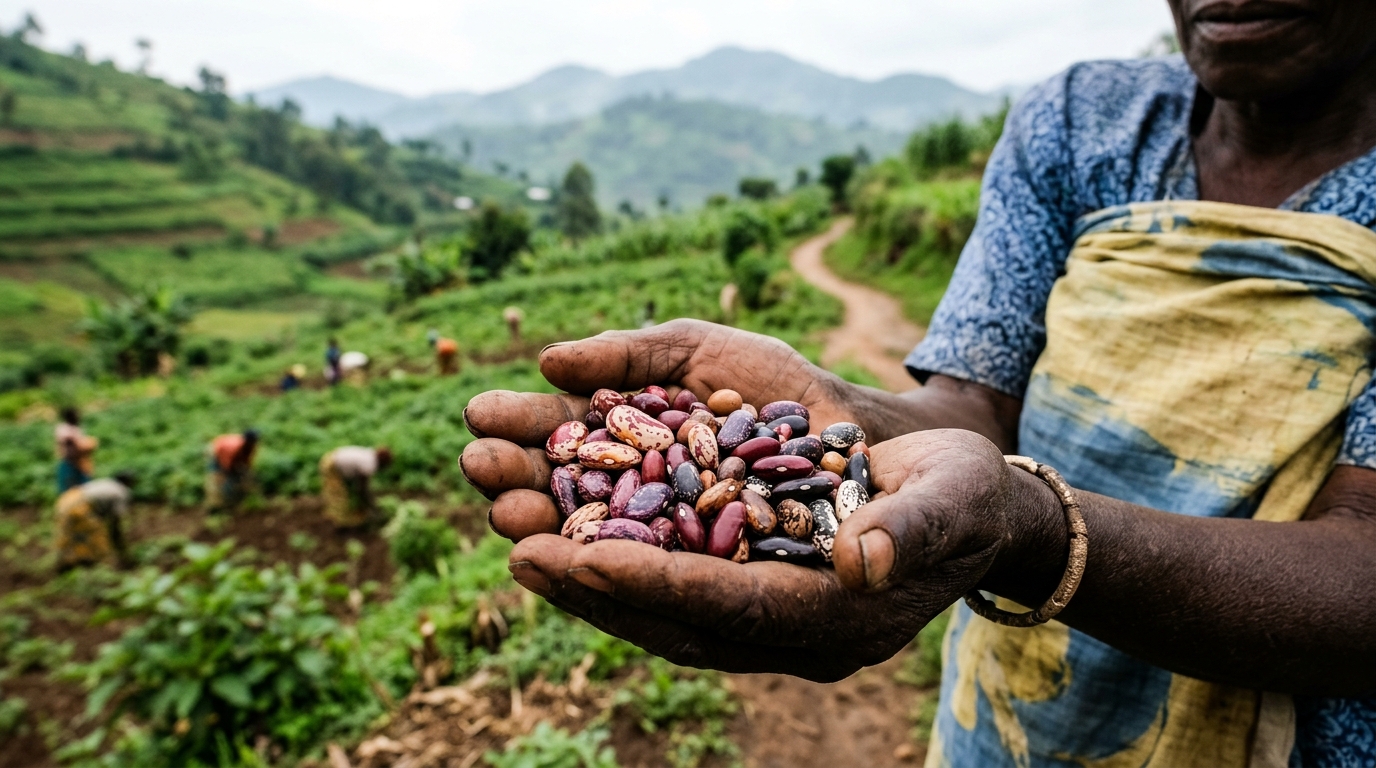
Iron and zinc deficiencies remain among the most stubborn nutritional problems in regions where common bean is a daily staple, and a new genome-wide study of bean germplasm from Burundi now offers a detailed picture of the genetic machinery behind seed micronutrient accumulation. The research, published in BMC Genomics, set out to identify genomic regions and marker–trait associations linked to seed iron and zinc concentrations in a genetically diverse collection of local common bean lines, using genome-wide association analysis as its central tool.
The team found significant phenotypic variation for both micronutrients, with iron showing greater dispersion than zinc. Broad-sense heritability ranged from 0.73 to 0.81 for iron and from 0.70 to 0.81 for zinc, indicating that a large share of the observed variation is genetically rather than environmentally determined. Genotypic effects accounted for 85.24 percent of total variation in iron concentration and 84.61 percent in zinc concentration, reinforcing the case that breeding programmes can realistically target these traits.
Iron and zinc also turned out to be moderately correlated, with a phenotypic correlation of 0.58 and a genetic correlation of 0.55. The authors interpret this as evidence that simultaneous improvement of both micronutrients may be feasible, although the association analysis itself told a more complicated story for the two traits.
Population structure was pronounced. Principal component analysis revealed clear differentiation between the Andean gene pool, represented by 62 accessions, and the Mesoamerican gene pool, represented by 101 accessions, with the first principal component explaining 44.12 percent of molecular variation. Linkage disequilibrium in the panel remained extended, with a predicted r² of 0.2717 at a distance of 250 kilobases, a feature that shapes how finely association signals can be localised.
When the researchers scanned the genome for markers associated with seed iron concentration, no single-nucleotide polymorphisms reached the strict Bonferroni threshold for either trait. However, for iron, 20 SNPs were significant under the more permissive Benjamini–Hochberg false discovery rate, and 16 iron-associated SNPs were retained for detailed interpretation and candidate-gene analysis. These loci were distributed across chromosomes Pv01, Pv04, Pv06 and Pv07, and each individually explained between 12.61 and 16.28 percent of the phenotypic variance — effect sizes large enough to make them attractive candidates for marker-assisted selection.
In contrast, no significant or even suggestive marker–trait associations were detected for zinc. The authors attribute this to the complex genetic control of zinc accumulation and suggest that genomic selection and multi-locus approaches may be more productive routes for improving zinc levels than single-marker association mapping.
Using linkage disequilibrium-informed candidate-gene analysis, the team identified 145 unique putative candidate genes within 100-kilobase regions surrounding the 16 iron-associated SNPs. These genes spanned a wide range of functional categories, including metal and mineral homeostasis, signalling, transcriptional regulation, redox processes, protein processing, RNA-related processes, and photosynthesis or chloroplast functions — a catalogue that points to the biological breadth of the machinery governing iron accumulation in bean seeds.
The study concludes that the Burundi germplasm harbours substantial genetic variation and complex genetic control of seed iron and zinc accumulation. The identified iron-associated SNPs and candidate genes are presented as useful genomic resources for iron biofortification efforts, while the absence of detectable zinc associations highlights the potential value of genomic selection and multi-locus methods for zinc improvement.
The authors are careful to note that independent validation and functional characterisation will be necessary to confirm the stability and biological relevance of the identified iron-associated regions. Until those steps are completed, the loci remain candidate markers rather than proven breeding tools, but they represent a concrete starting point for developing nutritionally improved common bean cultivars in a region where the crop matters most to daily diets.
Subject of Research: Genetic architecture of seed iron and zinc concentration and candidate marker identification for biofortification in common bean populations from Burundi.
Article Title: Genetic architecture of iron and zinc concentration and identification of candidate markers for biofortification in common bean (Phaseolus vulgaris L.) populations
Article References: Nduwarugira, E., Nchimbi-Msolla, S., Kusolwa, P. M., Assefa, T., Mukankusi, C. T. M., & Rubyogo, J. C. (2026). Genetic architecture of iron and zinc concentration and identification of candidate markers for biofortification in common bean (Phaseolus vulgaris L.) populations. BMC Genomics. https://doi.org/10.1186/s12864-026-13513-0
Image Credits: AI Generated
DOI: 10.1186/s12864-026-13513-0
Keywords: common bean, Phaseolus vulgaris, iron biofortification, zinc concentration, genome-wide association study, candidate genes, Burundi germplasm, marker-trait associations, broad-sense heritability, linkage disequilibrium, Andean gene pool, Mesoamerican gene pool
News Source: Juliet Wilcox. (November 8, 2026). Genome-wide study maps iron genes in Burundi’s common beans. Scienmag.