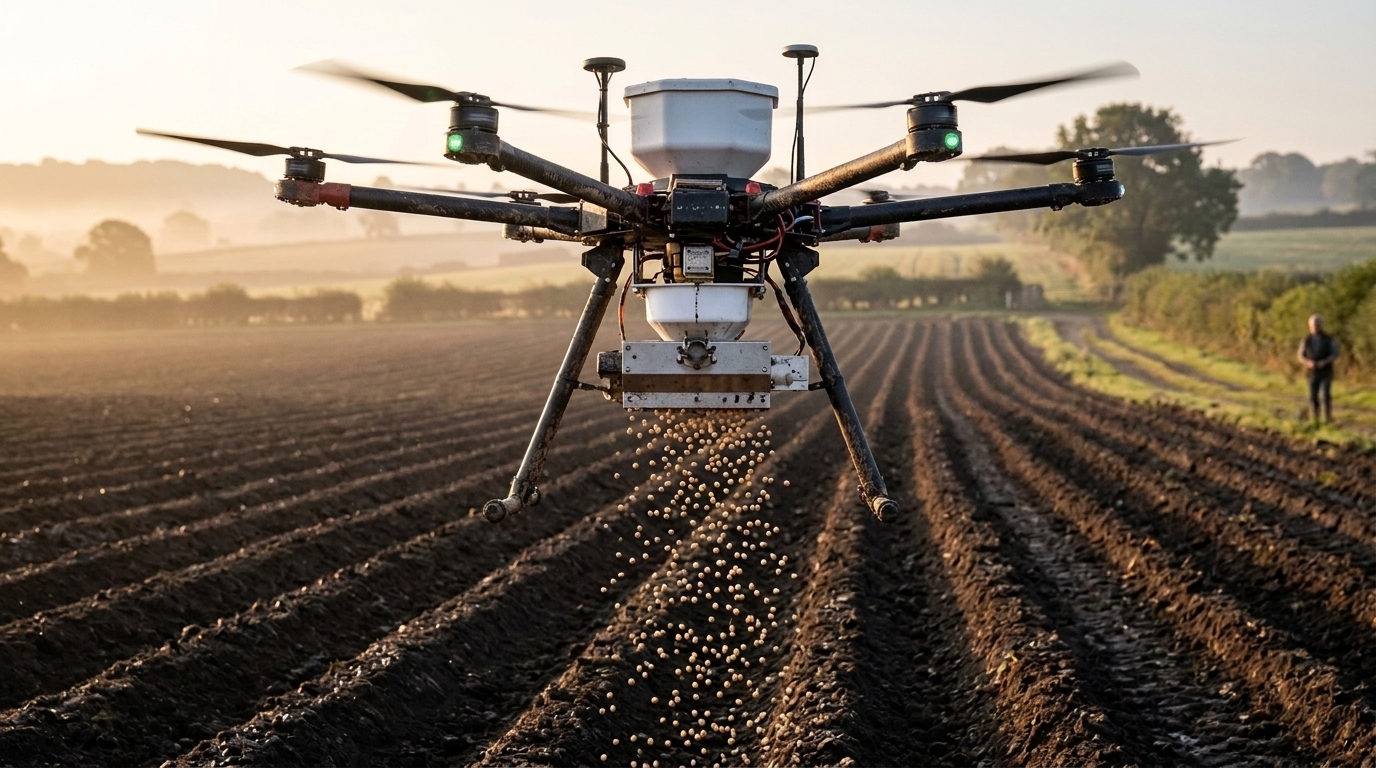
Researchers from the Central Institute of Agricultural Engineering in Bhopal, India, have developed and calibrated a multi-rotor drone system designed for the precision direct seeding of soybean. The study addresses the engineering challenges of aerial seeding by evaluating a three-unit seed-metering mechanism that releases individual seeds into defined rows. Unlike conventional broadcasting methods that scatter seed indiscriminately, this system aims to maintain specific intra-row and inter-row spacings, a critical requirement for optimizing soybean crop establishment in fields where ground-based machinery is restricted by wet conditions or difficult terrain.
The core of the system is a hexacopter platform with a maximum take-off mass of 30 kg, adapted from a rice-seeding drone. The platform carries three independent seed-metering units, each equipped with a hopper and an encoder-controlled motor. To accommodate the larger and more rounded shape of soybean seeds compared to rice, the researchers designed a new metering rotor. This rotor is a single-piece, horizontally oriented fluted cell wheel made from a wear-resistant engineering polymer, featuring nineteen equally spaced seed cells. The geometry was specifically selected to hold approximately 1.5 to 2 seeds per cell, allowing for a higher seed population to compensate for typical germination rates of around 70%.
Calibration of the seed-metering rotor revealed a strong linear relationship between the rotor-speed setting and the seed discharge rate. Under controlled laboratory conditions, the application rate increased by approximately 1.21 kg per hectare for every one-percentage-point increase in the rotor-speed setting. The regression model demonstrated a high coefficient of determination, indicating that 99.7% of the variation in application rate was explained by the rotor speed. To achieve the target seed rate of 60 kg per hectare at a forward speed of 1.0 m/s, the system required a rotor-speed setting of approximately 40.1%. This calibration ensures that the drone can deliver the intended seed mass per unit area, although the study notes that higher forward speeds would require settings near the upper limit of the tested range.
Seed placement uniformity was evaluated using a motor-driven adhesive belt rig that simulated the relative movement between the drone and the ground. The belt moved at a constant speed of 1.0 m/s beneath the stationary metering unit, allowing researchers to measure seed-to-seed distances and lateral displacement without the interference of rotor downwash. The experiment employed a factorial design, testing three rotor-speed settings (35%, 40%, and 45%) across four dispensing heights (5, 10, 15, and 20 cm). This setup allowed for the separation of metering accuracy from field-level uncertainties, providing a controlled environment to assess how different operating parameters affect seed distribution.
The analysis of along-row seed spacing indicated that the quality of feed index, which represents the proportion of acceptable seed spacings, varied among the tested treatments. The highest quality of feed index was recorded at a 45% rotor-speed setting and a 15 cm drop height, reaching 78.79%. Conversely, the lowest value was observed at 35% rotor speed and 20 cm height, at 58.62%. However, statistical analysis using two-way analysis of variance showed that neither rotor speed nor drop height had a statistically significant effect on the overall distribution of seed-to-seed spacing. This suggests that while specific combinations yielded better descriptive indices, the differences were within the range of sampling variation for the single runs conducted in the laboratory.
In contrast, the lateral placement of seeds relative to the intended row centerline was significantly influenced by the dispensing height. As the distance between the metering outlet and the receiving surface increased, the mean absolute lateral displacement of the seeds increased substantially. At a 5 cm drop height, the mean absolute displacement ranged from 0.57 to 0.69 cm, whereas at 20 cm, it increased to 1.95 to 2.61 cm. The proportion of seeds landing within a ±2 cm accuracy band around the row centerline decreased from 93.8% at 5 cm to 57.8% at 20 cm. Statistical testing confirmed that drop height had a highly significant effect on absolute lateral displacement, while rotor speed did not. This finding highlights that the free-fall phase of seed delivery is a critical factor in determining cross-row accuracy.
The direction of lateral displacement was found to depend on the interaction between rotor speed and drop height. While the magnitude of displacement was primarily controlled by height, the signed displacement analysis revealed that the direction of the shift varied according to the specific combination of operating parameters. For instance, at higher drop heights, some treatments showed a concentration of seeds on the left side of the centerline, while others showed a shift to the right. This directional variability suggests that factors such as seed release dynamics and residual rotational motion may contribute to the final seed position, although these mechanisms were not independently measured in the study.
The study emphasizes the distinction between metering accuracy and placement accuracy in UAV-based seeding systems. While the rotor speed effectively regulated the bulk seed discharge rate, the final location of individual seeds was influenced by aerodynamic and gravitational forces during the free-fall phase. The researchers noted that a satisfactory discharge rate at the metering outlet does not guarantee satisfactory seed placement on the ground. This distinction is particularly relevant for precision agriculture, where uniform plant distribution is associated with better crop performance and yield, especially in reduced plant population scenarios.
Limitations of the study include the use of a laboratory belt test rather than actual flight trials. The propellers were not running during the bench tests, meaning the results do not account for the aerodynamic disturbances caused by rotor downwash, which can significantly alter seed trajectory in real-world conditions. Additionally, each treatment was tested in a single continuous run, which limits the statistical power to detect subtle differences and does not account for run-to-run variation. The researchers acknowledge that field trials are necessary to evaluate the system under actual flight conditions, including the effects of wind, vibration, and crop canopy.
Despite these limitations, the study provides a valuable engineering basis for the development of UAV-based precision soybean seeders. The findings suggest that a release height of 5 cm is preferred for minimizing lateral displacement, although a 15 cm height produced the highest pooled quality of feed index. The researchers propose that future improvements should focus on refining the seed-metering cells to achieve true singulation, where each cell releases exactly one seed.
The work contributes to the development of UAV-based precision soybean seeders by demonstrating that a UAV-mounted metering mechanism can be calibrated for controlled seed discharge and placement. As agricultural landscapes become more fragmented and challenging for conventional machinery, aerial seeding offers a viable alternative for timely crop establishment. The detailed calibration and evaluation of the seed-metering mechanism in this study provide a roadmap for future research and development in this area. By addressing the specific engineering challenges of soybean seeding, the researchers have laid the groundwork for field validation of the proposed 3-row metering arrangement.
Subject of Research: UAV-based precision seeding of soybean: calibration and evaluation of a multi-rotor seed-metering system
Article Title: UAV-based precision seeding of soybean: calibration and evaluation of a multi-rotor seed-metering system
Article References: Chaudhary, V. P., Sahni, R. K., Ganesh, V. S., Rout, T. S., Pathak, A. N., Porwal, Y., Shivani, & Soni, P. (2026). UAV-based precision seeding of soybean: calibration and evaluation of a multi-rotor seed-metering system. Results in Engineering, 32, Article 113959. https://doi.org/10.1016/j.rineng.2026.113959
Image Credits: AI Generated
DOI: 10.1016/j.rineng.2026.113959
Keywords: UAV-based, precision, seeding, soybean, calibration, evaluation, multi-rotor, seed-metering, system, scientific research
News Source: Denise Maddox. (November 8, 2026). UAV Soybean Seeder Calibrated for Precision Aerial Planting. Scienmag.