In comprehensive wind tunnel experiments and numerical simulations examining an AGARD-B ogive-cylinder body-delta wing configuration, researchers have determined that the critical angle of attack triggering vortex bursting increases from 12 degrees to 13 degrees as the freestream Mach number rises from 0.3 to 0.9, before disappearing entirely up to an angle of attack of 15 degrees at Mach 0.95. This behavior reveals a distinct aerodynamic threshold within the transonic flight regime, demonstrating that vortex breakdown is suppressed at moderate angles of attack under specific transonic conditions. Investigating these aerodynamic interactions across subsonic and transonic speeds provides essential clarity regarding how Mach number, Reynolds number, and body-induced flow fields govern vortex stability. Conducted by Arash Alipoor, Mohammad Mehdi Alishahi, and Mohammad Hossein Montazeri, the investigation combines physical measurements from the ASSEF Transonic Wind Tunnel with computational fluid dynamics to resolve long-standing uncertainties surrounding the onset and physical movement of leading-edge vortex bursting over integrated wing-body configurations.
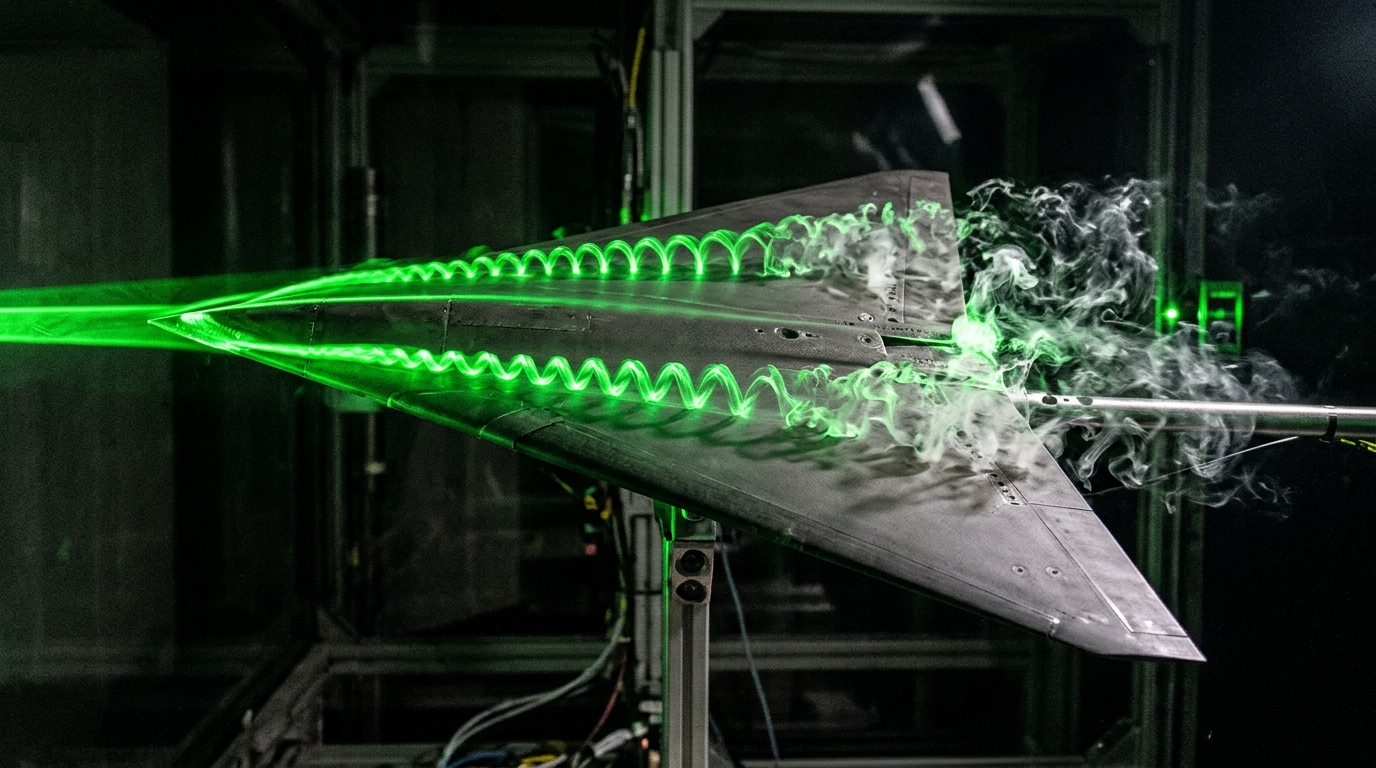
The flow physics governing slender delta wings centers on the formation of powerful leading-edge vortices that fundamentally alter surface pressure distributions. When an airflow encounters a highly swept leading edge at an angle of attack, the lower-surface stream diverges outward and separates over the sharp edge, establishing a coiled primary vortex on the suction surface. As the air sweeps beneath this core toward the outer edge, it passes the minimum pressure peak and meets a steep adverse pressure gradient, which forces a secondary separation that forms a secondary vortex, and occasionally a tertiary vortex beneath it. These vortical structures generate significant suction that enhances overall aerodynamic lift and postpones stall, making delta wings standard across high-speed aircraft designs. However, when these longitudinal vortices travel into areas of intensifying adverse pressure gradients, they can undergo vortex bursting, suddenly converting from jet-like coherent cores into reversed-flow bubbles. This breakdown abruptly diminishes surface suction, leading to substantial lift loss and inducing severe, destabilizing pitch-up moments.
Understanding vortex breakdown becomes substantially more intricate when a delta wing is integrated with a central fuselage, introducing complex mutual interference. In a wing-body configuration, the upwash flow generated by the body interacts directly with the leading-edge vortices, significantly reducing the angle of attack at which vortex bursting initiates compared to an isolated wing planform. Concurrently, compressibility introduces further complications throughout transonic flight regimes, where embedded supersonic regions and shock structures can emerge within the vortex core at Mach numbers as low as 0.4. These shock formations and pressure perturbations intensify local adverse pressure gradients, accelerating vortex degradation. Despite decades of study, theoretical formulations cannot yet predict vortex breakdown reliably, while computational fluid dynamics has historically faced decreased confidence during complex maneuvering states due to a scarcity of detailed experimental anchoring data. Examining an ogive-cylinder body-delta wing across subsonic and transonic envelopes directly addresses this deficiency, providing validated measurements of vortex interactions under realistic aerodynamic load conditions.
To capture experimental flow characteristics, the researchers evaluated the standard AGARD-B calibration model in the ASSEF Transonic Wind Tunnel, an open-circuit suction facility featuring a test section measuring 0.9 meters wide, 0.9 meters high, and 1.2 meters long. The physical model represents an axisymmetric body of revolution spanning 8.5 diameters in total length, with an ogive nose, a cylindrical aft body, and a 60-degree swept delta wing spanning four body diameters. The longitudinal aerodynamic center was positioned at 50 percent of the mean aerodynamic chord from the trailing edge, yielding a modest facility blockage ratio of 0.2 percent. Testing spanned Mach numbers between 0.3 and 0.95 across angles of attack ranging from -5 degrees to +15 degrees, with Reynolds numbers based on mean aerodynamic chord varying from 0.6 million to 1.4 million. Aerodynamic forces and moments were recorded with an internal six-component strain gauge balance, while surface static pressures were measured through 30 tap orifices across six spanwise stations using a 64-port, 50-psid electronically scanned pressure module.
To model flow dynamics without wind tunnel wall interference and isolate viscous effects, the team executed steady Reynolds-averaged Navier-Stokes simulations using ANSYS Fluent 2023 with a density-based solver and second-order upwind discretization. The computational domain enclosed the model, balance, and support sting within a rectangular volume extending 10 body lengths upstream and 20 body lengths downstream from the nose. A hybrid mesh comprising 3.86 million cells resolved boundary layer flows with a initial cell height of 0.0001 meters, a growth rate of 1.2, and average non-dimensional wall distance values remaining below 1.7. Turbulent flow closure was achieved using the two-equation k-omega SST model with a turbulent viscosity ratio of 5 and a freestream turbulence intensity of 5 percent. To dynamically capture the developing leading-edge vortices, the team implemented adaptive mesh refinement guided by the vorticity-based Q-criterion, establishing threshold limits of 300 and 1200 times the freestream velocity squared divided by reference length squared across two successive adaptation stages to properly resolve vortical structures above the suction surface.
Experimental results from the ASSEF tunnel were corroborated against historical datasets gathered at the Arnold Engineering Development Complex and the Council for Scientific and Industrial Research. While forebody drag coefficients demonstrated strong agreement across all three test facilities up to high incidences, noticeable differences emerged in the lift and moment curves. In the ASSEF tests, sudden lift drop-offs and abrupt nose-up pitching moment breaks occurred above an angle of attack of 12 degrees for Mach 0.3 and 0.5, and above 13 degrees for Mach 0.8 and 0.9. In contrast, corresponding breaks in the AEDC and CSIR facilities were delayed until roughly 15 degrees angle of attack, a discrepancy attributed to differing facility Reynolds numbers. Furthermore, as the Mach number increased to 0.95, these sudden coefficient breaks vanished entirely in the ASSEF measurements, allowing the forebody lift coefficient to climb steadily up to the maximum tested angle of 15 degrees while establishing neutral or slightly positive longitudinal stability due to an aft shift in the center of pressure.
Detailed numerical simulations at Mach 0.8 confirmed the aerodynamic trends observed during physical testing while exposing the underlying vortex structures. Computational lift predictions tracked wind tunnel measurements closely, showing a linear lift progression up to 14 degrees angle of attack, where vortex bursting initiated and reduced the lift-curve slope. Simulated surface oil flow patterns and velocity streamlines at Reynolds number 1.3 million illustrated distinct behavioral shifts between 12 degrees and 14 degrees angle of attack. At 12 degrees, vortex breakdown occurred downstream of the wing trailing edge, allowing the secondary separation line to maintain a straight path across the entire wing surface. When the angle of attack increased to 14 degrees, vortex breakdown migrated upstream over the wing surface, bending the secondary separation trajectory toward the leading edge. Surface pressure comparisons across spanwise stations corroborated this movement: stations B and C retained high suction peaks ahead of the burst, whereas station A exhibited a flattened pressure distribution corresponding to early breakdown.
To isolate genuine Reynolds number effects from wind tunnel wall interferences and balance measurement noise, the researchers conducted controlled numerical simulations at Mach 0.8 by raising the inlet stagnation pressure, doubling the Reynolds number from 1.3 million to 2.6 million. By analyzing iso-surfaces of zero axial velocity, representing reversed-flow bubbles where internal axial velocities turn negative, the study tracked the precise spatial progression of vortex bursting. The data revealed that below an angle of attack of approximately 14 degrees, the longitudinal vortex burst position remains virtually insensitive to changes in Reynolds number. Beyond this 14-degree threshold, however, increasing the Reynolds number noticeably defers the forward migration of the burst position toward the wing apex while shifting the vortex breakdown core slightly outward in the spanwise direction. This boundary establishes a critical angle of attack separating Reynolds-independent vortex behavior from a regime where viscous boundary layer interactions and turbulent development directly delay vortex breakdown progression.
The influence of Mach number on vortex dynamics revealed intricate structural shifts across the wing suction surface. As freestream Mach number increases, the vortex-induced pressure footprint widens and the maximum suction peak shifts inward toward the fuselage. Concurrently, surface suction induced by attached flow reattachment intensifies, maintaining overall lift performance up to Mach 0.95 and compensating for the localized pressure reduction of the primary core. At Mach 0.95, the forward transmission of trailing-edge pressure recovery diminishes, mitigating the adverse longitudinal pressure gradient over the rear wing and delaying vortex breakdown beyond the tested 15-degree incidence. Tracking the chordwise breakdown location across Mach numbers at 14 degrees angle of attack demonstrated pronounced nonlinearity linked to vortex bursting modes. For low subsonic velocities below Mach 0.4, stable spiral-mode bursting shifts downstream toward the trailing edge, whereas exceeding Mach 0.4 initiates bubble-mode breakdown, propelling the burst location forward toward the apex and inducing substantial spatial fluctuations through the transitional regime.
These integrated experimental measurements and numerical simulations establish valuable quantitative benchmarks regarding vortex breakdown across swept wing-body configurations. The findings confirm that steady Reynolds-averaged Navier-Stokes modeling equipped with adaptive mesh refinement provides an accurate, computationally viable methodology for resolving complex vortical structures and predicting burst locations. Across the subsonic spectrum between Mach 0.3 and 0.9, vortex breakdown consistently initiates lift degradation and unstable pitch-up breaks at moderate angles of attack, whereas reaching Mach 0.95 effectively eliminates these penalties by mitigating adverse longitudinal pressure gradients. Furthermore, identifying the 14-degree angle of attack boundary clarifies where Reynolds number effects actively govern breakdown migration, resolving prior ambiguities in wind tunnel data correlation. To advance aerodynamic optimization for future combat aircraft, the authors note that subsequent investigations should expand experimental and numerical analyses across diverse planform geometries and wing profiles, refining turbulence models to capture unsteady vortex core interactions throughout broader maneuvering envelopes.
Subject of Research: Vortex bursting thresholds and influencing factors on a delta wing-body configuration
Article Title: Thresholds and influencing factors on vortex bursting of an ogive-cylinder body-delta wing: an experimental and numerical approach
Article References: Alipoor, A., Alishahi, M. M., & Montazeri, M. H. (2026). Thresholds and influencing factors on vortex bursting of an ogive-cylinder body-delta wing: an experimental and numerical approach. Advances in Aerodynamics, 8(1), Article 1. https://doi.org/10.1186/s42774-025-00213-8
Image Credits: AI Generated
DOI: 10.1186/s42774-025-00213-8
Keywords: aerodynamics, vortex bursting, delta wing, transonic flow, wind tunnel testing, computational fluid dynamics, Mach number, Reynolds number, Thresholds, influencing, factors, vortex
News Source: Audrey Campbell. (November 8, 2026). Wind Tunnel Tests Reveal Key Thresholds Governing Delta Wing Vortex Bursting. Scienmag.