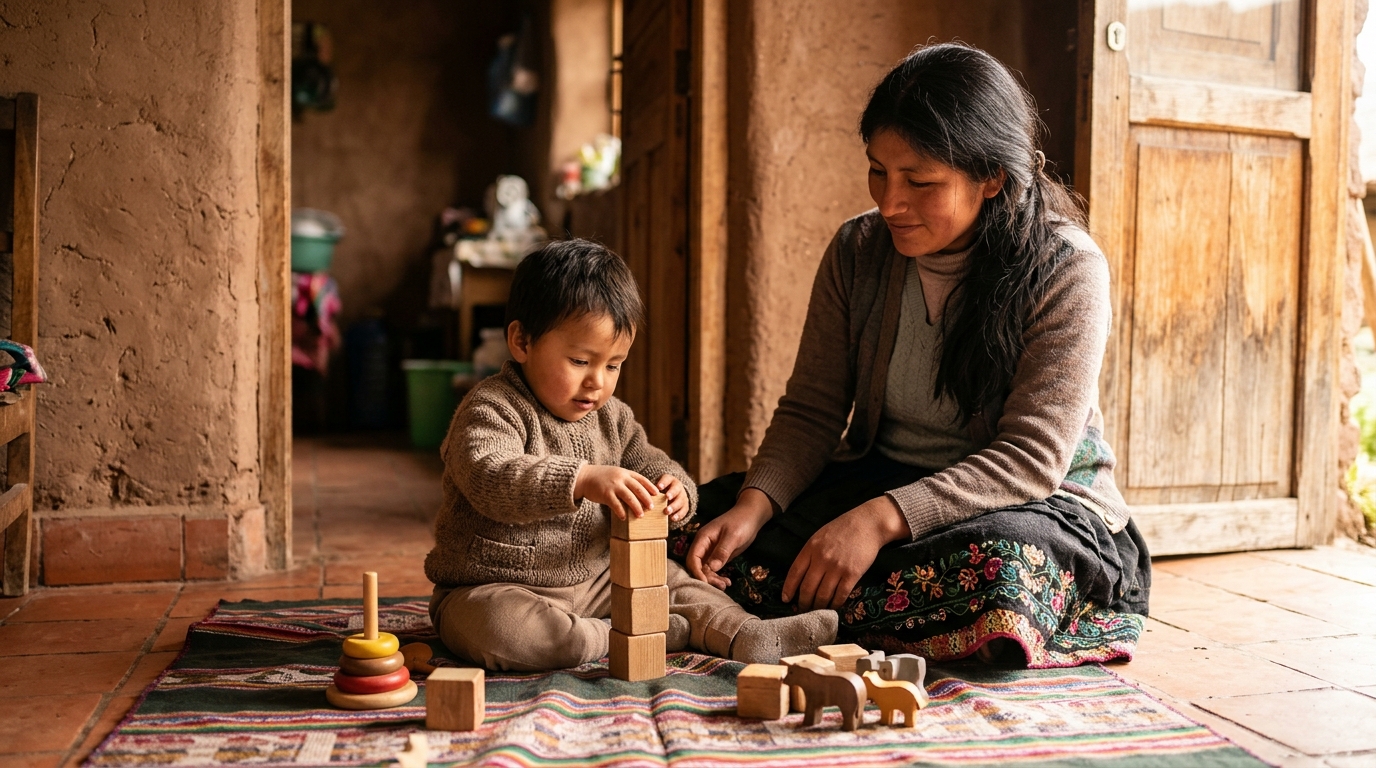
A new observational study conducted in the rural Andean highlands of Peru has found no significant association between maternal depressive symptoms and early childhood development outcomes during infancy or toddlerhood. By examining 769 mother-child dyads in the Cajamarca region, the study provides nuanced insights into how caregiving environments in low- and middle-income countries may buffer or alter the typical developmental trajectories associated with maternal mental health struggles.
The study utilized data from a recently completed cluster-randomized controlled trial evaluating a digital infant stimulation platform. Although the parent trial was an intervention study, the present analysis employed an observational approach to examine the natural associations between maternal mental health and child development. Maternal depressive symptoms were measured using the DASS-21 depression subscale, a validated self-report instrument administered by trained interviewers. Child development was assessed concurrently at infancy using the Caregiver Reported Early Development Instrument (CREDI) and prospectively at toddlerhood using the Global Scales for Early Development Long Form (GSED-LF).
The analytic sample consisted of 769 mother-child dyads with complete data on both maternal depressive symptoms and child developmental outcomes at both timepoints. At infancy, the mean age of children was 5.2 months, while at toddlerhood, it was 28.7 months. Approximately one in six mothers, representing 17.4% of the sample, reported mild or greater depressive symptoms in infancy, defined as a DASS-21 score of 10 or higher. The distribution of depression scores was right-skewed, with a mean of 4.94 and a median of 2, indicating that most mothers reported few or normal-range symptoms, while a smaller proportion presented with moderate to severe levels.
The primary results indicated that maternal depressive symptom scores in infancy were not associated with child development in infancy, with an unstandardized coefficient of 0.00 and a 95% confidence interval ranging from -0.01 to 0.01. Similarly, no significant association was found between maternal depressive symptoms in infancy and child development in toddlerhood, where the coefficient was -0.01 with a 95% confidence interval from -0.07 to 0.05. In standardized terms, both associations were close to zero, and their confidence intervals excluded associations of 0.1 standard deviations or larger, suggesting that the data are compatible with a null or very small effect at either timepoint.
The study also investigated whether household composition moderated the association between maternal depressive symptoms and child development. Specifically, the researchers examined the number of young siblings under six years old and the number of adults in the household. The hypothesis was that the presence of multiple young siblings might amplify risks associated with maternal depression, while a larger number of adults might buffer these risks through shared caregiving responsibilities. However, the analysis revealed that household composition did not moderate the association at either infancy or toddlerhood. Interaction terms for both variables were not statistically significant, indicating that the structural presence of other family members did not alter the relationship between maternal symptoms and child outcomes.
In exploratory analyses, the study found that stimulation activities were positively associated with child development both concurrently at infancy and prospectively at toddlerhood. Stimulation was measured using six items adapted from the UNICEF Multiple Indicator Cluster Survey, capturing activities such as reading, singing, and playing. The association remained stable even when social support was excluded from the models. This finding suggests that children’s exposure to stimulating interactions is a critical factor for developmental outcomes, independent of the mother’s depressive symptom status. The researchers noted that stimulation levels did not differ between mothers with and without depressive symptoms, implying that children continued to receive adequate stimulation through caregiving provided by other household members or through the mothers’ own engagement despite their symptoms.
The null findings in this study contrast with evidence from high-income contexts, where maternal depression is often linked to poorer child growth and socio-emotional outcomes. The authors suggest that the caregiving environment in rural Andean communities, characterized by strong cultural traditions, close family networks, and shared childcare responsibilities, may play a protective role. Qualitative evidence from the same region highlights local caregiving strengths, such as intergenerational caregiving and shared duties, which may sustain child development even in the face of maternal mental health challenges. When caregiving duties are distributed among multiple adults, mothers may experience reduced stress, potentially supporting more sensitive interactions with their children.
However, the study acknowledges several limitations that must be considered when interpreting these results. The observational design precludes causal inference, meaning that the study cannot establish whether maternal depression causes developmental delays or if other unmeasured factors are at play. Additionally, the use of overall composite scores for child development may dilute effects that are concentrated in specific domains, such as language or motor skills. The researchers also noted that the DASS-21, as a self-report measure, may be influenced by cultural norms and social desirability, potentially capturing only a partial picture of maternal distress in this specific cultural context.
The socioeconomic index was independently associated with child development at toddlerhood but not in infancy, highlighting the complex interplay between economic status and developmental outcomes as children grow. Future research should examine caregiving dynamics in more depth, including who provides stimulation activities and how caregiving responsibilities are shared within households.
This research contributes to a growing body of evidence suggesting that the impact of maternal mental health on child development is not uniform across different populations and settings. By focusing on a rural Andean population, the study offers valuable insights into the role of extended family networks and communal caregiving in shaping early childhood development. The findings suggest that structural indicators of household composition alone are insufficient to capture the caregiving dynamics that shape early child development, and that more direct measures of caregiving practices are needed to fully understand these complex relationships.
The study was conducted in three provinces of the Cajamarca region in the northern highlands of Peru: Cajamarca, Cajabamba, and San Marcos. These areas encompass both urban and rural communities situated at altitudes ranging from 1,900 to 3,900 meters above sea level. The local economy is primarily driven by small-scale agriculture and livestock, alongside employment in sectors such as education, healthcare, construction, and mining. Recruitment for the parent trial took place from September 2021 to March 2023, utilizing community outreach and referrals from local health centres. The study setting is characterized by persistent structural challenges, including high levels of poverty, food insecurity, and limited access to health and mental health services. Cultural stigma surrounding mental illness and traditional gender roles may further discourage women from seeking help, compounding the burden of untreated maternal mental health conditions in this region.
Maternal depressive symptoms were assessed using the depression subscale of the DASS-21, a validated self-report instrument administered by trained interviewers who read each item aloud to participants. The scale includes seven items assessing symptoms such as hopelessness, low mood, and lack of interest, rated on a four-point Likert scale. Raw item scores were summed and multiplied by two to align with normative severity bands, yielding total subscale scores ranging from 0 to 42. In this sample, the subscale demonstrated high internal consistency, with a Cronbach’s alpha of 0.836. For descriptive purposes, a score of 10 or higher on the 0-42 scale was used to classify participants as having mild or greater symptoms, corresponding to the DASS-21 severity scale. These categories indicate symptom burden and do not represent clinical diagnoses.
Child development outcomes were measured using distinct instruments at each timepoint to capture age-appropriate milestones. In infancy, the Caregiver Reported Early Development Instrument (CREDI) was used, a caregiver-report tool that assesses development across cognitive, language, motor, and socio-emotional domains. The CREDI produces overall z-scores normalized within each age group in a global reference sample. In toddlerhood, the Global Scales for Early Development Long Form (GSED-LF) was employed, an open-access tool designed to measure development in children up to 36 months. The GSED-LF produces a D-score that is not age-standardized, necessitating the inclusion of child age in days as a covariate in all toddlerhood models. The GSED-LF was developed as a unidimensional measure using a Rasch model and yields a single overall score without domain-specific breakdowns.
The analytic approach accounted for the clustered design of the parent trial by using cluster-robust standard errors at the community level. Regression coefficients were reported as unstandardized estimates with 95% confidence intervals, reflecting the expected change in child development scores per one-unit increase in maternal depressive symptoms. To assess the robustness of the findings, the researchers conducted several sensitivity analyses, including multiple imputation under a missing at random assumption and the use of endline DASS-21 scores as a proxy for baseline depression. These analyses yielded results substantively consistent with the primary complete-case analysis, supporting the stability of the null association between maternal depressive symptoms and child development outcomes.
Stimulation activities were assessed using six items adapted from the UNICEF Multiple Indicator Cluster Survey module, capturing whether the child had engaged in specific activities with any household member aged 15 years or older in the three days preceding the survey. Responses were summed to produce a total score ranging from 0 to 6, with higher scores indicating that the child experienced a greater number of stimulation activities. This measure allowed the researchers to examine whether the frequency of such interactions was associated with developmental outcomes independently of maternal mental health status.
Perceived social support was measured using a composite score of eight items rated on a four-point Likert scale, with total scores ranging from 0 to 24. Higher scores indicated greater perceived emotional and instrumental support from key individuals. Social assistance programme participation was operationalized as a binary variable indicating whether the primary caregiver or any household member had participated in a formal or informal social programme in the previous 12 months. Household socioeconomic status was measured using an asset-based index generated by principal components analysis, constructed from 20 household-level indicators across overcrowding, ownership of household assets, and dwelling quality indicators. The first principal component was retained as a continuous standardized score, with higher values indicating greater socioeconomic advantage.
The study highlights that the absence of a significant association between maternal depressive symptoms and child development does not diminish the importance of supporting maternal mental health during the early years of parenting. The findings suggest that in this specific rural Andean context, the caregiving environment may operate differently than in high-income settings where caregiving is predominantly dyadic. The data indicate that children’s exposure to stimulating interactions remained associated with child development regardless of maternal depressive symptom status. This pattern suggests that structural indicators of household composition alone are insufficient to capture the caregiving dynamics that shape early child development, pointing to the need for more direct measures of caregiving practices and roles in future research.
Subject of Research: Maternal depressive symptoms and early childhood development in rural Peru
Article Title: Maternal depressive symptoms and early childhood development in rural Peru
Article References: Alvarado, M., McCoy, D. C., Mäusezahl, D., Jäggi, L., Hinckley, K., Gastiaburu Cabello, M. C., Hatch, S. F., Hartinger, S., Aguilar, L., Castellanos, A., & Fink, G. (2026). Maternal depressive symptoms and early childhood development in rural Peru. SSM – Mental Health, 10, Article 100727. https://doi.org/10.1016/j.ssmmh.2026.100727
Image Credits: AI Generated
DOI: 10.1016/j.ssmmh.2026.100727
Keywords: Maternal, depressive, symptoms, early, childhood, development, rural, Peru, scientific research
News Source: Glenn Wilkins. (November 7, 2026). No Link Found Between Maternal Depression and Child Development in Peru. Scienmag.