Solid-state cooling devices can achieve roughly 10 percent greater maximum cooling temperature spans when electrical current flows in alignment with a spatially graded Seebeck coefficient rather than through a conventional uniform material. In an experimental peer-reviewed study published in the journal The Innovation, a research team led by Tongji University alongside investigators from Shanghai University demonstrated that grading this thermoelectric transport property across an n-type bismuth telluride alloy single crystal makes cooling performance depend directly on the direction of current flow. Because solid-state cooling systems pump heat purely through electric current without requiring moving mechanical parts or circulating refrigerant gases, the research introduces a design degree of freedom that enhances cooling without demanding the synthesis of an entirely new thermoelectric compound.
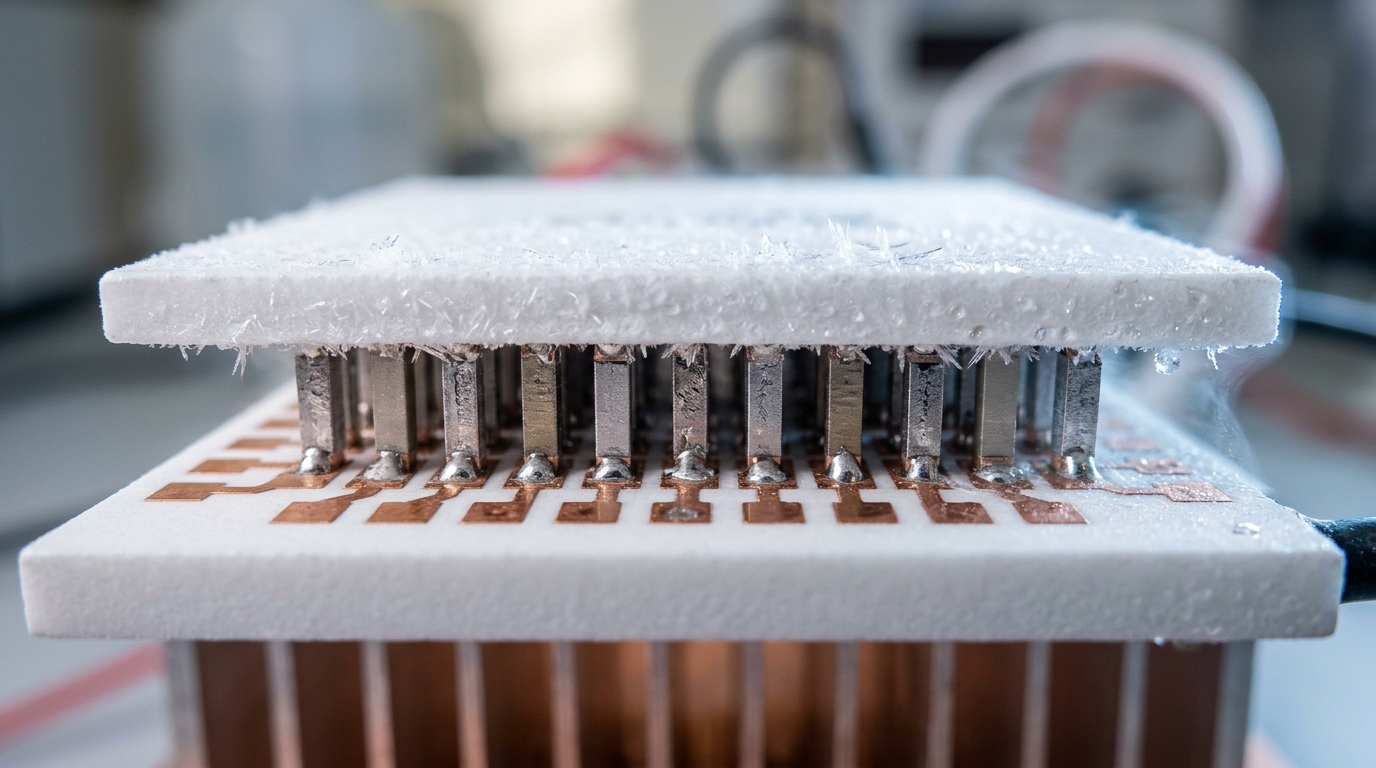
Solid-state cooling technology currently supports practical applications where quiet operation and compact mechanical stability are essential, including portable coolers that keep insulin cold during travel, miniature refrigerators installed in cars, and temperature stabilization systems for lasers inside fiber-optic networks. Thermoelectric cooling functions fundamentally because an applied electric current drags entropy along its path through a conducting medium, absorbing heat at the cold end and expelling it at the hot end. In conventional thermoelectric devices, the vast majority of this heat exchange takes place at the physical junctions established between the thermoelectric material and the metallic electrodes, a process known as the Peltier effect. A secondary thermodynamic contribution occurring directly within the interior volume of the material, known as the Thomson effect, remains negligible in conventional systems because the Seebeck coefficient barely changes across the device operating range. As a direct result, the maximum temperature span a cooler can reach, designated as ΔTmax, has historically remained pinned to the intrinsic thermoelectric figure of merit of the material, known as zT.
To expand this fundamental constraint, the researchers from Tongji University and Shanghai University widened the thermodynamic accounting framework of the system. They proposed an extended figure of merit, termed zextended, which accounts for the total electronic entropy change occurring along the entire electrical transport path. This formulation incorporates entropy variations that originate from any environmental or internal physical variable capable of shifting the Seebeck coefficient, including local temperature, chemical potential, and applied magnetic fields. Because the Seebeck coefficient represents the physical property that governs how much thermal energy each passing electron carries, varying this property continuously along the length of the conductor alters how heat is absorbed and distributed along the internal transport path.
To test this theoretical formulation experimentally, the team grew a compositionally graded n-type Bi2Te2.7Se0.3 single crystal. In this as-grown material, an internal chemical-potential gradient spreads the Seebeck coefficient across a difference of roughly 50 microvolts per kelvin from one end of the crystal leg to the other. This spatial divergence represents a sharp departure from conventional commercial thermoelectric legs made of the identical alloy, where uniform composition leaves the Seebeck values differing by only about 2.5 percent between opposing hot and cold ends. By establishing an intentional spatial gradient in chemical potential during crystal growth, the researchers successfully realized nonreciprocal thermoelectric transport within a single-leg architecture.
The physical consequence of this spatial grading is directional asymmetry in device performance. In the experimental graded single-leg device, reversing the direction of the electrical current shifted the maximum cooling temperature span by about 20 percent. When the electric current flowed in alignment with the spatial Seebeck gradient, the maximum temperature span came out approximately 10 percent larger than the span achieved by an otherwise identical reference cooler lacking a Seebeck gradient. In contrast, when the direction of current flow was reversed in a standard commercial leg with uniform composition, the device barely registered which way the electrical current ran, demonstrating no meaningful directional preference.
The study notes that this cooling performance gain is not achieved without an accompanying thermodynamic trade-off. Aligning the internal Seebeck gradient to boost heat absorption deliberately pulls the alloy away from its optimal average zT value, a balance that the authors mapped explicitly in their analysis. Theoretical modeling conducted by the team revealed that this cooling bonus increases as the material electronic quality factor, denoted as B, decreases. For a typical bismuth telluride alloy, this electronic quality factor is around 0.33, and it drops even lower near cryogenic operating temperatures where elevated lattice thermal conductivity significantly drags down conventional thermoelectric performance. Consequently, the researchers identified low-temperature cooling environments as the most promising domain for implementing this graded-property approach, precisely where improvements in material efficiency have historically been difficult to achieve.
The reported experimental demonstration functions as a single-leg proof of concept with modest absolute cooling metrics, with the graded leg reaching a temperature difference of roughly 15 kelvins. The investigators observed that much of the available thermal budget in the test setup was lost through heat leaking directly through the electrical lead wires. The authors anticipate that full thermoelectric modules assembling paired n-type and p-type legs will display the nonreciprocal cooling enhancement much more clearly. Because the operational strategy relies purely on spatial dopant grading, the authors argue that the concept can, in principle, be applied to any dopable thermoelectric materials. This methodology provides a complementary design degree of freedom that works alongside, rather than replaces, the traditional pursuit of higher material zT, offering another viable tuning knob for silent devices protecting traveling medicines or stabilizing critical optical lasers.
Subject of Research: Nonreciprocal solid-state thermoelectric cooling via spatially graded Seebeck coefficients
Article Title: Solid-state coolers run 10% colder when current flows with a graded Seebeck coefficient
Article References: Solid-state coolers run 10% colder when current flows with a graded Seebeck coefficient. Original publication (Bibliographic details unavailable.)
Image Credits: AI Generated
DOI: Not provided
Keywords: thermoelectric cooling, solid-state cooling, Seebeck coefficient, bismuth telluride, Peltier effect, materials science, thermal management, condensed matter physics, Solid-state, coolers, colder, current
News Source: Katie Riggs. (November 7, 2026). Graded Seebeck Coefficients Enable Ten Percent Colder Solid-State Thermoelectric Cooling. Scienmag.