• HOME
  • NEWS
  • EXPLORE
    • CAREER
      • Companies
      • Jobs
    • EVENTS
    • iGEM
      • News
      • Team
    • PHOTOS
    • VIDEO
    • WIKI
  • BLOG
  • COMMUNITY
    • FACEBOOK
    • INSTAGRAM
    • TWITTER
Thursday, June 25, 2026
BIOENGINEER.ORG
No Result
View All Result
  • Login
  • HOME
  • NEWS
  • EXPLORE
    • CAREER
      • Companies
      • Jobs
        • Lecturer
        • PhD Studentship
        • Postdoc
        • Research Assistant
    • EVENTS
    • iGEM
      • News
      • Team
    • PHOTOS
    • VIDEO
    • WIKI
  • BLOG
  • COMMUNITY
    • FACEBOOK
    • INSTAGRAM
    • TWITTER
  • HOME
  • NEWS
  • EXPLORE
    • CAREER
      • Companies
      • Jobs
        • Lecturer
        • PhD Studentship
        • Postdoc
        • Research Assistant
    • EVENTS
    • iGEM
      • News
      • Team
    • PHOTOS
    • VIDEO
    • WIKI
  • BLOG
  • COMMUNITY
    • FACEBOOK
    • INSTAGRAM
    • TWITTER
No Result
View All Result
Bioengineer.org
No Result
View All Result
Home NEWS Science News Neuroscience

Mimicking brain cells to boost computer memory power

Bioengineer by Bioengineer
October 12, 2014
in Neuroscience
Reading Time: 2 mins read
0
Share on FacebookShare on TwitterShare on LinkedinShare on RedditShare on Telegram

Researchers have brought ultra-fast, nano-scale data storage within striking reach, using technology that mimics the human brain.
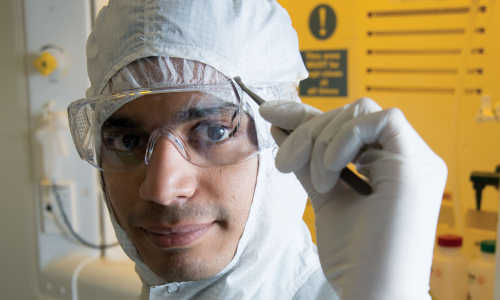
neuro-chip

Dr Sharath Sriram, RMIT University. Photo Credit: RMIT University

The researchers have built a novel nano-structure that offers a new platform for the development of highly stable and reliable nanoscale memory devices.

The pioneering work will feature on a forthcoming cover of prestigious materials science journal Advanced Functional Materials (11 November).

Project leader Dr Sharath Sriram, co-leader of the RMIT Functional Materials and Microsystems Research Group, said the nanometer-thin stacked structure was created using thin film, a functional oxide material more than 10,000 times thinner than a human hair.

“The thin film is specifically designed to have defects in its chemistry to demonstrate a ‘memristive’ effect – where the memory element’s behaviour is dependent on its past experiences,” Dr Sriram said.

“With flash memory rapidly approaching fundamental scaling limits, we need novel materials and architectures for creating the next generation of non-volatile memory.

“The structure we developed could be used for a range of electronic applications – from ultrafast memory devices that can be shrunk down to a few nanometers, to computer logic architectures that replicate the versatility and response time of a biological neural network.

“While more investigation needs to be done, our work advances the search for next generation memory technology can replicate the complex functions of human neural system – bringing us one step closer to the bionic brain.”

The research relies on memristors, touted as a transformational replacement for current hard drive technologies such as Flash, SSD and DRAM. Memristors have potential to be fashioned into non-volatile solid-state memory and offer building blocks for computing that could be trained to mimic synaptic interfaces in the human brain.

The research, which was supported by an Australian Research Council Discovery grant, was a collaboration between members of the Functional Materials and Microsystems Research Group and Professor Dmitri Strukov from the University of California, Santa Barbara.

Story Source:

The above story is based on materials provided by RMIT University.
Share12Tweet8Share2ShareShareShare2

Related Posts

Redox biomarker could predict progression of epilepsy

October 5, 2016

Neural membrane’s structural instability may trigger multiple sclerosis

October 5, 2016

Scientists find new path in brain to ease depression

October 5, 2016

Key players responsible for learning and memory formation uncovered

October 3, 2016
Please login to join discussion

POPULAR NEWS

  • Saying Goodbye to PGY-6: Pediatric Fellowship Realities

    103 shares
    Share 41 Tweet 26
  • Multi-Hospital Study Reveals Long Covid Burden Is Twice as High as Current Estimates

    92 shares
    Share 36 Tweet 23
  • Detection of EDCs in Breast Milk and Infant Urine Up to Six Months Highlights Early Exposure Risks

    77 shares
    Share 31 Tweet 19
  • New Drug Candidate Developed at McMaster Shows Potential for Treating Brain Cancer

    58 shares
    Share 23 Tweet 15

About

We bring you the latest biotechnology news from best research centers and universities around the world. Check our website.

Follow us

Recent News

Tracking Lanthanide-Labeled Microplastics in Plants

POSTECH Researchers Slash Cost of Reconstituted Cell-Free Systems by 95%

AI and Physics Collaborate to Design Advanced Hydrogen Storage Materials

Subscribe to Blog via Email

Enter your email address to subscribe to this blog and receive notifications of new posts by email.

Join 82 other subscribers
  • Contact Us

Bioengineer.org © Copyright 2023 All Rights Reserved.

Welcome Back!

Login to your account below

Forgotten Password?

Retrieve your password

Please enter your username or email address to reset your password.

Log In
No Result
View All Result
  • Homepages
    • Home Page 1
    • Home Page 2
  • News
  • National
  • Business
  • Health
  • Lifestyle
  • Science

Bioengineer.org © Copyright 2023 All Rights Reserved.