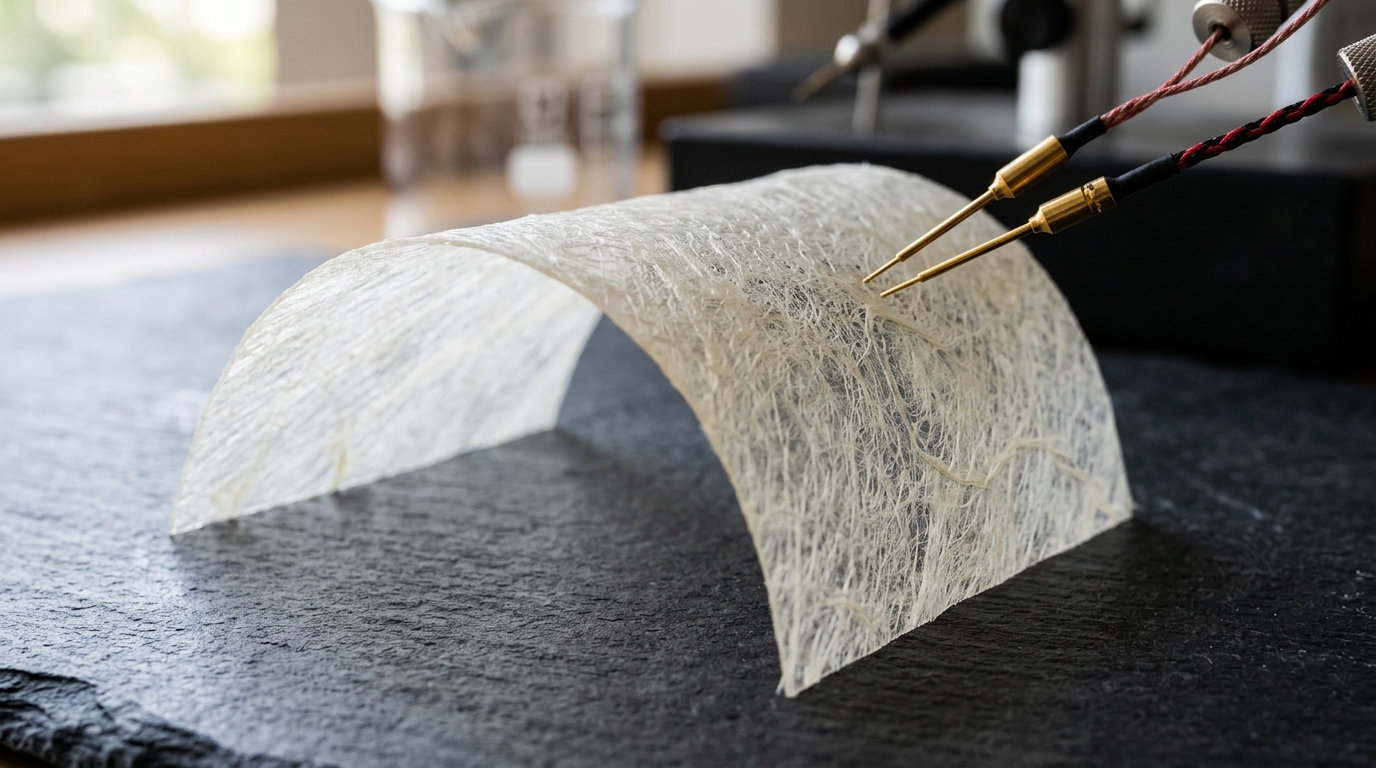
Researchers have demonstrated that electroconductive films derived from agave bagasse, a lignocellulosic agroindustrial residue, can achieve high electrical conductivity when functionalized with reduced graphene oxide and titanium dioxide. The study, published in Biotechnology for Sustainable Materials, compares two distinct forms of nanocellulose: cellulose nanocrystals (CNCs) and cellulose nanofibrils (CNFs). By extracting these nanomaterials from waste generated by the tequila industry, the team aimed to evaluate how specific morphological and structural features influence the electrical performance of composite films. The findings indicate that the type of nanocellulose used is a decisive factor in determining the final conductivity of the material.
The central finding of the research is that films based on cellulose nanocrystals significantly outperform those based on cellulose nanofibrils in terms of electrical conductivity. Specifically, the CNC-based films achieved conductivities of up to 23.2 S/m, whereas the CNF-based films exhibited much lower values, on the order of 10-4 S/m. This substantial difference highlights the critical role of structural order and particle morphology in facilitating charge transport within the composite matrix. The results suggest that nanocrystalline structures are more effective at creating continuous pathways for electron flow compared to fibrillar structures.
The study utilized agave bagasse fibers obtained from a tequila production company in Jalisco, Mexico. The researchers employed an organosolve method followed by cellulose bleaching to isolate the cellulose. Two different processing routes were then used to produce the nanocellulose. Cellulose nanocrystals were obtained through acid hydrolysis using 64% sulfuric acid at 45 °C for 30 minutes. In contrast, cellulose nanofibrils were produced via mechanical treatment using a microfluidizer, which applied high-pressure shear and impact forces to individualize the fibers. These distinct production methods resulted in materials with different physical and chemical properties.
Characterization of the nanocellulose revealed clear morphological differences between the two types. Atomic force microscopy (AFM) images showed that CNCs are short, rod-like particles with average diameters of 16 ± 6 nm and lengths of 65 ± 19 nm. CNFs, on the other hand, appeared as longer and thinner fibers with average lengths of 500 ± 45 nm and diameters of 21 ± 4 nm. X-ray diffraction analysis confirmed that CNCs possess a higher degree of crystallinity, with a crystallinity index of 84%, compared to 67% for CNFs. This higher crystallinity in CNCs is attributed to the acid hydrolysis process, which selectively removes amorphous regions of the cellulose.
The reduced graphene oxide (RGO) used in the composites was synthesized through rapid thermal exfoliation of graphene oxide under a nitrogen atmosphere at 1000 °C. Raman spectroscopy was used to confirm the reduction state of the material, yielding an ID/IG ratio of 0.93. This ratio indicates that the material is in a reduced form with a partial recovery of the graphitic structure. Fourier transform infrared spectroscopy (FTIR) further supported these findings by showing a decrease in the intensity of oxygenated functional groups, such as carboxyl and hydroxyl groups, compared to pristine graphene oxide. The persistence of some oxygenated groups suggests that the reduction was not complete, which may influence the interaction between the RGO and the nanocellulose matrix.
Electroconductive films were prepared by mixing the nanocellulose suspensions with a dispersion of titanium dioxide and reduced graphene oxide in ethanol. The ratio of nanocellulose to the TiO2-RGO filler was maintained at 99:1 to ensure adequate dispersion and prevent agglomeration. The films were then dried at room temperature for 48 hours. Electrical properties were evaluated using a modified Kelvin measurement method, measuring voltage drop across the samples under applied currents. The conductivity was calculated from the measured resistivity, which was determined by varying the applied voltage from 10 V to 110 V. All measurements were performed in triplicate to ensure statistical reliability.
The electrical evaluation revealed a marked difference in behavior between the two types of films. CNC/TiO2-RGO films exhibited considerably lower resistivities, ranging from 0.045 to 0.057 Ω·m, which corresponds to the high conductivity values observed. In contrast, CNF/TiO2-RGO films showed much higher resistivities, gradually decreasing from 2.8 to 2.2 Ω·m as the voltage increased. The superior conductivity of the CNC films is attributed to their higher crystallinity, smaller particle size, and better structural order. These features favor the formation of dense, continuous percolation paths for electron transport through the composite matrix.
The structural advantages of CNCs extend beyond crystallinity. The rod-like morphology of CNCs allows for better alignment and packing within the film, promoting effective contact with the conductive fillers. Additionally, CNCs have a more negative zeta potential (-45.9 mV) compared to CNFs (-42 mV), which enhances their colloidal stability and dispersion in suspension. This improved dispersion facilitates better interaction with the TiO2 and RGO fillers, reducing interfacial resistance and promoting charge mobility. The presence of surface sulfate groups on CNCs, introduced during the acid hydrolysis process, may also contribute to ionic conduction and further enhance the overall electroconductive behavior.
The study also noted that the conductivity of CNF/TiO2-RGO films showed an initial upward trend up to approximately 60 V, reaching a maximum of 0.458 S/m, before slightly decreasing. This behavior may be related to electric field-induced structural reorganization or saturation processes in the electron transport pathways. In contrast, the conductivity of CNC/TiO2-RGO films remained relatively stable across the voltage range, suggesting that the system already possesses an efficient conductive framework with less dependence on external voltage. This stability indicates that the CNC-based films have a robust percolation network that is less susceptible to changes in applied electric fields.
While the results demonstrate the potential of agave bagasse-derived nanocellulose for sustainable electronics, the authors acknowledge several limitations. Mechanical performance tests, such as tensile strength and elongation at break, were not performed due to equipment constraints. Long-term stability analyses and high-resolution structural characterizations were also not conducted. Furthermore, the films have not yet been tested in real device prototypes. Therefore, while the conductivity and morphology suggest potential applications in flexible electronics, sensors, and energy storage, further research is necessary to confirm practical applicability and long-term performance.
The valorization of agricultural waste like agave bagasse represents a significant step toward sustainable materials science. By converting a byproduct of the tequila industry into high-performance electroconductive films, the study highlights the potential of biocomposites to address environmental challenges associated with fossil fuel-based materials. The ability to produce conductive materials from renewable, biodegradable sources offers a promising alternative for the development of environmentally conscious electronic devices. Future work should focus on mechanical evaluations, aging studies, and integration testing in functional systems to fully realize the potential of these nanocellulose-based composites.
Subject of Research: Nanocellulose-based materials functionalized with reduced graphene oxide and titanium dioxide for potential applications in electronic devices
Article Title: Nanocellulose-based materials functionalized with reduced graphene oxide and titanium dioxide for potential applications in electronic devices
Article References: Sulbarán-Rangel, B., Macias-Tello, M. G., Vargas-Hernández, M. D. L. Á., Haro-Falcón, N., & Santos-Ventura, E. M. (2025). Nanocellulose-based materials functionalized with reduced graphene oxide and titanium dioxide for potential applications in electronic devices. Biotechnology for Sustainable Materials, 2(1), Article 18. https://doi.org/10.1186/s44316-025-00044-z
Image Credits: AI Generated
DOI: 10.1186/s44316-025-00044-z
Keywords: Nanocellulose-based, materials, functionalized, reduced, graphene, oxide, titanium, dioxide, potential, applications, electronic, devices
News Source: Gregory Coleman. (November 7, 2026). Agave Waste Nanocellulose Films Show High Conductivity. Scienmag.