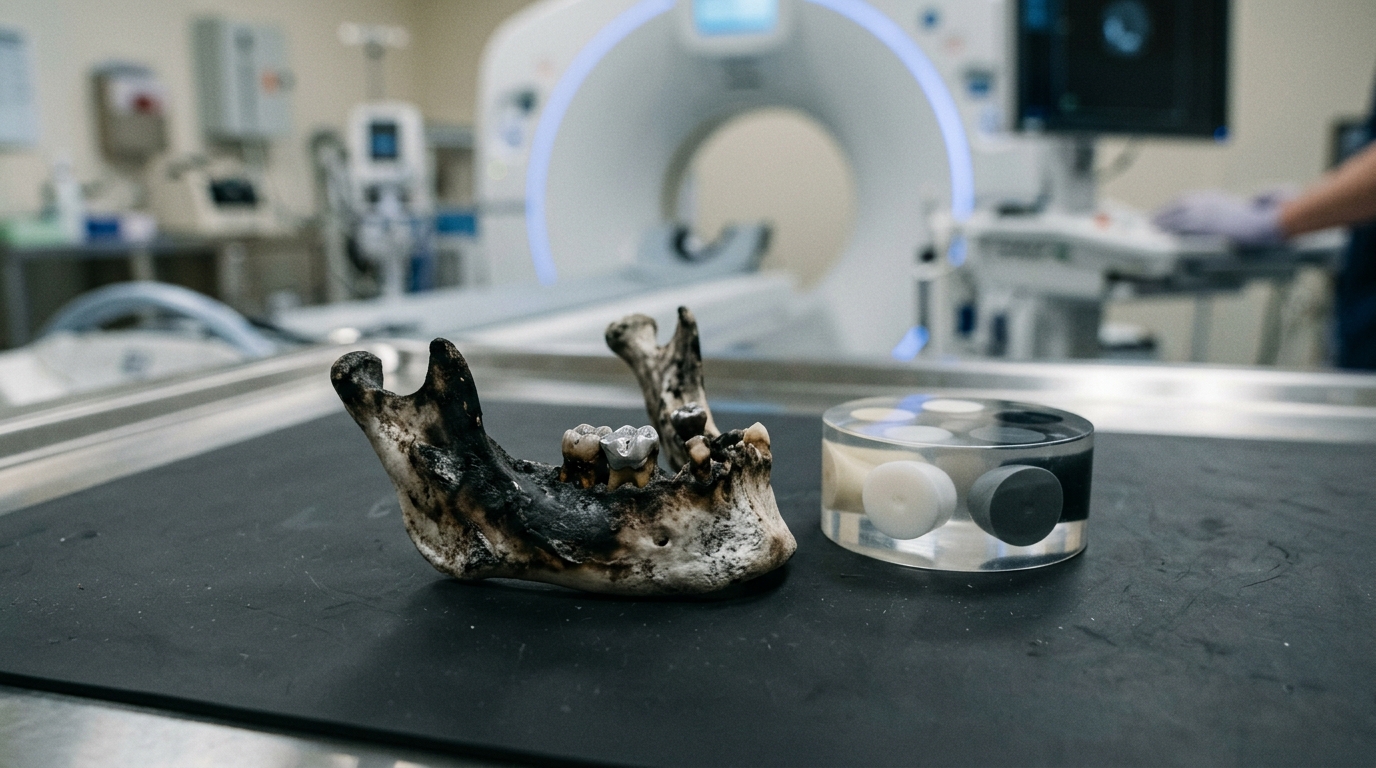
An extended Hounsfield unit scale applied to post-mortem computed tomography scans enabled forensic odontologists to detect dental restorations obscured on conventional imaging and positively identify severely charred victims, according to a case series conducted at the Institute of Legal Medicine in Toulouse, France.
The researchers reported that positive identification of charred victims represents a major challenge in forensic medicine, where resilient dental structures serve as key markers for human identification. However, resin restorations can be indistinguishable from natural enamel on standard computed tomography display windows because of similar Hounsfield unit values, creating conditions that can compromise ante-mortem to post-mortem odontological comparisons.
The fatal motor vehicle collision examined by the investigators involved five young adults, four of whom sustained severe charring. During post-mortem full-body computed tomography of one victim, designated X88, standard window settings failed to display a composite restoration on tooth 46 because its radiopacity saturated within the same display range as enamel. Applying an extended Hounsfield unit scale rendered the restoration visible at 10,985 Hounsfield units—an attenuation value consistent with a highly radio-opaque composite resin—which permitted comparison with the ante-mortem odontogram and provided eighteen concordant elements supporting positive identification.
In a second charred victim, designated X85, post-mortem examinations revealed amalgam restorations and metallic crowns. While these restorative materials were detectable on iterative metal artifact reduction series displayed with standard windows, the images remained degraded by metallic streak artifacts; by contrast, reconstructions using the extended Hounsfield unit scale without iterative metal artifact reduction demonstrated improved visualization with less conspicuous artifacts under the reconstruction conditions used, which facilitated comparison with ante-mortem records.
The authors concluded that the extended Hounsfield unit scale may provide valuable additional information during post-mortem computed tomography dental analysis in forensic odontology, particularly when restorative materials are poorly delineated on conventional images and require attenuation measurements consistent with their likely composition. They also noted that the broader diagnostic value of this imaging approach should be evaluated in larger, systematically studied cohorts.
In post-mortem examinations of severe thermal trauma, forensic identification depends heavily on the resilience of dental anatomy, yet conventional computed tomography windowing introduces notable diagnostic limitations. When forensic specialists attempt ante-mortem to post-mortem comparisons, standard display windows can cause composite resin restorations and natural enamel to appear indistinguishable due to overlapping Hounsfield unit values. This display saturation masks restorative work, impeding the verification of dental landmarks essential for confirming identity.
The case series illustrated distinct practical solutions for these imaging obstacles across different dental materials. In the examination of victim X88, switching to an extended Hounsfield unit scale uncovered the previously invisible composite filling on tooth 46 by capturing its specific radiopacity at 10,985 Hounsfield units. This measurement, characteristic of a highly radio-opaque resin, supplied the objective basis required to identify eighteen concordant features against the victim’s ante-mortem odontogram. In the evaluation of victim X85, extended scale reconstructions addressed severe metallic streak artifacts that degraded standard iterative metal artifact reduction displays of amalgam fillings and metallic crowns. Reconstructing the scans using the extended scale without iterative metal artifact reduction produced cleaner images with less conspicuous artifact distortion under the chosen reconstruction parameters, streamlining correlation with ante-mortem dental charts.
Ultimately, the authors underscored that applying extended Hounsfield unit scales provides critical supplementary information during post-mortem computed tomography dental analysis. The technique enables practitioners to visualize otherwise undetectable restorative materials and obtain attenuation measurements that reflect their physical composition. However, because these observations were obtained from a case series involving four severely charred victims from a fatal five-person collision, the researchers cautioned that the technique’s broader diagnostic value and operational limits warrant systematic evaluation across larger, structured cohorts.
Subject of Research: Post-mortem computed tomography and extended Hounsfield unit scale in forensic odontological identification
Article Title: Case series: odontological identification using post-mortem CT in charred victims after a fatal road traffic accident: contribution of the extended Hounsfield unit scale
Article References: Fournier, G., Deny, O., Maret, D., & Dédouit, F. (2026). Case series: odontological identification using post-mortem CT in charred victims after a fatal road traffic accident: contribution of the extended Hounsfield unit scale. International Journal of Legal Medicine. https://doi.org/10.1007/s00414-026-04053-z
Image Credits: AI Generated
DOI: 10.1007/s00414-026-04053-z
Keywords: forensic odontology, post-mortem CT, extended Hounsfield unit scale, dental identification, charred victims, composite restorations, forensic medicine, case series, Case, series, odontological, identification
News Source: Ophelia Keating. (November 7, 2026). Extended Hounsfield Unit Scale Aids Dental Identification in Charred Victims. Scienmag.