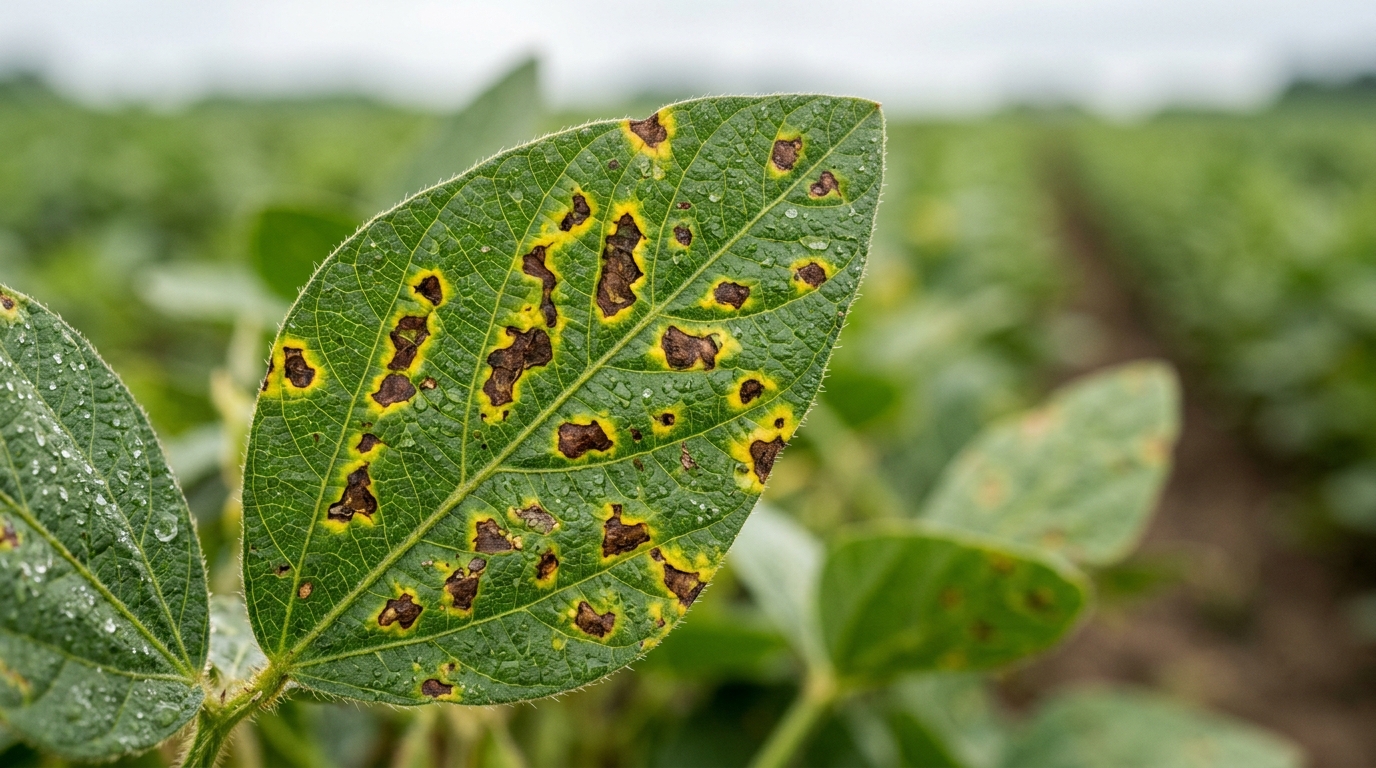
Researchers have identified a specific group of bacteria that accumulate in the roots of soybean plants affected by red crown rot, a disease caused by the soil-borne fungus Calonectria ilicicola. The selective enrichment of lineages carrying dlt genes, rather than lineages defined solely by pathogenicity-related genes, suggests that host defense-associated pressures may be a key driver shaping disease-associated root microbiomes. The work highlights a complex interaction between the plant, the fungal pathogen, and the surrounding microbial ecosystem.
Soybean is a globally significant agricultural crop, and its productivity is heavily influenced by biotic interactions in the soil and on the roots. Red crown rot is a widespread issue that leads to substantial yield losses, yet the factors driving the variability of disease severity within a single field have not been fully understood. However, the specific ways in which infection reshapes these bacterial communities remained poorly defined prior to this investigation.
To address this gap, the research team combined multiple genomic approaches, including 16S ribosomal RNA gene sequencing, shotgun metagenomics, and strain-resolved single-cell genomics. They analyzed bacterial communities in soybean root-associated soils from both healthy and diseased plants. This multi-layered approach allowed them to move beyond general community profiling to identify specific bacterial lineages and their genetic traits. By integrating these methods, the researchers could link broad shifts in community composition to the presence of specific genes in individual bacterial strains.
The initial amplicon sequencing revealed that the microbiomes of diseased plants were compositionally distinct from those of healthy plants. Shotgun metagenomics further supported this observation by showing that diseased rhizoplane samples contained higher levels of genes associated with antibiotic resistance.
To connect these community-level shifts to specific organisms, the researchers applied single-cell genomics, which allowed them to recover seven nonredundant genomes from the Enterobacterales order. This technique is crucial for identifying traits that might be hidden in bulk community analyses. The analysis showed that genes related to plant pathogenicity were broadly distributed across these recovered genomes. However, the dlt genes, which confer putative resistance to cationic antimicrobial peptides, were detected exclusively in the Enterobacterales lineages that were enriched in the diseased rhizoplane soils.
The study demonstrates that soybean red crown rot is associated with the restructuring of the rhizoplane microbiome and the specific enrichment of Enterobacterales lineages carrying these resistance genes. The magnitude of this enrichment varied among individual plants. The findings imply that host defense-associated pressures, rather than pathogenicity alone, may be a primary force shaping the disease-associated root microbiome.
The use of strain-resolved single-cell genomics in this study underscores the value of high-resolution genomic tools in microbial ecology. Bulk community analyses often mask the presence of specific traits within diverse populations, but single-cell approaches can uncover these hidden details. This methodological advance highlights the potential for such techniques to clarify the complex interactions among plants, pathogens, and the root microbiome in other agricultural systems.
Subject of Research: Microbial ecology of soybean red crown rot and bacterial resistance genes
Article Title: Single-cell genomics reveals opportunistic Enterobacterales carrying putative cationic antimicrobial peptide resistance genes in red crown rot-affected soybean rhizoplanes
Article References: Ochi, T., Nishikawa, Y., Kifushi, M., Sato, T., & Takeyama, H. (2026). Single-cell genomics reveals opportunistic Enterobacterales carrying putative cationic antimicrobial peptide resistance genes in red crown rot-affected soybean rhizoplanes. Environmental Microbiome. https://doi.org/10.1186/s40793-026-00961-0
Image Credits: AI Generated
DOI: 10.1186/s40793-026-00961-0
Keywords: soybean, red crown rot, Enterobacterales, single-cell genomics, rhizoplane, antimicrobial peptides, microbiome, plant pathology, Single-cell, genomics, reveals, opportunistic
News Source: Drew Townsend. (November 7, 2026). Soybean Disease Linked to Bacteria Resisting Host Defenses. Scienmag.