A comprehensive microscopic investigation of twenty-seven commercial plant-based meat substitute products sold in Brazil has revealed that microscopic foreign matter was present across all evaluated food lines when accounting for multi-batch testing, while histological analysis uncovered undeclared soy structures in twenty-two percent of the items. Published in the journal Food Safety and Risk, the study provides an unprecedented examination of the physical integrity and histological authenticity of commercially marketed meat analogs within the expanding Brazilian consumer market. The research team evaluated twenty-seven distinct products representing five separate commercial brands, categorized into seven popular food formats including plant-based chicken, plant-based ground beef, plant-based kibbeh, plant-based penne ready-to-eat pasta, plant-based burgers, plant-based breaded fish fillets, and plant-based cod fish cakes. Across the entire sample set, microscopic contaminants—ranging from fragmented insect bodies to unidentified mammalian hairs and mites—were detected in twenty-five of the twenty-seven individual packages, corresponding to a ninety-three percent raw sample detection rate and a one hundred percent product contamination association across analyzed production batches. Simultaneously, the structural examination of plant tissues demonstrated that while most formulations accurately matched their declared primary protein sources, several products concealed significant ingredient discrepancies, notably the presence of undeclared soy in ground beef and burger alternatives, exposing critical vulnerabilities in manufacturing sanitation, labeling compliance, and consumer allergen safety.
The study was designed to address a pronounced scientific and regulatory gap regarding the physical purity and formulation authenticity of novel alternative protein formulations. The global commercialization of plant-based meat analogs has accelerated rapidly under consumer perceptions of healthfulness and environmental sustainability, yet standardized authentication methods and sector-specific purity thresholds have lagged far behind industrial expansion. To capture an accurate cross-section of retail offerings, the researchers procured commercially available products in the city of Campinas, located in São Paulo State, Brazil. The sampling encompassed four plant-based chicken items, four ground beef items, two kibbeh preparations, two penne pasta formulations, nine burgers, four breaded fish products, and two cod cake products, spanning brands designated anonymously as a, b, c, d, and e. All samples were acquired frozen and maintained in their original commercial packaging under strict frozen storage until extraction. To address batch-to-batch variations in industrial processing, at least two separate manufacturing batches were evaluated for every single product format, ensuring that findings reflected continuous manufacturing practices rather than isolated industrial anomalies.
To rigorously isolate and quantify microscopic foreign matter from the dense food matrices, the investigators applied two standardized analytical flotation methodologies established by the Association of Official Analytical Chemists, selecting each protocol according to the presence or absence of starches on ingredient lists. For fifteen starch-free samples comprising chicken, ground beef, and burger preparations, the team utilized AOAC method 993.28, which isolates light filth from bean pastes. In this procedure, one hundred grams of homogenized food material was treated in a two-liter beaker with six hundred milliliters of hot filtered water and fifteen milliliters of the nonionic surfactant Igepal, brought to a boil on a heated magnetic stirrer for ten minutes, and transferred hot onto a No. 230 tamis sieve. The retained fraction was rinsed thoroughly with hot water between fifty-five and seventy degrees Celsius until the effluent ran clear, transferred to a two-liter trap flask using a forty percent isopropanol solution, boiled again, cooled, and blended with mineral oil to create an extraction phase that concentrated hydrophobic impurities into the upper solvent layer across two successive oil recoveries.
For the remaining twelve samples containing starches—including the breaded fish preparations, cod fish cakes, ready-to-eat penne pasta, kibbeh, and specific burger formulations—the researchers deployed AOAC method 969.41, designed for light filth recovery from alimentary pastes. A one-hundred-gram aliquot was blended with two liters of filtered water, fifty milliliters of analytical reagent grade hydrochloric acid, and one milliliter of ethyl ether, sealed, and digested in an autoclave at one hundred and twenty-one degrees Celsius for fifteen minutes to hydrolyze cohesive starch matrices. After autoclaving, the digested material was sieved through the No. 230 mesh, treated again with thirty milliliters of hydrochloric acid and fifty milliliters of mineral oil, boiled for five minutes under magnetic agitation, and transferred into a two-liter percolator. Hot filtered water flushes and controlled draining separated the heavy digested solids from the buoyant oil meniscus, and all recovered oil phases were vacuum-filtered through Whatman 40 creped qualitative filter papers before stereoscopic examination at thirty-times magnification and compound optical microscopic identification at four hundred times magnification.
Rigorous analytical quality control measures validated the performance and recovery accuracy of these filtration protocols in accordance with INMETRO guidelines and recent food microscopy literature. Blank assays spiked with single insect fragment standards demonstrated a one hundred percent recovery rate across ten consecutive trials, confirming that the limit of detection for both isolation techniques was precisely one foreign matter particle per one hundred grams of sample. In addition, recovery and trueness testing was conducted across independent spike levels: additions of five, ten, and fifteen insect fragment standards in the non-starch protocol yielded recoveries of one hundred percent, eighty-seven percent, and one hundred percent, respectively. For the starch-digestion protocol, spike additions of five, fifteen, and thirty standards resulted in recoveries of ninety-three percent, one hundred percent, and one hundred percent. Because all recovered values comfortably surpassed the benchmark threshold of eighty percent recovery, the analytical procedures were deemed highly robust, and duplicate analyses demonstrated high reproducibility with variance between replicates remaining well below the ten-unit re-test threshold across all samples.
Examination of the filter papers confirmed the complete absence of macroscopic contaminants, such as intact insects, rigid plastic shards, or metallic fragments, reflecting the efficacy of industrial sieving, sorting, and mechanical screening systems currently employed by commercial manufacturers. However, optical inspection identified a total of ninety-nine microscopic foreign matter items across the twenty-seven samples. Insect fragments represented the dominant contaminant category, accounting for sixty-three percent of all observed particles and appearing in twenty-two of the twenty-seven samples, representing eighty-one percent of tested units. These insect remains—identified by structural characteristics such as diagnostic pigmentation, bristle structures, and surface pore patterns—are strongly linked to raw agricultural commodities such as soybeans, wheat, and corn. Grains are chronically vulnerable to field infestations and internal storage pests, whose microscopic remains cannot be fully eliminated and are subsequently pulverized into tiny fragments during commercial dry milling and fractionation processes.
Unidentified mammalian hairs constituted the second most prevalent impurity, making up thirty-two percent of the total foreign matter and occurring in twenty individual samples, representing seventy-four percent of the analyzed items. The highest concentrations occurred in specific plant-based chicken and burger samples, which contained up to three mammalian hairs per one hundred grams. Diagnostic evaluation of hair marrow morphology and cuticular scale architecture classified these specimens as mammalian undercoats. However, because species identification requires medullary patterns located exclusively within the shield zone of guard hairs, the exact biological origin of the undercoat fibers could not be definitively established. Mites comprised the remaining five percent of identified contaminants, discovered exclusively in two batches of plant-based chicken from a single manufacturer and confirmed by their fused cephalothorax and abdomen, lack of antennae, and characteristic eight-legged adult anatomy. The presence of mammalian hairs and storage mites points toward environmental contamination and hygiene weaknesses during ingredient handling, warehousing, or manufacturing line operations.
From a regulatory standpoint, the researchers emphasized that foreign matter in processed foods must be evaluated against established manufacturing realities, as absolute zero-contamination thresholds are virtually unattainable for processed agricultural commodities. Regulatory frameworks enforced by Brazil’s National Health Surveillance Agency (ANVISA) and the United States Food and Drug Administration establish legally acceptable defect tolerance levels for baseline raw materials such as wheat flour, corn meal, ground pepper, tomatoes, and cocoa powder. Because every plant-based meat analog evaluated in this study incorporated at least one of these regulated agricultural ingredients, the presence of certain field-derived insect fragments is partially unavoidable under current agricultural practices. However, no specific tolerance standards or defect thresholds currently exist for commercial plant-based meat analogs under Brazilian law or international standards. Furthermore, while the presence of mammalian hairs does not constitute evidence of immediate toxicological danger to consumers, it indicates potential failures in good manufacturing practices, sanitation boundaries, and pest exclusion along the processing chain.
To assess composition and ingredient authenticity, the researchers implemented optical histology based on methods outlined by Rodrigues and colleagues, employing four-hundred-times magnification, Lugol’s iodine staining, and a five percent sodium hydroxide chemical hydrolysis step to clarify highly complex multi-ingredient formulations. By comparing observed tissue structures against established reference literature and standards maintained by the Adolfo Lutz Institute microscopy laboratory, the team successfully identified fourteen declared plant ingredients, including modified starches, rice, garden peas, chickpeas, cassava, corn, black pepper, parsley, wheat, and beet root. Five declared fibrous ingredients—including bamboo fiber, concentrated lentil protein, and fava bean protein—could not be confirmed due to a lack of cataloged histological reference standards. Conversely, ten declared botanical ingredients, such as powdered tomato, strawberry, cocoa, spinach, dill, and potato, were completely undetectable under microscopy, an outcome attributed to thermal degradation, shear stress during extrusion, and very low inclusion percentages within products formulated with fifteen to twenty-five discrete ingredients.
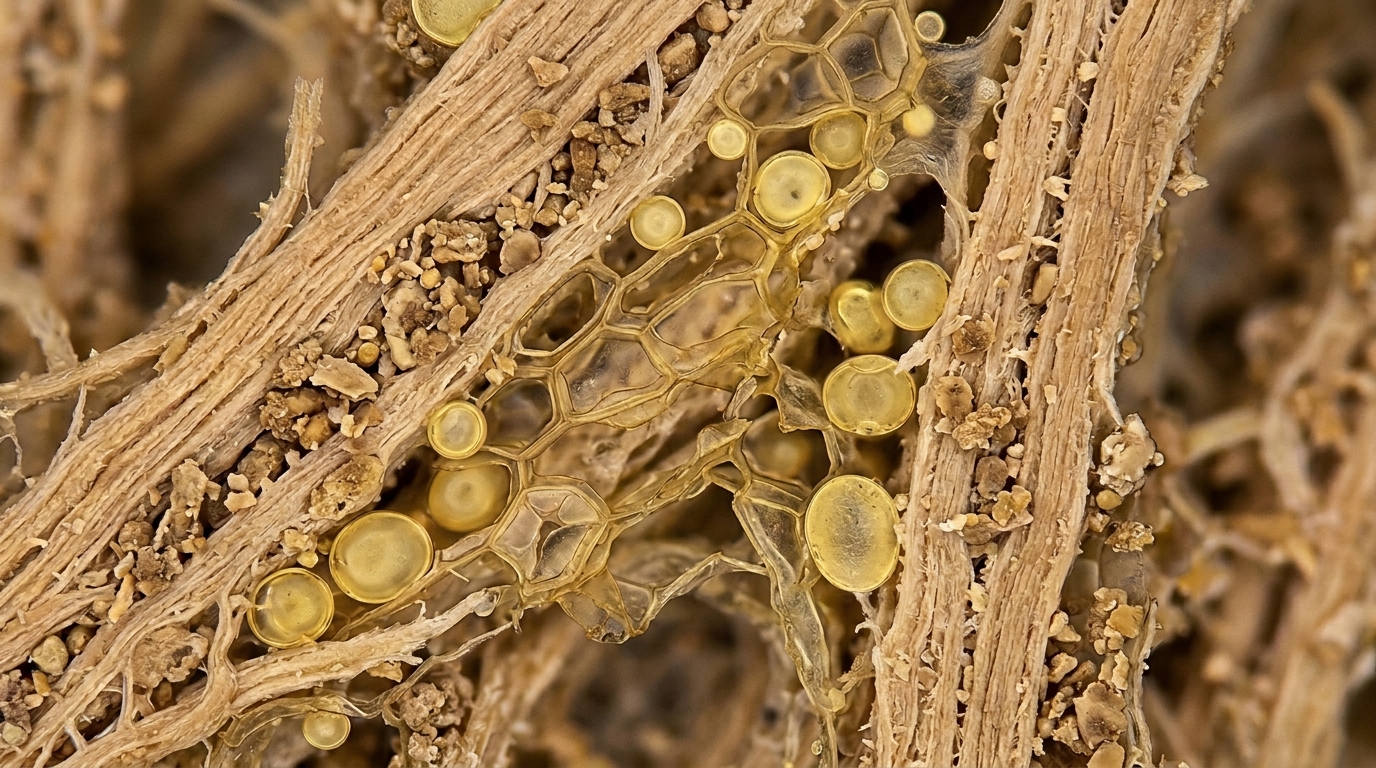
The most consequential finding emerged from the histological evaluation of protein matrices, where twenty-two percent of the products exhibited major labeling discrepancies involving undeclared soy. While soy and pea proteins were confirmed as the primary structural bases across seventy-eight percent of compliant samples, six products—specifically four plant-based burger samples from brand c and two ground beef samples from brand e—contained unambiguous histological markers of soy, including characteristic elongated palisaded cells, intensely polarized column cells, and spherical isolate bodies displaying internal reel formations that turned amber when stained with Lugol’s solution. These six products omitted soy from their primary ingredient lists, although brand e included a generic precautionary statement noting that the item may contain trace allergens. Because soybeans represent a major food allergen capable of triggering severe hypersensitivity reactions, the authors concluded that these undeclared inclusions represent either industrial cross-contamination, formulation inconsistencies, or deliberate ingredient substitution. The researchers stressed that microscopic screening provides a cost-effective, indispensable tool for regulatory agencies and manufacturers to establish rigorous purity standards, improve good manufacturing practices, and guarantee consumer safety in the rapidly evolving plant-based meat sector.
Subject of Research: Microscopic analysis of foreign matter and histological authenticity in commercial plant-based meat substitutes
Article Title: Food integrity in plant-based meat marketed in Brazil: Identification of physical contaminants and histological elements
Article References: Andrekowisk Fioravanti, M. I., de Mattos, E. C., de Oliveira Silva, I., de Carvalho, F., Morgano, M. A., & Bragotto, A. P. A. (2026). Food integrity in plant-based meat marketed in Brazil: Identification of physical contaminants and histological elements. Food Safety and Risk, 13(1), Article 26. https://doi.org/10.1186/s40550-026-00149-x
Image Credits: AI Generated
DOI: 10.1186/s40550-026-00149-x
Keywords: food integrity, plant-based meat, food safety, microscopic analysis, insect fragments, mammalian hair, food adulteration, undeclared allergens, ANVISA, food microscopy, Food, integrity
News Source: Alan Morgan. (November 7, 2026). Microscopic Testing Uncovers Foreign Matter and Undeclared Soy in Plant-Based Meats. Scienmag.