Researchers have identified a specific molecular mechanism through which cholesterol binding stabilizes the activated state of the THIK-1 potassium channel, thereby promoting the progression of atherosclerosis. Published in EMBO Reports, this study combines high-resolution cryo-electron microscopy structures with cellular and preclinical animal models to elucidate the role of the tandem pore domain halothane-inhibited potassium channel 1 (THIK-1) in vascular inflammation. The findings suggest that cholesterol acts as a structural stabilizer for the channel’s activator, arachidonic acid, creating a direct link between lipid accumulation and the release of the pro-inflammatory cytokine interleukin-1β (IL-1β).
Atherosclerosis is a chronic inflammatory disorder characterized by lipid accumulation and plaque formation within arterial walls, remaining a leading cause of global morbidity and mortality. While it is established that cholesterol activates the NLRP3 inflammasome pathway to drive IL-1β production, the precise molecular mechanisms linking cholesterol overload to this inflammatory response have been incompletely understood. The study addresses this gap by investigating how THIK-1, a two-pore domain potassium channel selectively expressed in macrophages and microglia, mediates IL-1β release during the progression of the disease.
To uncover the structural basis of THIK-1 regulation, the research team determined five high-resolution cryo-EM structures of the channel in various states, including the apo form, the disease-related R92S variant, and complexes with the activator arachidonic acid and the inhibitors halothane and C101248. The structure of THIK-1 in the apo state revealed a previously unreported fatty acid binding pocket formed by specific transmembrane helices, with the arginine residue Arg92 positioned near the carboxyl head of the fatty acid. This pocket is critical for the channel’s activation by arachidonic acid, a signaling lipid known to modulate THIK-1 activity.
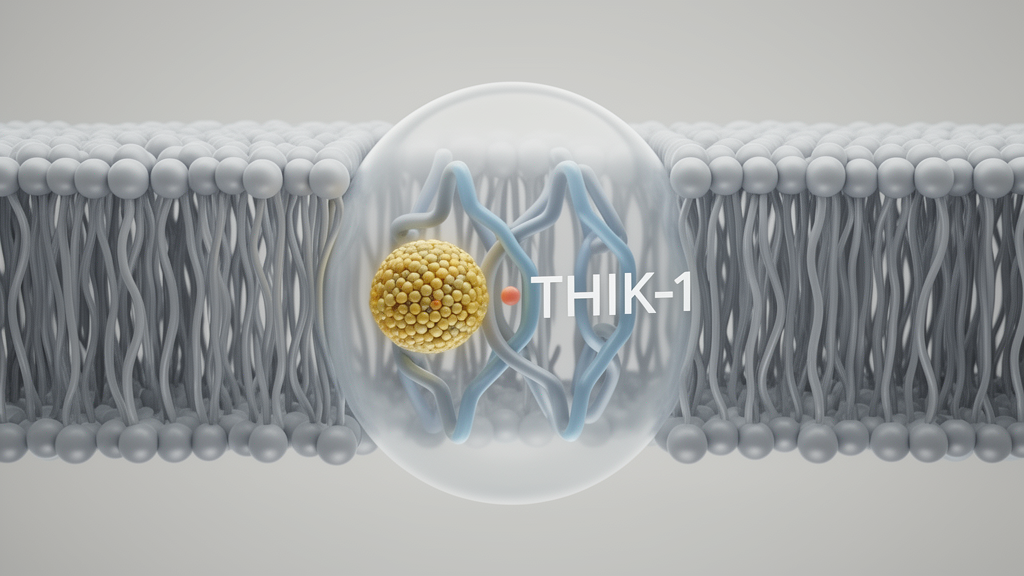
Unexpectedly, the cryo-EM structure of THIK-1 bound to arachidonic acid showed a strong density closely associated with the fatty acid pocket that precisely matched the shape of cholesterol. The interaction between cholesterol, arachidonic acid, and the channel is mediated by extensive hydrophobic contacts, effectively allowing cholesterol to function as a structural cap over the fatty acid pocket. This stabilization facilitates a conformational change in the channel’s gate, specifically displacing the tyrosine residue Tyr273 from the central axis, which enhances potassium permeability and stabilizes the activated state of the channel.
Complementary cellular assays using the human THP-1 monocyte cell line, differentiated into macrophage-like cells, confirmed the functional significance of this structural observation. Neither arachidonic acid nor cholesterol alone significantly increased IL-1β expression or secretion in these cells. However, when cells were exposed to a combination of arachidonic acid and cholesterol, a pronounced upregulation of IL-1β was observed. This synergistic effect was effectively suppressed by the THIK-1 inhibitors halothane and C101248, confirming that the cholesterol-amplified inflammatory response is dependent on THIK-1 activity.
The study also elucidated the distinct inhibitory mechanisms of halothane and C101248. Structural analysis revealed that halothane inhibits THIK-1 by binding to a hydrophobic pocket adjacent to the fatty acid site, inducing allosteric conformational changes that sterically hinder fatty acid engagement. In contrast, C101248 directly blocks the channel pore by interacting with key gating residues and the selectivity filter, thereby preventing ion conduction. These distinct mechanisms provide a structural basis for developing selective inhibitors with optimized efficacy and reduced off-target effects.
To evaluate the therapeutic potential of targeting THIK-1 in vivo, the researchers used Apoe-deficient mice fed a high-cholesterol diet, a standard preclinical model for atherosclerosis. The mice were treated with the selective THIK-1 inhibitor C101248 at two different doses during the final three weeks of a 12-week experimental period. Blood biochemistry analysis demonstrated that administration of C101248 did not alter the atherosclerosis index calculated from plasma total cholesterol and high-density lipoprotein cholesterol levels, indicating that the drug’s effects were independent of lipid modulation.
Analysis of atherosclerotic lesions in the mouse aortas using Oil Red O staining showed that the high-cholesterol diet significantly exacerbated plaque formation compared to the chow diet control. However, treatment with C101248 significantly mitigated atherosclerotic plaque formation in a dose-dependent manner. The high-dose group showed a particularly marked reduction in plaque burden in both the whole aorta and aortic root cross-sections. These results demonstrate that inhibiting THIK-1 can slow the progression of atherosclerosis without affecting plasma lipid levels.
The selective expression of THIK-1 in macrophages and microglia, but not in adaptive immune cells, suggests that targeting this channel could mitigate inflammation without inducing systemic immunosuppression. This offers a significant advantage over broad anti-cytokine therapies, which may carry risks of immune-related side effects. The findings position THIK-1 as a central component in the cholesterol-NLRP3-IL-1β axis, providing a mechanistic explanation for how dietary or metabolic cholesterol exacerbates vascular inflammation.
By integrating structural insights with functional and preclinical data, this study highlights THIK-1 as a novel therapeutic target for atherosclerosis. The identification of cholesterol as a co-stabilizer of the channel’s activator bridges the gap between lipid accumulation and inflammasome activation. Future efforts to optimize drug candidates and further elucidate the broader physiological roles of THIK-1 will be essential for translating these findings into clinical benefits for patients with atherosclerotic disease.
The structural and functional characterization of THIK-1 in this study relies on the expression of full-length human recombinant protein in HEK293F cells, followed by purification using affinity and size-exclusion chromatography. The resulting cryo-EM structures were resolved at high resolutions, ranging from 2.52 Å for the apo state to 3.21 Å for the C101248-bound state. These high-resolution maps allowed the research team to identify specific atomic interactions that were not previously observable. For instance, the apo structure revealed a domain-swapped architecture, a feature consistent with prior studies but now detailed with the addition of the newly identified fatty acid pocket. The presence of this pocket, formed by pore helix 1, transmembrane helix 1, and transmembrane helix 4, provides a molecular explanation for how the channel senses lipid ligands. The structural data also confirmed that the channel functions as a potassium channel, with currents modulated by arachidonic acid, halothane, and C101248, as demonstrated by whole-cell patch electrophysiology in HEK293T cells.
The R92S variant of THIK-1, which is associated with multiple human diseases according to the GENEBASS database, served as a critical tool for understanding the role of the arginine residue in fatty acid binding. Structural comparison between the wild-type apo state and the R92S variant showed highly similar overall conformations, with a Cα root mean square deviation of 0.69 Å across 409 atoms. However, the substitution of arginine with serine led to local rearrangements within the fatty acid pocket. In the R92S structure, the fatty acid shifted to occupy the original position of arginine, forming bidirectional hydrogen bonds with both serine 92 and arginine 258. This interaction allowed the variant to maintain fatty acid binding despite the loss of the charged side chain. Pore radius measurements indicated that the R92S substitution induced a more constricted channel conformation, a finding supported by electrophysiological data showing reduced potassium conductance in cells expressing the R92G and R92S mutants compared to the wild-type channel.
The distinct inhibitory mechanisms of halothane and C101248 were further clarified by the structural data, revealing that these compounds target different regions of the channel. Halothane was found to bind to a hydrophobic pocket adjacent to the fatty acid site, surrounded by residues including valine 91, methionine 115, and phenylalanine 103. This binding induced allosteric effects, causing a downward shift of arginine 92 and an inward shift of phenylalanine 262, which sterically hindered the engagement of fatty acids. In contrast, C101248 occupied a binding pocket within the pore region, forming hydrogen bonds with threonine 110 and threonine 237, while hydrophobic interactions with isoleucine 139, phenylalanine 276, and tyrosine 273 stabilized the complex. The binding of C101248 resulted in the displacement of the tyrosine gate, forcing it apart and directly inhibiting ion conduction. These structural insights highlight the diverse approaches available for targeting THIK-1 and provide a basis for developing selective inhibitors with optimized efficacy.
In the preclinical animal study, the therapeutic potential of C101248 was evaluated in 8-week-old female Apoe-deficient mice on a C57Bl/6J background. The mice were allocated into four groups over a 12-week period, with the treatment groups receiving intraperitoneal injections of C101248 at doses of 10 mg/kg or 20 mg/kg every three days during the final three weeks of the experiment. The selection of this mouse model was justified by the 85.91% sequence identity between murine and human THIK-1, with the critical amino acid residues for C101248 binding conserved between the orthologs. Blood biochemistry analysis confirmed that C101248 administration did not alter the atherosclerosis index, calculated from plasma total cholesterol and high-density lipoprotein cholesterol levels. This indicates that the observed reduction in plaque formation was not due to changes in lipid metabolism but rather to the direct inhibition of the inflammatory pathway mediated by THIK-1.
The study also addressed the role of THIK-1 in the broader context of vascular inflammation by examining its expression in macrophage-like cells. Immunoblot analysis revealed that THIK-1 expression was markedly upregulated during the differentiation of THP-1 cells into macrophages using phorbol esters or lipopolysaccharides, whereas undifferentiated cells exhibited minimal levels. This selective expression pattern suggests that targeting THIK-1 could mitigate inflammation in specific cell types without broadly suppressing immune function. The findings position THIK-1 as a central component in the cholesterol-NLRP3-IL-1β axis, providing a mechanistic explanation for how dietary or metabolic cholesterol exacerbates vascular inflammation. By elucidating the structural dynamics of THIK-1 and demonstrating its efficacy in preclinical models, the study lays the groundwork for the development of THIK-1 inhibitors as a novel class of anti-inflammatory therapeutics for atherosclerotic disease.
Subject of Research: Molecular mechanisms of THIK-1 channel regulation by cholesterol and its role in atherosclerosis progression.
Article Title: Cholesterol binding stabilizes the activated state of THIK-1 and promotes atherosclerosis
Article References: Dai, Z., Li, Y., Hou, Z., Duan, G., Hu, Z., Yang, A., Wang, Q., Wang, W., Luo, J., Zuo, P., Yin, Y., & Yin, Y. (2026). Cholesterol binding stabilizes the activated state of THIK-1 and promotes atherosclerosis. EMBO Reports. https://doi.org/10.1038/s44319-026-00921-2
Image Credits: AI Generated
DOI: 10.1038/s44319-026-00921-2
Keywords: THIK-1, Atherosclerosis, Cholesterol, Cryo-EM, Inflammation, Potassium Channel, IL-1β, NLRP3, binding, stabilizes, activated, state
News Source: Drew Townsend. (November 7, 2026). Cholesterol Binding Stabilizes THIK-1 Channel and Promotes Atherosclerosis. Scienmag.