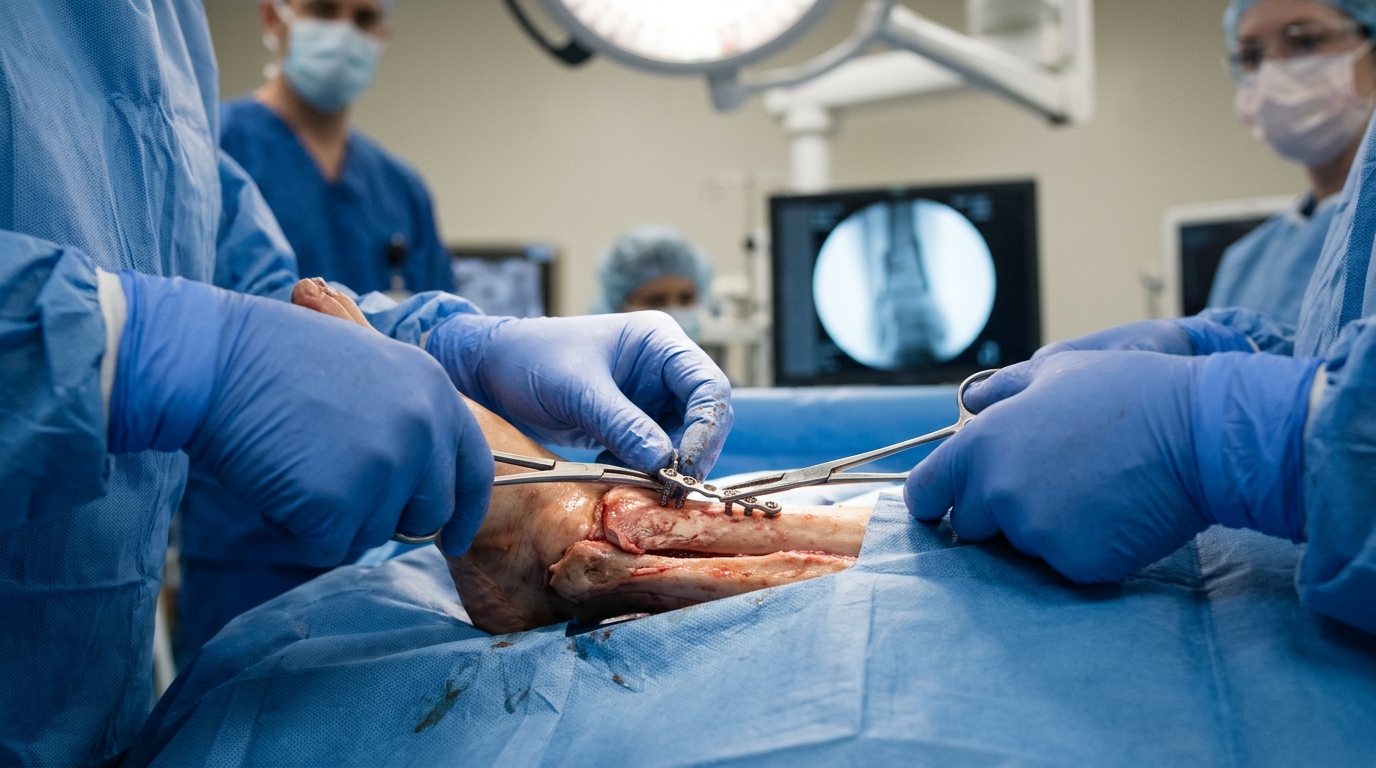
In a multicenter retrospective case series of 89 patients, surgeons evaluating the posterior to anterior malleolar extended lateral approach, known as PAMELA, combined with a dual-window technique reported favorable radiographic reduction quality and acceptable short-term exploratory functional outcomes. The clinical study investigated the intervention in strictly selected patients presenting with low-energy rotational ankle fractures involving posterior malleolar fractures accompanied by anterior tibiofibular syndesmosis injury. All 89 enrolled individuals were treated using the single-incision technique and successfully completed the postoperative monitoring protocol.
The surgical approach established two distinct operating windows—an anterior tibiofibular syndesmosis window and a posterolateral window—through a single surgical cut. Researchers aimed to assess both the reduction quality of the injured structures and short-term functional recovery following treatment. Investigators tracked primary radiographic endpoints using standard postoperative X-rays alongside detailed computed tomography scans to inspect articular surfaces and syndesmotic alignment.
All fractures examined in the series achieved complete bone union within a reported time of 13.0 weeks, with observed union times spanning between 12.0 and 14.0 weeks. Follow-up across the multicenter cohort lasted for a duration of 14.0 months, within an overall recorded range of 13.0 to 16.0 months. Standard postoperative radiographs evaluated according to the Burwell-Charnley radiographic criteria demonstrated that all 89 patients, representing 100 percent of the cohort, achieved anatomical reduction of their ankle fractures.
Cross-sectional assessment using postoperative computed tomography scans provided closer evaluation of posterior malleolar articular surface reduction and tibiofibular syndesmosis restoration. These scans revealed that 87 patients, or 97.8 percent, achieved excellent articular surface reduction defined as a sagittal step-off of 1 millimeter or less. Two patients, representing 2.2 percent of the group, showed satisfactory reduction with a step-off between 1 and 2 millimeters, while no patient experienced poor reduction characterized by a step-off of 2 millimeters or greater. Syndesmotic malreduction was documented on computed tomography in 1 patient, accounting for 1.1 percent of the cohort.
Exploratory functional outcomes recorded at the final follow-up visit included the American Orthopaedic Foot & Ankle Society ankle-hindfoot score, the visual analog scale for pain, and range of motion measurements. The cohort achieved an ankle-hindfoot score of 91.0 points, ranging from 88.0 to 98.0 points. Among the participants, 63 patients (70.8 percent) received an excellent rating, and 26 patients (29.2 percent) were categorized as good. Patients reported a visual analog scale pain score of 0.0 with a range from 0.0 to 1.0, while ankle range of motion demonstrated plantar flexion of 30.0 degrees (range, 25.0 to 35.0 degrees) and dorsiflexion of 10 degrees (range, 5.0 to 15.0 degrees).
The authors noted significant methodological boundaries, classifying the investigation as Level IV evidence due to its retrospective design and the lack of a comparative control group. Because the case series did not evaluate patients against traditional surgical approaches, the findings cannot confirm whether the dual-window technique offers superior outcomes over conventional operations. Consequently, the researchers concluded that the PAMELA procedure can currently be regarded only as an alternative surgical option for managing selected low-energy rotational ankle injuries.
Subject of Research: Radiographic reduction quality and functional outcomes of the PAMELA dual-window approach in rotational ankle fractures
Article Title: Reduction quality in posterior malleolar fractures with anterior tibiofibular syndesmosis injury using the posterior to anterior malleolar extended lateral approach (PAMELA) with dual-window technique: a multicenter retrospective case series
Article References: Feng, Y., Xia, J., Yu, G., Cao, G., Zhao, D., Zhang, K., Zhou, H., Li, S., & Song, Y. (2026). Reduction quality in posterior malleolar fractures with anterior tibiofibular syndesmosis injury using the posterior to anterior malleolar extended lateral approach (PAMELA) with dual-window technique: a multicenter retrospective case series. BMC Surgery. https://doi.org/10.1186/s12893-026-04339-4
Image Credits: AI Generated
DOI: 10.1186/s12893-026-04339-4
Keywords: ankle fractures, posterior malleolar fractures, anterior tibiofibular syndesmosis, PAMELA technique, orthopedic surgery, computed tomography, reduction quality, retrospective case series, Reduction, quality, posterior, malleolar
News Source: Ophelia Keating. (November 7, 2026). Study Assesses Dual-Window PAMELA Technique for Complex Ankle Fracture Reduction. Scienmag.