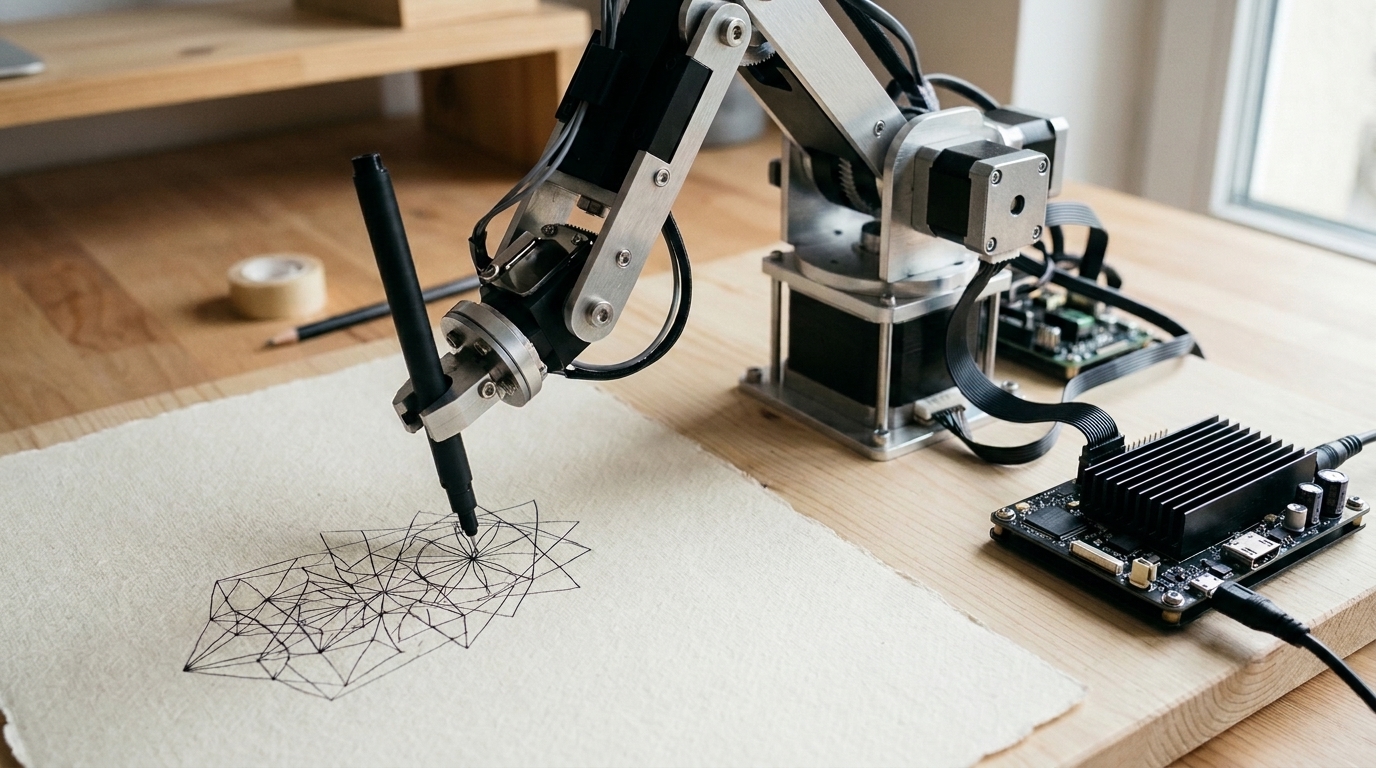
Robotics researchers have demonstrated an autonomous human-robot interaction pipeline that enables a physical six-degree-of-freedom robotic drawing arm to interpret natural language scene descriptions and execute physical drawings on paper without relying on cloud processing, external computational servers, or computer vision sensors. Published in the journal Discover Robotics by a research team comprising Nuttasorn Aiemsetthee, Renke Liu, Kavé Salamatian, and Hideyuki Sawada, the study investigates how compact, locally hosted large language models can perform spatial decomposition and numerical parameter generation within resource-constrained environments. While contemporary language-guided robotic frameworks typically depend on high-performance remote servers running massive commercial models or vision-language systems that require substantial bandwidth, this newly evaluated platform operates entirely on local consumer hardware coupled with a low-cost physical manipulator assembled for less than one hundred dollars.
The central motivation of the investigation addresses a persistent barrier in embodied artificial intelligence and human-robot interaction: bridging the gap between high-level semantic reasoning and deterministic, low-level robotic motion on embedded platforms. In conventional drawing-robot architectures, machines typically reproduce images via computer-vision pipelines, non-photorealistic rendering, portrait tracing algorithms, or predefined templates that trace existing visual contours. By contrast, the authors devised a direct text-to-geometry-to-robot framework wherein a user simply provides conversational descriptive sentences, such as instructions depicting a landscape with mountains, houses, and flowers. The system translates these descriptions into structured two-dimensional geometric specifications, converts them into explicit metric coordinates constrained to a physical sheet of paper, calculates required joint angles through analytical inverse kinematics, and actuates physical servo motors to sketch the intended composition.
To achieve local execution without server dependence, the researchers screened several compact open-source model architectures, including LLaMA 3, Gemma 3, Mistral, and DeepSeek-R1, focusing specifically on their stability during geometric decomposition and their adherence to strict numerical formatting constraints. Preliminary evaluations revealed that Gemma 3 and LLaMA 3 exhibited superior numerical consistency, leading the team to conduct in-depth benchmarking across three specific model configurations: Gemma 3 at the four-billion parameter scale occupying 3.3 gigabytes of memory, Gemma 3 at the twelve-billion parameter scale requiring 8.1 gigabytes, and LLaMA 3 at the eight-billion parameter scale utilizing 4.7 gigabytes. All language models were hosted locally without fine-tuning using Ollama on a consumer laptop equipped with an Apple M1 Pro processor, mirroring realistic computational limits for embedded, decentralized robotic workstations.
The software architecture translates natural language input through a structured multi-stage reasoning pipeline designed to prevent the numerical drift and formatting errors often produced when small models generate raw coordinates in a single step. The workflow begins with semantic scene interpretation to identify distinct target objects, progresses to geometric decomposition where each object is resolved into basic primitives such as rectangles, circles, or triangles with assigned dimensions, and advances through shape extraction and schema normalization to ensure valid two-dimensional representations. Finally, the pipeline executes zero-shot coordinate generation, calculating explicit polygonal boundary vertices in millimeters bounded by a standardized drawing surface measuring 255 millimeters by 180 millimeters. This strict modularity ensures that high-level linguistic reasoning remains independent from the downstream kinematic calculations and trajectory planning algorithms.
To evaluate the language interpretation subsystem systematically across different degrees of contextual guidance, the researchers established three prompt categories: free-layout prompts providing semantic concepts without spatial constraints, layout-guided prompts specifying coarse spatial anchors such as top-left or bottom-center while leaving exact dimensions unspecified, and geometry-guided prompts providing explicit millimeter measurements and predetermined placements. Across thirty unique scene descriptions evaluated across five experimental repetitions for each model—totaling 450 experimental trials—the authors measured completion rates, scene timeout frequencies under a ten-minute budget, JSON schema parsing success, object coverage, and wall-clock execution latency on CPU hardware under fixed decoding parameters.
The benchmark findings demonstrated marked operational differences across the evaluated models. Both the four-billion parameter Gemma 3 and the eight-billion parameter LLaMA 3 achieved near-complete execution across all prompt conditions, whereas the larger twelve-billion parameter Gemma 3 model suffered frequent timeouts during unconstrained free-layout and layout-guided tasks due to the computational latency of processing multi-stage reasoning on CPU hardware. Every evaluated model achieved a perfect one-hundred percent schema parsing success rate, confirming that the structured normalization pipeline successfully eliminated syntactic errors. Across all runs, the median pipeline runtime was approximately 82 seconds per scene. Highly constrained geometry-guided prompts accelerated Gemma 3 processing to an average of 53 seconds per scene, while free-layout prompting on LLaMA 3 required an average of 128 seconds, highlighting the direct relationship between prompting constraints and computational overhead.
In terms of scene completeness, the four-billion parameter Gemma 3 model generated the highest overall object coverage across prompt variations, producing an average of 5.35 objects per scene overall and reaching 7.6 objects per scene under layout-guided conditions. Detailed omission analyses indicated that large structural primitives, such as mountains, were reliably generated across trials, whereas smaller or multi-part elements, such as flower stems or detailed house components, were omitted more frequently under free-layout prompts. Because the compact four-billion parameter Gemma 3 model demonstrated the optimal balance of high object coverage, zero parsing failures, reliable pipeline completion, and low runtime latency under local CPU constraints, the researchers selected it as the primary language engine for subsequent physical drawing trials.
The physical robotic apparatus consisted of an articulated six-degree-of-freedom manipulator actuated by six digital metal-gear servo motors offering 35 kilogram-centimeter torque and a 270-degree operational range, controlled by an Arduino Mega 2560 microcontroller operating at a serial baud rate of 115,200 bits per second. Powered by a regulated 12.5-volt electrical supply to prevent voltage drops during multi-joint actuation, the manipulator confronted a vertical drawing board placed 6.5 centimeters in front of its base. To execute movements, the system converted two-dimensional paper waypoints into spatial end-effector poses using Denavit-Hartenberg forward kinematics, followed by a damped least-squares inverse kinematics solver that prevented mathematical singularities and sudden joint velocity spikes when the arm reached across the drawing plane, while an adaptive trajectory interpolator filtered out displacements smaller than the mechanical dead-zone of the servo gears.
Physical drawing experiments assessed single-primitive execution fidelity across two distinct free-layout prompts instructing the generation of a landscape containing a mountain, a house, and a small flower. Drawing trajectories were extracted for two representative elements whose vertices could be precisely digitized: the triangular main peak of the mountain and the rectangular wall of the house. To isolate robotic actuation repeatability from linguistic variability, the experimental protocol evaluated two prompt formulations across three generation runs, testing two target shapes with five repeated physical drawing trials per coordinate set, producing sixty physical drawing tests. Pen-tip contact against the vertical surface was modulated via controlled rotational micro-adjustments of joint M0, while joints M1 through M5 controlled continuous planar drawing motion from a calibrated reference home posture.
Quantitative geometric error analysis assessed drawing precision across four primary metrics: dimensional size error, vertex Euclidean deviation, vertex standard deviation across repetitions, and centroid position error. For the rectangular house wall, mean size errors were measured at 6.27 millimeters under the first prompt and 7.33 millimeters under the second prompt. However, the second prompt achieved substantial improvements in spatial placement, reducing mean vertex error from 33.43 millimeters down to 16.08 millimeters and mean position error from 30.27 millimeters down to 15.34 millimeters. The authors noted that rectangular boundary precision was primarily influenced by joint-level positioning drift accumulated along straight lines rather than dimensional scaling errors.
Conversely, the triangular mountain peak exhibited different error characteristics. Triangular instances displayed mean size errors of 24.35 millimeters under Prompt 1 and 18.00 millimeters under Prompt 2, with corresponding mean vertex errors of 20.46 millimeters and 16.81 millimeters, and position errors of 10.10 millimeters and 9.20 millimeters. Interestingly, linguistic interpretation occasionally produced trapezoidal approximations rather than pure triangles under the first prompt, resulting in a 22.43 millimeter vertex error and an 11.60 millimeter position error. This finding illustrated that while the compact language model reliably satisfied coarse metric dimensions, it occasionally substituted related geometric sub-types. Robotic execution tests on complete multi-object scenes further revealed that small line segments and slanted contours exhibited minor breaks or jitter caused by mechanical backlash, servo dead-zones, base vibrations, and decreased kinematic sensitivity near the boundaries of the workspace axes.
Ultimately, the study validates the practical feasibility of deploying compact, four-billion parameter language models on local hardware as deterministic geometric planners for low-cost robotic arms. By decoupling linguistic semantic reasoning from analytical motion kinematics, the framework proves that physical drawing machines can interpret open-ended textual prompts without resorting to resource-heavy vision systems or remote cloud computation. The authors concluded that future iterations will focus on implementing automated full-scene multi-object execution without manual operator selection, refining schema constraints to strictly enforce geometric sub-types, and integrating higher-resolution closed-loop actuators to mitigate mechanical dead-zone artifacts during intricate stroke transitions.
Subject of Research: On-device natural language human-robot interaction and robotic drawing
Article Title: Visual scene drawing through human–robot natural language interactions using lightweight large language models
Article References: Aiemsetthee, N., Liu, R., Salamatian, K., & Sawada, H. (2026). Visual scene drawing through human–robot natural language interactions using lightweight large language models. Discover Robotics, 2(1), Article 10. https://doi.org/10.1007/s44430-026-00025-5
Image Credits: AI Generated
DOI: 10.1007/s44430-026-00025-5
Keywords: Robotics, Human-Robot Interaction, Large Language Models, Kinematics, Embedded Systems, Trajectory Planning, Computer Science, Artificial Intelligence, Visual, scene, drawing, human
News Source: Scienmag.