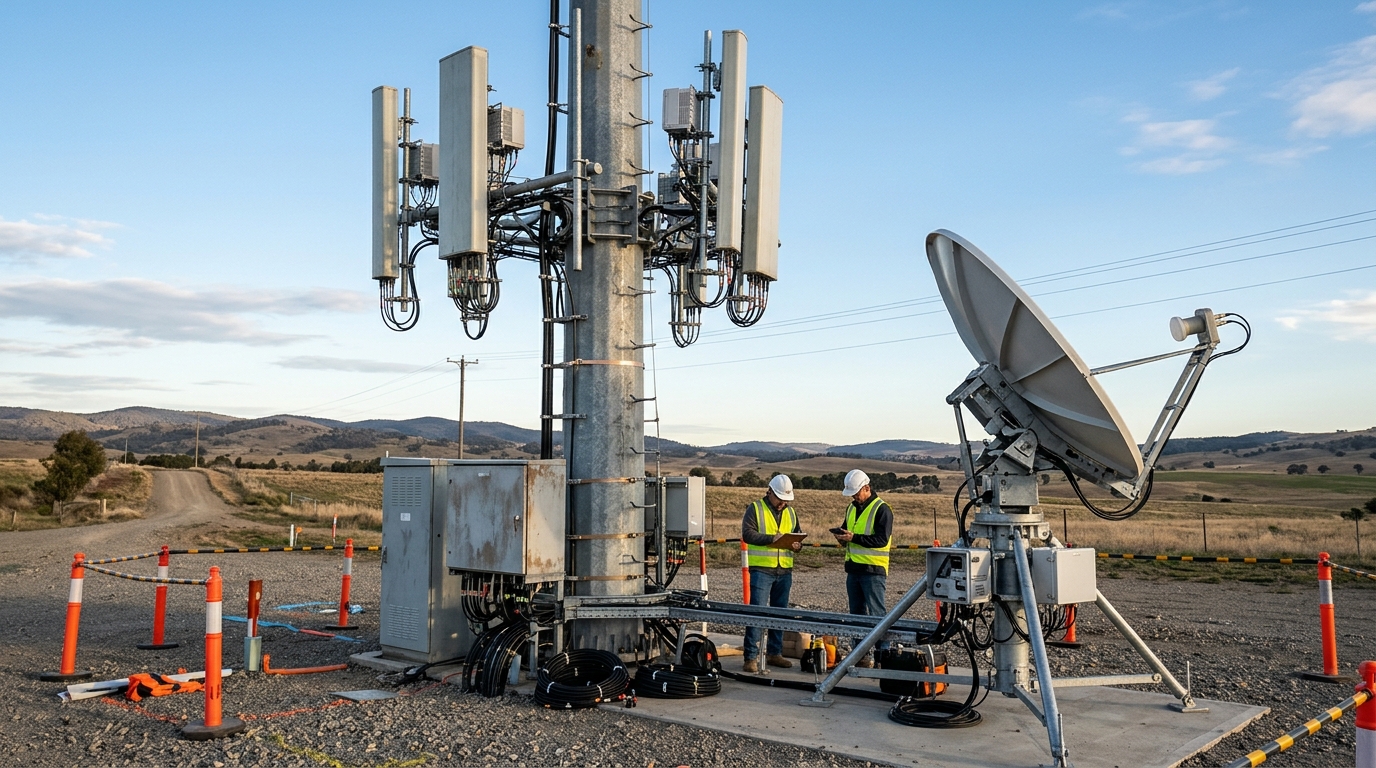
A comprehensive system-level simulation study has revealed that coupling high-frequency terrestrial millimeter-wave base stations with low Earth orbit satellites through 5G New Radio Dual Connectivity provides substantial throughput and latency gains for downlink transmissions while exposing severe performance bottlenecks across the uplink path. Conducting extensive network simulations across thirty independent trials, researchers Grishan Pradhan and Babu R. Dawadi found that configuring user equipment to concurrently aggregate radio resources from a fixed 28 gigahertz terrestrial master cell and dynamically selected 2 gigahertz satellite secondary cells boosted constant bit rate downlink goodput by 321.29 percent compared to a satellite-only baseline and by 28.95 percent relative to a terrestrial-only baseline. Downlink end-to-end transmission delay simultaneously dropped by 71.16 percent against satellite-only links and 62.75 percent against standalone terrestrial links. However, the evaluation demonstrated that these gains do not extend symmetrically across network traffic flows, as uplink transmissions through dual connectivity suffered drastic throughput degradation and severe millisecond-scale latency inflation compared to dedicated terrestrial connections.
The study directly addresses critical deployment dilemmas underlying fifth-generation mobile standards, where high-bandwidth millimeter-wave spectrum supports enhanced mobile broadband, ultra-reliable low-latency communication, and massive machine-type communication at the expense of high path attenuation and pronounced signal blockage vulnerability. In standalone urban or rural millimeter-wave configurations, mobile terminals frequently experience severe ping-pong handovers, frequent service drops, and elevated latency variations that disrupt real-time applications. While integrating non-terrestrial networks comprised of low Earth orbit constellations has emerged as an essential architectural paradigm within 3GPP Technical Report 38.821 to guarantee coverage across remote, rural, and disaster-prone zones, conventional deployments rely primarily on hard handovers between passing satellites or coarse multi-connectivity handoffs. Prior literature heavily emphasized theoretical stochastic geometry formulations, high-level structural surveys, or isolated terrestrial carrier aggregations without evaluating how end-to-end transport layer protocols, dynamic orbital mechanics, packet convergence split-bearer policies, and physical layer channel variations interact concurrently inside a single unified simulation environment.
To evaluate these complex protocol interactions under rigorous system-level conditions, the investigators developed a customized software architecture built upon discrete-event network simulation tools comprising OMNeT++ version 6.2.0, the INET framework version 4.5.4, and Simu5G version 1.3.0. Because standard Simu5G distributions natively focus on E-UTRA-NR dual connectivity wherein legacy long-term evolution base stations serve as master anchors, the authors substantially modified the core platform to realize true standalone New Radio to New Radio Dual Connectivity. The resulting computational architecture integrates an NR-primary master cell group running at 28 gigahertz with an array of moving regenerative low Earth orbit gNodeBs acting as secondary cell group candidates at 2 gigahertz. The platform maintains continuous centralized tracking of user dual-connectivity states, implements dynamic secondary cell measurement and handover routines, supports Packet Data Convergence Protocol split-bearer forwarding with automatic master fallback, and embeds a runtime-selective hybrid channel model capturing disparate terrestrial and non-terrestrial propagation environments.
The central protocol advancement within the evaluated architecture governs how packet flows are handled across heterogeneous physical links through the Packet Data Convergence Protocol layer. Under the proposed dual-connectivity configuration, user devices maintain an uninterrupted control and user plane connection with the stationary terrestrial gNodeB serving as the master anchor while opportunistically engaging with passing satellites. When an eligible satellite secondary cell is detected and activated, the downlink bearer splits incoming packet streams across both physical access legs in accordance with preconfigured split policies, aggregating transmission bandwidth across disparate frequency bands. If orbital motion moves a satellite out of viable range or received signal strength drops below operable limits without a superior candidate available, the framework executes an immediate fallback routine, routing all outstanding traffic solely through the terrestrial master cell. This make-before-break forwarding discipline prevents catastrophic session drops during rapid orbital traverses while isolating end-user applications from underlying space-segment handover interruptions.
Managing satellite secondary attachments requires precise mathematical decision rules capable of tracking orbital sweeps without triggering excessive high-frequency cell switching. The researchers formulated an event-driven measurement pipeline where secondary candidates are evaluated whenever broadcast signal metrics arrive from satellites registered in the master cell candidate directory. The measurement metric, derived from the mean received signal-to-interference-plus-noise ratio computed across allocated resource blocks, must satisfy a strict minimum threshold of negative 105 decibels to maintain candidate eligibility. To replace an existing active candidate, an alternate satellite must exceed the stored candidate quality by an adaptive hysteresis margin defined as the candidate signal metric divided by an implementation factor of ten. Once candidate selection or cell release conditions are verified, the simulator enforces a brief measurement collection window of 0.00001 seconds followed by an execution switching delay of 0.050 seconds before applying physical link attachments, thereby establishing an adaptive buffer against transient fading fluctuations.
The underlying physical layer simulation integrates distinct propagation regimes through a hybrid radio channel engine that dynamically routes mathematical link evaluations based on nodal altitude. Terrestrial millimeter-wave paths operating at 28 gigahertz are modeled via standardized 3GPP Technical Report 38.901 equations, whereas satellite paths operating at 2 gigahertz invoke large-scale non-terrestrial formulations defined in 3GPP Technical Report 38.811. The satellite engine computes instantaneous line-of-sight elevation angles and Earth-curvature slant distances to determine basic free-space path attenuation using logarithmic carrier frequency and distance terms alongside situational clutter losses and log-normal shadow fading. Furthermore, because conventional Simu5G Jakes fading implementations calculate Doppler shifts solely from ground terminal velocity, the researchers incorporated a customized velocity vector dot-product calculation. This formula extracts the true radial relative velocity between the satellite traveling at 7.5 kilometers per second and the ground terminal, driving realistic time-selective Jakes fading characterized by theoretical maximum Doppler frequency shifts approaching approximately 50 kilohertz.
The evaluation scenario was constructed using thirty-five user terminals positioned within the coverage footprint of a stationary terrestrial base station and nine regenerative low Earth orbit satellites orbiting at an altitude of approximately 600 kilometers with overlapping ground coverage footprints. To evaluate mixed mobility impacts without disconnecting terminals from terrestrial range, eight user terminals were assigned random waypoint mobility patterns across continuous spatial paths while twenty-seven remained stationary. The traffic generation profile comprised both fixed constant bit rate applications delivering 4096-byte datagrams every 1.6 milliseconds—equating to an offered load of 20.07 megabits per second per flow—and connection-oriented TCP sessions attempting bulk transfers of 300 mebibytes. Uplink traffic was assigned across dedicated subsets of mobile and static devices generating matching constant bit rate and TCP data volumes directed toward an application server positioned behind an idealized, unconstrained core network and User Plane Function.
Across thirty independent 50-second simulation runs, the aggregate results demonstrated dramatic yet asymmetric performance shifts across application types and directional paths. In constant bit rate downlink tests across twenty-four user terminals, mean goodput escalated from 3.2818 megabits per second under satellite-only operation and 10.7222 megabits per second under terrestrial-only operation to 13.8259 megabits per second under New Radio Dual Connectivity. Downlink latency plummeted from 1479.841 milliseconds in the satellite baseline and 1145.698 milliseconds in the terrestrial baseline down to 426.771 milliseconds in the dual configuration. For downlink TCP flows across five test terminals, dual connectivity similarly elevated mean goodput to 2.4126 megabits per second compared to 0.0465 megabits per second for satellite-only and 0.5707 megabits per second for terrestrial-only modes. However, TCP downlink delay increased relative to both baselines due to transport-layer buffer queuing, asymmetric path latency, acknowledgment pacing, and packet reordering across disparate terrestrial and non-terrestrial routes.
In stark contrast to downlink gains, the uplink evaluation highlighted profound performance deficits when dual connectivity was compared against direct terrestrial links. Uplink TCP goodput exhibited a matching disparity, recording 0.0222 megabits per second under dual connectivity versus 2.6912 megabits per second in terrestrial-only mode. Radio-level metrics elucidated this gap: while the non-terrestrial downlink leg achieved viable mean channel quality indicators of 8.72 and signal-to-interference-plus-noise ratios of 18.38 decibels, the non-terrestrial uplink signal-to-interference-plus-noise ratio averaged negative 4.89 decibels, compared to positive 18.87 decibels on the terrestrial leg, leaving the satellite uplink severely power-limited.
Temporal tracking of serving-cell evolution confirmed that terrestrial master connections remained perfectly continuous throughout the simulation runs while satellite secondary attachments transitioned in highly synchronized waves reflecting shared orbital trajectory dynamics across the user array. The investigators noted that while dual connectivity successfully converts satellite links into effective supplementary downlink pipes, its overall utility is fundamentally shaped by path asymmetry and transport-layer queuing. The authors emphasized that future developments must incorporate satellite trajectory prediction, intelligent queue-aware split scheduling, non-ideal feeder and X2 backhaul latency modeling, residual carrier frequency offset tracking, and Packet Data Convergence Protocol packet duplication to mitigate uplink penalties and stabilize delay-sensitive traffic across emerging beyond-5G and 6G non-terrestrial architectures.
Subject of Research: Evaluation of New Radio Dual Connectivity in integrated terrestrial-satellite 5G networks
Article Title: Evaluation of integrated framework for terrestrial-LEO 5G networks with new radio dual connectivity
Article References: Pradhan, G., & Dawadi, B. R. (2026). Evaluation of integrated framework for terrestrial-LEO 5G networks with new radio dual connectivity. Discover Networks, 2(1), Article 24. https://doi.org/10.1007/s44354-026-00039-w
Image Credits: AI Generated
DOI: 10.1007/s44354-026-00039-w
Keywords: 5G New Radio, Dual Connectivity, Non-Terrestrial Networks, LEO Satellites, Simu5G, Network Simulation, Packet Data Convergence Protocol, Satellite Communications, Evaluation, integrated, framework, terrestrial-LEO
News Source: Denise Maddox. (November 7, 2026). Dual Connectivity Boosts Downlink Performance in Terrestrial-Satellite 5G Networks. Scienmag.