A new study has successfully established the first definitive, specimen-based records of the giant ruby snapper, Etelis boweni, from Okinawa Prefecture in Japan and Taiwan, resolving long-standing taxonomic uncertainty. For many years, this large-bodied marine fish was frequently misidentified as the superficially similar species Etelis carbunculus. The confusion stemmed from the historical tendency to classify these two distinct fish under a single taxon, a categorization that persisted until recent morphological and genetic advancements allowed for better separation. By examining specific anatomical characteristics and conducting mitochondrial DNA analysis on specimens recently collected from these regions, researchers have clarified that E. boweni is a distinct species with a broad distribution throughout the Ryukyu Archipelago and the waters surrounding Taiwan.
The study, which appeared in Acta Ichthyologica et Piscatoria, utilized detailed morphometric measurements and meristic counts to compare specimens of E. boweni with those of its close relative, E. carbunculus. Researchers followed standardized protocols for counting fin rays, scale rows, and gill rakers, utilizing calipers for precision measurements. Because some specimens were obtained directly from commercial fish markets, the research team went to significant lengths to verify the collection localities by interviewing market staff and those involved in the local fishing industry. These rigorous curatorial procedures were essential to ensure the validity of the distributional data, as the research team aimed to provide an unambiguous confirmation of the species’ presence in areas where its range had previously been speculative or mistakenly recorded.
To support the morphological findings, the research team performed phylogenetic analysis using partial sequences of the mitochondrial cytochrome oxidase subunit I, or COI, gene. Genomic DNA was extracted from muscle tissue using a standardized sodium hydroxide protocol, and the resulting sequences were amplified via polymerase chain reaction using specific primers designed for fish barcoding. The sequences were then processed through a maximum likelihood analysis with robust bootstrap support to ensure high confidence in the phylogenetic placement of the Okinawa specimens. The results placed the new specimens firmly within the E. boweni clade, distinctly separate from E. carbunculus and other related species in the genus, thereby providing a molecular basis to bolster the visual and meristic identification criteria.
The study highlights clear diagnostic characters that allow for the distinction between E. boweni and E. carbunculus. Most notably, the giant ruby snapper is characterized by a black-tipped upper lobe of the caudal fin, whereas E. carbunculus lacks such melanophores on its fin. Furthermore, the two species differ in the shape and structure of the opercular spine, with E. boweni possessing a blunt, short spine compared to the long, pointed spine observed in E. carbunculus. Meristic differences, specifically the count of 14 scale rows below the lateral line in E. boweni versus 12 in E. carbunculus, further substantiate the separation of these taxa. These findings align with criteria previously proposed by other researchers, though the present study noted minor variations in pectoral-fin ray counts and specific body proportions in the examined individuals, which the authors attributed to natural phenotypic variability.
Historical records of the genus Etelis from the Ryukyu Archipelago and Taiwanese waters underwent a thorough re-evaluation in light of these diagnostic criteria. The research revealed that many specimens previously labeled as E. carbunculus or E. marshi—a species now regarded as a junior synonym of E. carbunculus—were, in fact, E. boweni. Photographs from historical studies, such as those provided by Gushiken in 1972 and Yoshino in 1984, show clear indicators of the black-tipped caudal fin and other traits diagnostic of E. boweni. By re-identifying these historical occurrences, the researchers confirmed that the presence of E. boweni in these waters is not a recent phenomenon, but rather a long-standing ecological reality that had been obscured by taxonomic misunderstanding.
The study also provides insights into the spatial distribution of the giant ruby snapper in relation to its relative, E. carbunculus. Evidence from local fisheries suggests that these two species are landed simultaneously at various locations, including Nago Fishing Port and the Yaeyama Fisheries Cooperative Association, indicating a degree of sympatric coexistence in the waters of Okinawa Prefecture. This coexistence was also documented in Taiwan, where market observations and the re-identification of specimens from the National Museum of Marine Biology have clarified that both species are widely distributed along the coast.
Beyond the specimen-based research, the study integrated findings from public aquaria to track the presence of E. boweni. A notable example is an individual collected off Ie-jima Island in 2024 and maintained at the Okinawa Churaumi Aquarium. Genetic testing conducted on skin mucus samples from this aquarium specimen yielded a complete match with the COI sequences obtained from the researchers’ wild-caught specimens, providing a living reference for the species’ presence in the region. Such observations, when paired with professional biological surveys, contribute to a growing body of evidence that the population of E. boweni within the Ryukyu Archipelago is likely substantial and geographically widespread.
However, the study acknowledges the inherent limitations in interpreting some historical, non-specimen data. Several previously published records of E. boweni from Japanese waters rely on photographs where critical features, such as the exact scale counts or the precise opercular spine shape, are not clearly visible. Consequently, the research team maintained a cautious approach, explicitly noting that these ambiguous records could not be fully validated. For example, reports of lutjanid individuals from areas outside the Okinawa Trough and off Mie Prefecture remain speculative, as characteristics like the caudal fin pigmentation and scale counts could not be definitively confirmed.
Globally, E. boweni is now recognized as a widely distributed species, spanning the Indian Ocean and the western Pacific, from the Red Sea and Seychelles to the Timor Sea and Samoa. The consolidation of these records indicates that the giant ruby snapper is a significant component of the Lutjanidae family across this extensive range. By defining the key characteristics of the genus Etelis and providing a structured identification key, the researchers have created a valuable resource for future ichthyological work. This key integrates findings from previous researchers with the recent data gathered in Japan and Taiwan, offering a systematic approach to identifying E. boweni, E. carbunculus, E. coruscans, E. oculatus, and E. radiosus.
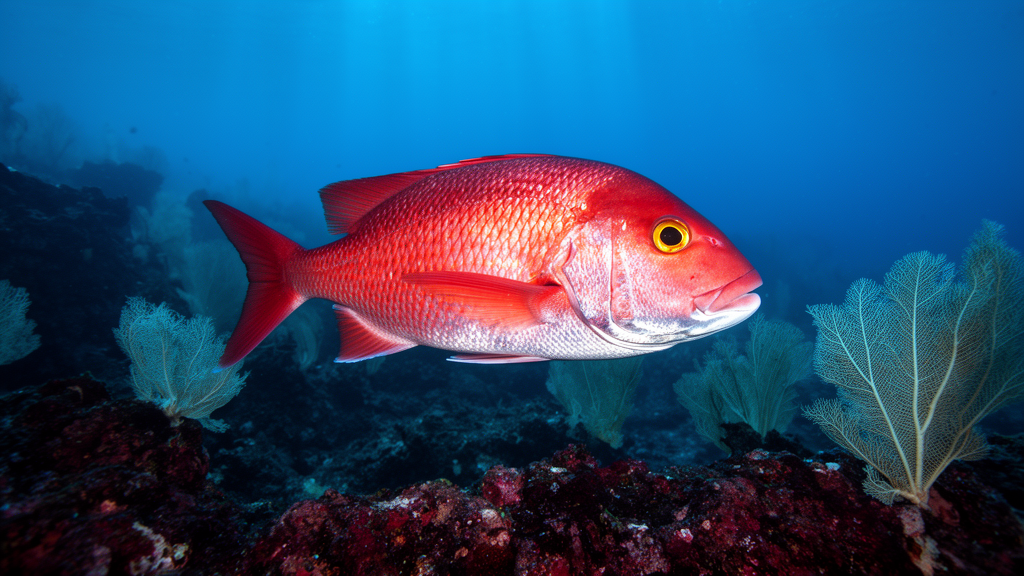
Freshly caught specimens exhibit distinct coloration patterns that assist field identification prior to preservation. The body transitions from a vivid red dorsum and upper flank to a uniform pinkish-silver tone across the lower sides and belly, highlighted by a yellow lateral line. While the dorsal fin is predominantly red with an orange-red anterior section and white highlights along the soft portions, the pectoral fins appear lightly red with a bright red base. The pelvic and anal fins are largely white with pinkish spines and rays, and the eyes feature a black pupil framed by a reddish-gold iris. Significantly, beyond the diagnostic black tip on the upper caudal-fin lobe, the lower lobe terminates in a contrasting white tip.
Morphological analysis of the voucher specimens also documented specific cranial, scaling, and dental structures characteristic of the species. The fish possess an oblong, laterally compressed body with a blunt snout and a terminal mouth in which the maxilla extends past the center of the eye without bony ridges. Dentition includes single rows of canine-like teeth on both jaws, complemented by several rows of smaller teeth at the anterior lower jaw, while dense conical teeth cover the palatine, tongue, and an arch-shaped vomer that lacks a medial posterior extension. Non-deciduous ctenoid scales cover the body and the lateral surface of the maxilla, whereas the preopercle, interorbital area, and the dorsal, pelvic, and anal fins are completely scaleless.
Furthermore, stark growth discrepancies between the two species provide an objective basis for reinterpreting historical landings. While Etelis carbunculus attains a maximum fork length of only 470 millimeters and a recorded maximum weight of 2.94 kilograms, Etelis boweni grows to more than one meter in total length and 1,150 millimeters in fork length. This substantial size divergence helps clarify several ambiguous historical reports from the Ryukyu Archipelago. In earlier fishery records, exceptionally heavy specimens, such as a 10.2-kilogram individual photographed outside the Okinawa Trough and a 10.5-kilogram fish landed at Chinen Market, were cataloged under the standard Japanese name for E. carbunculus despite vastly exceeding that species’ verified biological ceiling.
Subject of Research: Geographic distribution and taxonomic identification of the giant ruby snapper, Etelis boweni.
Article Title: First specimen-based records of the giant ruby snapper, Etelis boweni ( Actinopterygii , Acanthuriformes , Lutjanidae ), from Okinawa Prefecture, Japan, and Taiwan
Article References: Hata, H., Kita, T., Miyamoto, K., Imai, H., Sallan, L., & Ho, H.-C. (2026). First specimen-based records of the giant ruby snapper, Etelis boweni (Actinopterygii, Acanthuriformes, Lutjanidae), from Okinawa Prefecture, Japan, and Taiwan. Acta Ichthyologica et Piscatoria, 56, 497–508. https://doi.org/10.3897/aiep.56.213737
Image Credits: AI Generated
Keywords: Etelis boweni, giant ruby snapper, Lutjanidae, Okinawa, Taiwan, Ryukyu Archipelago, marine biology, taxonomy, specimen-based records, fish distribution, mitochondrial COI sequencing, morphological analysis, ichthyology, marine taxonomy, Indo-West Pacific, Etelis carbunculus, caudal fin morphology
News Source: Drew Townsend. (November 18, 2026). Definitive Records Confirm Giant Ruby Snapper Range in Japan and Taiwan. Scienmag.