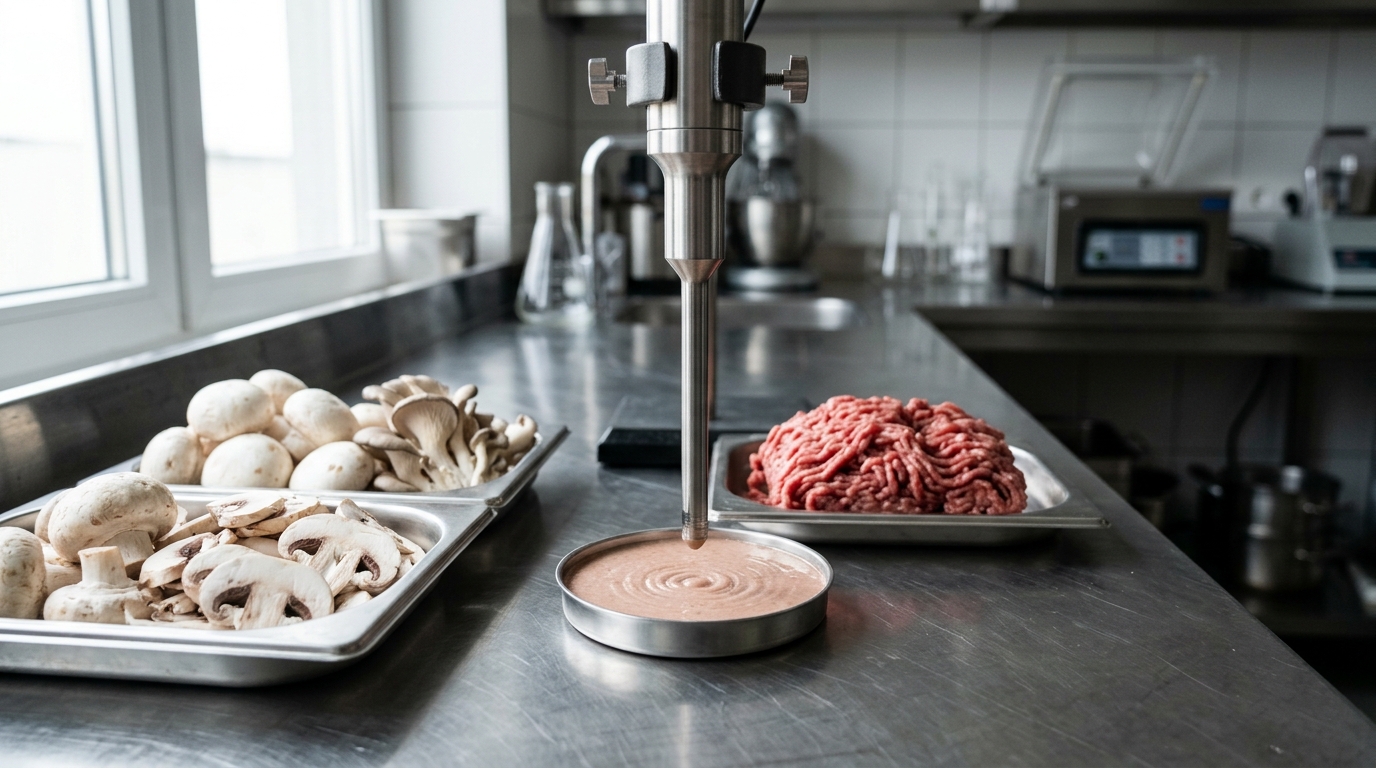
Food scientists have shown that a hybrid beef product made with 30% white mushroom (Agaricus bisporus) can hold its color, soften its texture, and resist lipid oxidation while allowing a reduction in synthetic phosphate additives, though the phosphate itself remains the decisive factor for controlling cooking loss. The study, published in Food Science and Biotechnology, combined high-intensity ultrasound (HIUS) with mushroom substitution in beef from the Gluteus medius muscle and then used response-surface modeling to probe how far the phosphate could be trimmed before the product suffered.
The motivation is both industrial and medical. Sodium tripolyphosphate (STPP) is a workhorse additive in processed meat: it alkalizes the matrix, raises ionic strength, improves water-holding capacity, cuts cooking loss, and slows lipid oxidation by chelating metal ions. But high daily phosphate intake has been linked to cardiovascular and kidney disease and disrupts the balance of calcium, iron, and magnesium in bone. Because consumers increasingly demand clean-label products with minimal additives, researchers have been hunting for ingredients and technologies that can do the same job with less chemistry on the label.
The team, led by Rodrigo Silveira de Albuquerque and Carlos Adam Conte-Junior, formulated eight treatment groups in a factorial design, varying three factors: the presence or absence of 30% A. bisporus, STPP, and a 10-minute HIUS treatment delivered at 500 W nominal power with a 19 mm probe at 5 ± 1 °C. Calorimetric measurement showed the actual acoustic power delivered to the medium was 81.39 W, corresponding to an intensity of 28.7 W cm⁻². Cooking loss was measured in an air fryer set to 180 °C until samples reached an internal temperature of 74 °C, and texture was assessed by double-compression texture profile analysis.
The first headline result concerns moisture. Cooking loss values ranged from 16.76 ± 1.96% to 27.84 ± 2.89%, and the statistical analysis identified STPP as the key factor in reducing it (p < 0.001). Groups containing the phosphate consistently lost less water and fat than their phosphate-free counterparts. HIUS alone did not fully replace this function: pairwise comparisons between sonicated and non-sonicated groups showed no significant differences, and the factorial analysis revealed only a significant interaction between mushroom content and ultrasound (p = 0.0453), meaning the efficacy of HIUS on water and fat retention depends on the matrix composition. Notably, adding 30% mushroom by itself did not change cooking loss at all, which the authors highlight as evidence that the hybrid formulation can lower animal protein content without sacrificing moisture retention.
Color told a more encouraging story. Total color difference (ΔE) was lowest in the groups containing mushroom, with Group 5 (mushroom only) at 2.58 ± 0.73 and Group 8 (mushroom plus STPP plus HIUS) at 1.85 ± 0.58. Since ΔE values under 3 are typically considered imperceptible to the human eye, the hybrid products maintained visual similarity to the all-meat control, though the authors caution that sensory evaluation would still be needed to confirm this. The redness parameter (a*) was governed by a three-way interaction among STPP, HIUS, and mushroom (p = 0.0109), and Group 8 showed no significant difference from the control, suggesting the combination preserved the meaty appearance despite the 30% substitution.
Texture shifted substantially with the mushroom. Hardness ranged from 164.48 ± 28.75 g to 1,065.12 ± 89.39 g, and the inclusion of A. bisporus was the most significant factor reducing it (p < 0.0001), followed by HIUS (p = 0.0004). The hybrid groups were markedly softer than the meat-only ones, an effect attributed to the disruption of the myofibrillar protein network when 30% of the meat matrix is replaced. Gumminess and chewiness fell in parallel, while springiness rose. The authors note that reduced chewiness has been associated in the literature with potential benefits for people with dysphagia, although the suitability of these specific formulations for that population was not evaluated. Interestingly, in the meat-only formulations HIUS actually increased hardness, a divergence from prior tenderization studies that the team links to the fiber composition of the Gluteus medius, which contains type IIb fibers resistant to ultrasonic softening.
Lipid oxidation provided perhaps the strongest signal for the combined approach. Thiobarbituric acid reactive substances (TBARS) ranged from 0.031 ± 0.003 mg MDA/kg in Group 8 to 0.320 ± 0.049 mg MDA/kg in the untreated control, with a highly significant three-factor interaction (p < 0.0001). The authors attribute the low oxidation in the fully combined group to three overlapping mechanisms: STPP chelates transition metals that would otherwise catalyze Fenton chemistry; the mushroom contributes selenium, phenolic compounds, and β-glucans with antioxidant activity; and replacing 30% of the meat dilutes both lipid and heme iron content. They also hypothesize that HIUS may facilitate extraction of antioxidant compounds from the mushroom tissue, though they flag that further work is needed to confirm this.
The second stage of the study used a Central Composite Rotatable Design (CCRD) with 22 additional formulations, split between meat-only and hybrid matrices, to map how STPP concentration and HIUS duration interact. In the meat-only system, significant models emerged for pH, intramolecular β-sheet content, and unordered structure content. The β-sheet model (R² = 0.8072) showed a positive linear effect of HIUS and a significant negative STPP × HIUS interaction, meaning the structuring effect of ultrasound was most pronounced precisely when phosphate was low. At the combination of high HIUS (around 17 minutes) and low STPP (around 0.1%), the intramolecular β-sheet content — a marker of a more stable protein network — increased relative to the central point, corresponding to an 80% reduction in total STPP.
The unordered-structure model told a complementary story: increasing sonication time reduced random-coil content while β-sheet content rose, indicating that HIUS shifted the protein secondary structure toward a more ordered conformation. In the hybrid matrix, by contrast, only resilience yielded a significant model, driven exclusively by STPP terms, with no significant HIUS effect. The authors interpret this as further evidence that the 30% mushroom inclusion modulates the mechanical effect of acoustic cavitation, making the efficacy of ultrasound dependent on the composition of the food matrix.
Taken together, the findings position A. bisporus and HIUS as complementary rather than interchangeable tools. The mushroom alkalinizes the matrix, contributes antioxidants, and softens texture while preserving color stability, making it a viable partial substitute in hybrid products. HIUS, meanwhile, drives protein restructuring in meat-only matrices at low phosphate levels, supporting its potential as a partial alternative to STPP for network stability. The authors conclude that the combination represents a promising strategy for reducing synthetic additives in meat products, with the caveat that STPP remains critical for cooking loss control and that the full substitution potential depends on the specific formulation and processing conditions.
Subject of Research: Effects of high-intensity ultrasound and sodium tripolyphosphate reduction on beef–Agaricus bisporus hybrid meat products
Article Title: Unveiling the effects of high-intensity ultrasound and sodium tripolyphosphate on a hybrid product of bovine meat and Agaricus bisporus
Article References: de Albuquerque, R. S., de Aguiar Bernardo, Y. A., dos Santos eSantos, D., de Oliveira Almeida, A. C., de Andrade, J. C., Contato, A. G., dos Santos Ferreira, J. F., & Conte-Junior, C. A. (2026). Unveiling the effects of high-intensity ultrasound and sodium tripolyphosphate on a hybrid product of bovine meat and Agaricus bisporus. Food Science and Biotechnology. https://doi.org/10.1007/s10068-026-02350-2
Image Credits: AI Generated
DOI: 10.1007/s10068-026-02350-2
Keywords: Agaricus bisporus, high-intensity ultrasound, sodium tripolyphosphate, hybrid meat products, cooking loss, lipid oxidation, protein secondary structure, texture profile analysis, clean label, food science, phosphate reduction, beef
News Source: Gregory Coleman. (November 6, 2026). Mushrooms and ultrasound team up to cut phosphates in beef products. Scienmag.