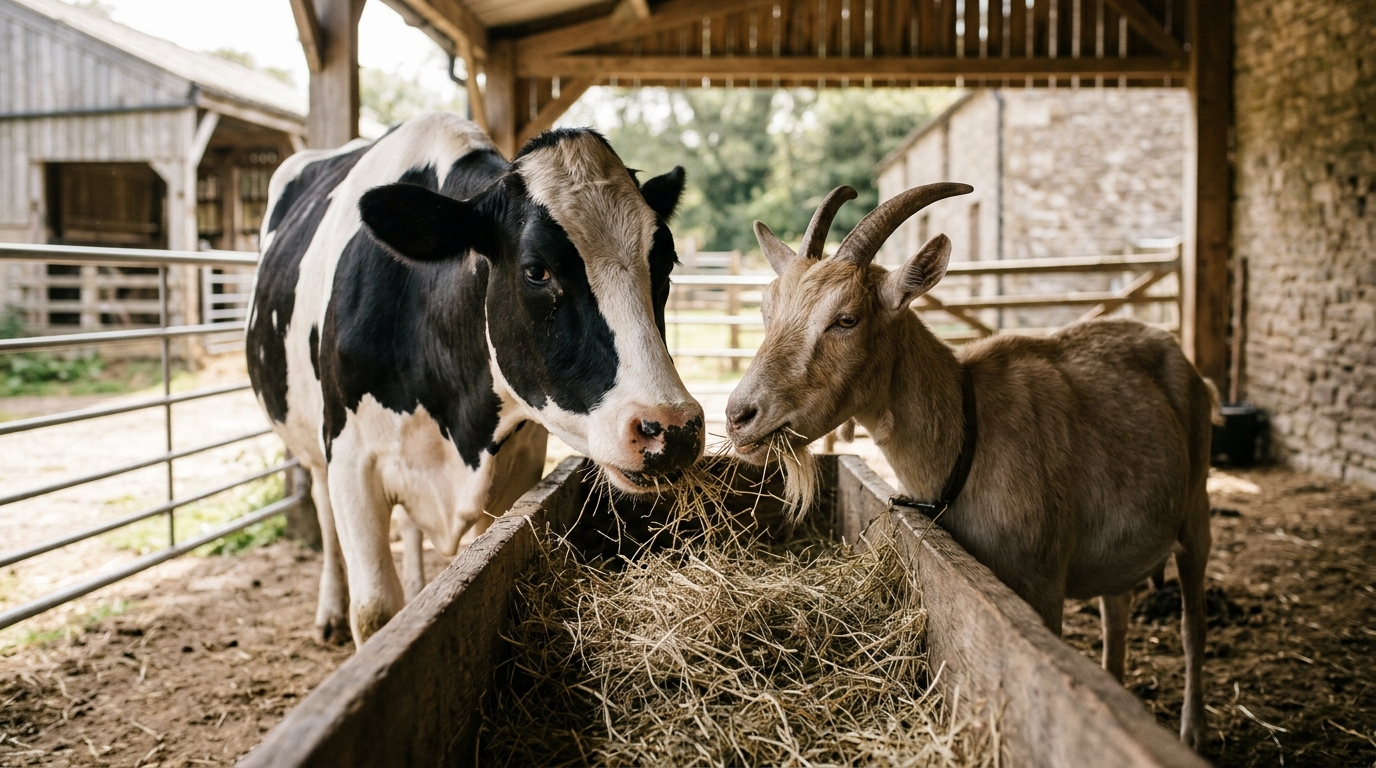
Faecal samples from cows and goats grazing on the same Italian organic farm, eating the same high-fibre diet of pasture and hay, harboured clearly different communities of anaerobic fungi, according to a new study published in Veterinary Medicine and Science. Despite being housed on the same farm and offered a similar diet, the two ruminant species showed significant differences in both the diversity and the composition of their faecal anaerobic fungal communities, supporting the idea that host species, rather than diet alone, shapes these little-studied microbes.
Anaerobic fungi are the least studied components of the herbivore microbiome, yet research over the last decade has shown they play a crucial role in the decomposition of biomass. Their contribution to the degradation of dietary fibre is significant: transcriptomic and proteomic studies have revealed a large array of biomass-degrading enzymes belonging to a broad range of glycoside hydrolase families, which efficiently decompose recalcitrant (hemi)cellulose structures of crude, untreated plant biomass. These enzymes can be organised in cellulosomes and work synergistically, making anaerobic fungi the most active plant-degrading microbes in nature. Ruminants owe their ability to convert low-quality lignocellulosic feed into milk and meat largely to the complex microbial communities residing in the rumen, which include bacteria, protozoa, archaea and fungi that degrade biomass into volatile fatty acids, the host’s primary energy source.
The research team, which had previously compared the faecal bacterial composition of cows and goats grazing on the same pasture, set out to clarify whether host species or diet exerts the stronger influence on anaerobic fungi. They examined 31 female animals on a private organic farm in Ceto, Lombardy, Italy: 15 Blond Adamellan goats and 16 Brown Swiss cows. The animals grazed freely in separate pastures during the day, in a landscape whose botanical composition varies mainly with altitude, ranging from pastures dominated by Festuca species to those where Carex and Sesleria species prevail. For the remainder of the time, the cows and goats were kept in separate housing systems on the same farm, goats in freestalls and cows in tie stalls, and were offered mixed hay, half polyphyte and half alfalfa, ad libitum three times daily with free access to water.
Fresh faecal samples were collected outdoors immediately after defecation and freeze-dried before being sent for analysis. The researchers extracted DNA from the samples, amplified the D2 region of the large subunit ribosomal DNA using a tailed-amplicon approach with primers specific for Neocallimastigomycetes, and sequenced the libraries on an Illumina NovaSeq 6000 system. The D2 region was chosen because it shows a lower degree of sequence heterogeneity than the more commonly used ITS1 spacer, provides better distinguishing of anaerobic fungal genera, eliminates ambiguous alignments and inaccurate taxonomic classification, and is less AT-rich and less variable in length. Sequences were processed with DADA2, subsampled to a minimum of 18,000 reads per sample, and clustered into amplicon sequence variants, with taxonomic assignment performed against the anaerobic fungal LSU database maintained by the Anaerobic Fungi Network.
The results revealed striking differences between the two species. Shannon Entropy, the Chao1 richness index, Pielou’s evenness index and Faith’s phylogenetic diversity all differed significantly between cows and goats, with lower diversity observed in the goat samples. Beta diversity analysis based on the weighted UniFrac distance matrix showed spatial separation of the cow and goat samples on a principal coordinate plot. A permutational multivariate analysis of variance confirmed a significant difference between the groups, with an R-squared of 0.438, indicating that 43.8% of the variation in the anaerobic fungal community could be attributed to host identity, a substantial effect size. A complementary test confirmed that the dispersion of samples within each group was homogeneous, supporting that the observed differences were driven by compositional shifts rather than intergroup variability.
Across all samples, the majority of filtered reads were assigned to the phylum Neocallimastigomycota, indicating high specificity of the primers used. In the cow samples, the order Neocallimastigales was represented by two dominant families, Caecomycetaceae at 37.79% and Neocallimastigaceae at 33.20%, followed by Anaeromycetaceae at 6.75% and a group of genera with unknown broader relationships at 11.16%. In two cow samples, the family Piromycetaceae formed a significant group. The goat samples were evidently divided into two subgroups despite identical breed, diet and management. In the first subgroup of seven goats, Anaeromycetaceae dominated at 46.51%, followed by Neocallimastigaceae and Caecomycetaceae. In the second subgroup of eight goats, Caecomycetaceae was the most dominant family at 60.62%, followed by Neocallimastigaceae and Anaeromycetaceae.
At the genus level, 16 genera were identified in total, comprising 11 cultured genera and 5 uncultured anaerobic fungi. In cows, the most abundant genera were Orpinomyces, Caecomyces and Cyllamyces, with lower abundances of Anaeromyces and Neocallimastix, and increased Piromyces in only three samples. In the first goat subgroup, Anaeromyces dominated at 46.03%, followed by Pecoramyces, Orpinomyces, Caecomyces and Cyllamyces. In the second goat subgroup, Caecomyces was the dominant genus at 42.34%, followed by Orpinomyces, Cyllamyces, Anaeromyces and Pecoramyces. Differential abundance analysis using DESeq2 showed that at the family level, Anaeromycetaceae was significantly more abundant in goats, whereas Piromycetaceae and Caecomycetaceae were more abundant in cows. At the genus level, Anaeromyces, Pecoramyces, an unclassified genus within Caecomycetaceae, and Feramyces were enriched in goats, while Caecomyces and Piromyces were more abundant in cows.
The finding that goats formed two distinct subgroups under standardised conditions was unexpected and suggests the influence of additional biological or ecological factors. One possibility is host genetics: observational records suggest that goats within each subgroup may be closely related, potentially sharing a maternal lineage, and maternal transfer of microbes begins at birth through exposure to the dam’s vaginal and faecal microbiota, as well as through colostrum, skin contact and saliva. Early-life microbial colonisation can also have long-lasting effects on gut community structure, and the presence of adult goats as companions to newborns may facilitate microbial transfer, accelerating both microbial colonisation and functional development of the rumen in young ruminants. Social behaviour and spatial foraging patterns offer another explanation, as goats naturally form stable subgroups within larger populations, and preferential grazing behaviours could result in differential exposure to environmental microbial sources. Microbial interactions within the gut, including competition and metabolite exchange between fungi, bacteria, archaea and protozoa, may also shape which fungal taxa dominate.
The authors note important limitations. Relative abundance data do not directly quantify functional activity, so although some genera are widely recognised for their fibrolytic capabilities, their enrichment in one host does not necessarily imply increased cellulolytic activity; the interpretations reflect assumed functional tendencies based on established physiological traits rather than direct measurements of enzymatic activity or fibre degradation. Cows and goats also differ markedly in grazing selectivity, with goats being browsers with highly selective feeding habits and cows grazers consuming a more homogeneous diet, which can lead to systematic variation in the botanical and chemical composition of ingested forage. In addition, because all animals were sampled within a single farm, the approach limits the generalizability of the observed species-related differences, although it reduced confounding from differing management and environmental conditions. The authors also acknowledge that faecal samples do not capture the same profile of anaerobic fungi as rumen samples and are less diverse, though they represent a practical and non-invasive proxy that respects animal welfare by avoiding the use of cannulated animals.
The findings align with a large-scale analysis of 661 faecal samples from 34 mammalian species across six continents, which identified 56 novel anaerobic fungal genera and found that host phylogenetic affiliation is the main factor shaping these communities, with domestication status and biogeography playing a less influential role. That study also reported that animal species cause 16% to 21% of the variance in anaerobic fungal community structure. The new results support the growing consensus that anaerobic fungal communities are closely tied to host species, a specificity likely driven by a combination of genetic, physiological and ecological factors influencing microbial colonisation, retention and function within the gastrointestinal tract. Future studies involving replicated herds across multiple farms, together with different dietary and management conditions, will be needed to determine whether the observed patterns hold across host species and production systems, and to disentangle host-species effects from farm-specific effects.
Subject of Research: Faecal anaerobic fungal diversity and composition in cows versus goats under a shared diet
Article Title: Comparison of Faecal Anaerobic Fungi of Cows and Goats Offered Similar Diet
Article References: Mahayri, T. M., Serra, A., Luthar, J., Roubalová, R., Moniello, G., Mattiello, S., Celozzi, S., Mrázek, J., & Fliegerová, K. O. (2026). Comparison of Faecal Anaerobic Fungi of Cows and Goats Offered Similar Diet. Veterinary Medicine and Science, 12(6), Article e71291. https://doi.org/10.1002/vms3.71291
Image Credits: AI Generated
DOI: 10.1002/vms3.71291
Keywords: anaerobic fungi, rumen microbiome, Neocallimastigomycota, host species, faecal microbiota, cows, goats, fibre degradation, alpha diversity, beta diversity, UniFrac, DESeq2
News Source: Daisy Hatcher. (November 6, 2026). Cows and Goats on the Same Diet Host Distinct Anaerobic Fungal Communities. Scienmag.