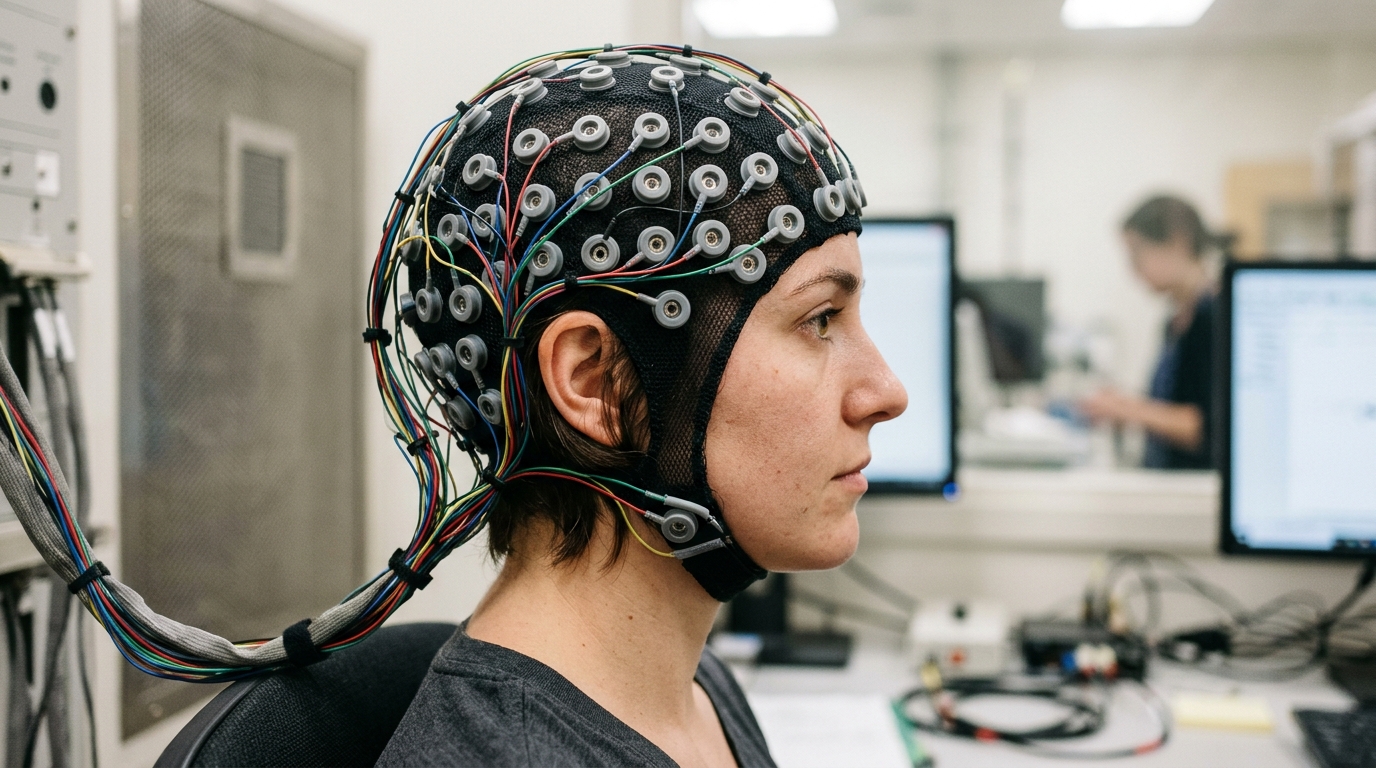
Resting-state electroencephalography recordings from 9751 participants across two sites have revealed reproducible brain-wave alterations that cut across schizophrenia, bipolar disorder and major depressive disorder, while also exposing measurable differences between the three conditions. The large-scale comparative study, published in Translational Psychiatry, reported resting-state EEG in schizophrenia, bipolar disorder and major depressive disorder compared with healthy controls, with standardized preprocessing and feature generation yielding spectral power and functional connectivity measures tested with both statistical and machine-learning approaches.
The most striking convergent finding was a shared reduction in alpha power alongside increased gamma-band functional connectivity across all three disorders. The researchers interpret these parallel alterations as implicating shared disruptions in inhibitory control and in the coordination of large-scale brain networks. The researchers interpret these convergent alterations as implicating shared disruptions in inhibitory control and in large-scale network coordination, suggesting that common electrophysiological features may underlie conditions that are clinically distinct.
Beyond the shared features, the spectral analysis uncovered disorder-specific patterns. Schizophrenia showed more pronounced elevation in the delta and theta frequency bands, and the three disorders formed a graded continuum in this low-frequency range, with schizophrenia exceeding bipolar disorder, which in turn exceeded major depressive disorder. The authors suggest this graded pattern points to a dimensional progression of neural dysregulation rather than sharply separated categories, a view consistent with transdiagnostic frameworks in psychiatry.
The scale of the dataset matters because prior EEG findings in psychiatry have been inconsistent, a problem the authors attribute to small, single-disorder cohorts. By analyzing schizophrenia, bipolar disorder and major depressive disorder alongside healthy controls within a single two-site design, the study tested both statistical and machine-learning approaches on spectral power and functional connectivity measures. Across the 9751 participants' EEG recordings, standardized preprocessing and feature generation yielded spectral power and functional connectivity measures that were tested with both statistical and machine-learning approaches.
Machine-learning models trained on these features robustly distinguished individuals with psychiatric diagnoses from healthy controls within each site. The abstract reports that machine-learning models robustly distinguished individuals with psychiatric diagnoses from healthy controls within sites, while cross-site generalization and inter-disorder discrimination remained limited. However, the models performed far less well when generalized across sites, and they remained limited in their ability to discriminate between the disorders themselves. The authors attribute these shortfalls to heterogeneity, underscoring a persistent challenge for translating EEG biomarkers into clinical practice.
The abstract attributes the limited cross-site generalization and inter-disorder discrimination to challenges of heterogeneity, underscoring that robust biomarkers to inform diagnosis and treatment remain elusive despite the reproducible group-level features.
The study arrives in a shared early-access form, citable with a permanent DOI, and is subject to further edits before the final Version of Record. The work was led by Shuying Rao with senior authors including Tao Li and Haiteng Jiang, and involved collaborators across multiple institutions. The article is open access, allowing full examination of the methods and results.
For the field, the findings identify reproducible EEG features that capture both shared and disorder-distinct neural alterations. The convergent alpha reduction and gamma-band connectivity increase are interpreted as implicating shared disruptions in inhibitory control and large-scale network coordination, while the graded delta-theta continuum is described as suggesting a dimensional progression of neural dysregulation. The authors state that these findings advance efforts towards early detection and individualized treatment in major psychiatric disorders, while the limited cross-site generalization and inter-disorder discrimination underscore challenges of heterogeneity.
Major psychiatric disorders are leading contributors to global disability, and the search for scalable, noninvasive measures of neural dysfunction has made EEG an attractive candidate. The study identifies reproducible EEG features that capture both shared and disorder-distinct neural alterations, but the limited cross-site generalization and inter-disorder discrimination underscore the challenges of heterogeneity that currently constrain translating these findings into clinical tools.
Subject of Research: Resting-state EEG oscillatory features shared across and distinguishing schizophrenia, bipolar disorder and major depressive disorder
Article Title: Large-scale EEG reveals shared and distinct neural oscillatory features across major psychiatric disorders
Article References: Rao, S., Xie, J., Niu, M., Pan, Y., Li, Y., Yu, H., Xie, J., Zhang, Y., Zhao, S., Pan, G., Guo, W., Li, T., & Jiang, H. (2026). Large-scale EEG reveals shared and distinct neural oscillatory features across major psychiatric disorders. Translational Psychiatry. https://doi.org/10.1038/s41398-026-04532-2
Image Credits: AI Generated
DOI: 10.1038/s41398-026-04532-2
Keywords: EEG, schizophrenia, bipolar disorder, major depressive disorder, alpha power, gamma-band connectivity, functional connectivity, delta-theta, machine learning, transdiagnostic, biomarkers, psychiatry
News Source: Glenn Wilkins. (November 6, 2026). Massive EEG study maps shared and distinct brain-wave signatures in schizophrenia, bipolar disorder and depression. Scienmag.