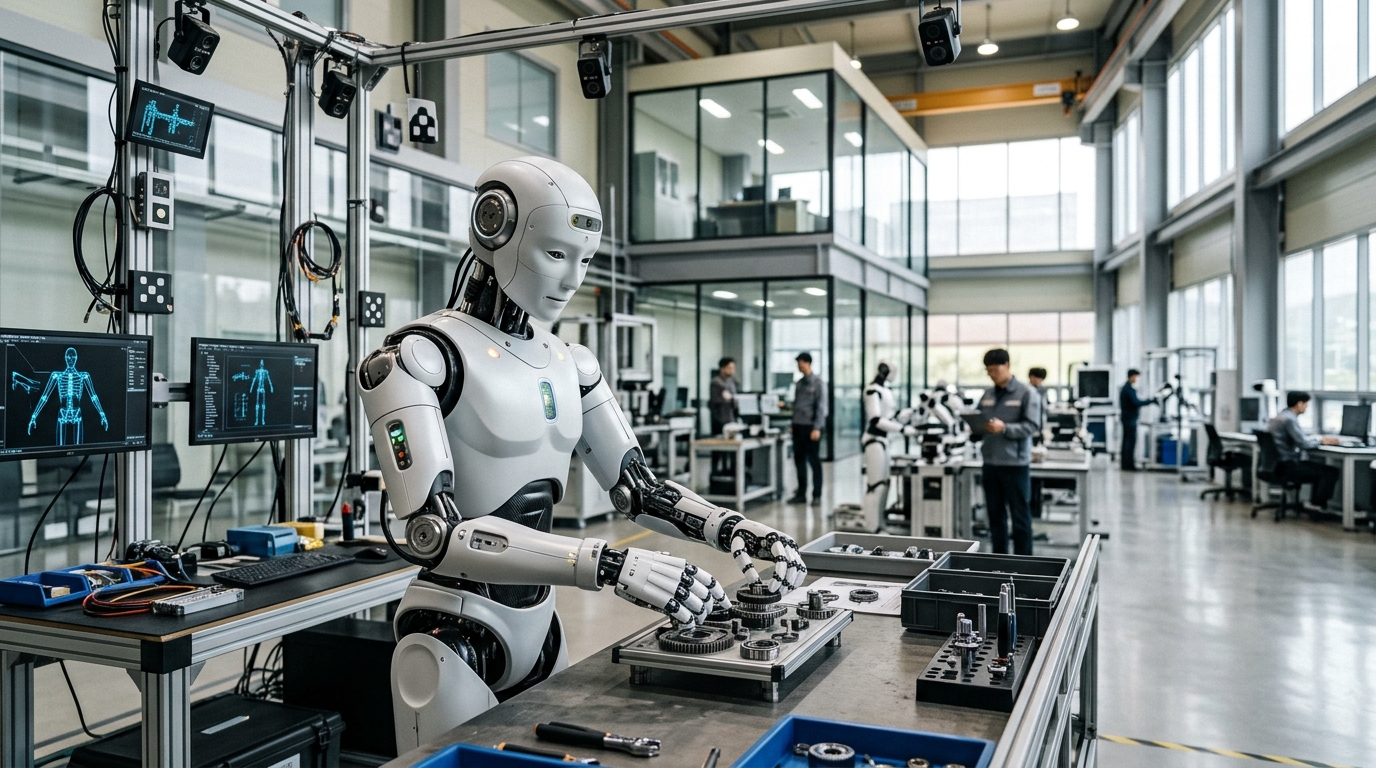
Korea has opened its first dedicated data production facility for bipedal humanoid robots, a site designed to capture the movements and task information that artificial intelligence models need before machines can work alongside people. The AI Humanoid Data Factory was officially unveiled at an opening ceremony on November 3 at the headquarters of the Korea Institute of Machinery and Materials (KIMM), where several humanoid robots demonstrated the collection of data from everyday chores such as taking items out of a refrigerator, handling laundry, and arranging a sofa, alongside industrial tasks like operating buttons and levers inside a vehicle.
The facility was established by the Global TOP Strategic Research Group for Self-Growing AI Humanoids, led by KIMM under the direction of Dr. Chan Hun Park, in collaboration with the Electronics and Telecommunications Research Institute (ETRI). According to the announcement, the factory is capable of collecting a wide range of data, from arm and leg movements to full-body tasks, making it the first facility of its kind in Korea focused specifically on producing training data for humanoid robots rather than for wheeled or stationary machines.
The core method relies on teleoperation. The Data Factory currently operates 12 humanoid robots, and human operators remotely control these machines as they perform various tasks. While a robot carries out a job under human guidance, its movements and task-related information are recorded, and those recordings become the raw material for AI training. This approach mirrors techniques used internationally, where demonstrations by human operators allow learning systems to associate sequences of motion with goals and contexts, but Korea has until now lacked domestic infrastructure to produce such data at scale for humanoids.
The collected data is used to train AI models so that robots can understand human instructions and their surroundings and eventually perform tasks autonomously. The training loop does not end once a model is deployed: the trained AI is placed on physical robots to evaluate its performance, and newly generated data from that evaluation is fed back into subsequent rounds of training. Through this iterative cycle, KIMM aims to improve the performance of AI models that can be applied across different robot platforms, as well as the K-Humanoid standard platform, an effort intended to prevent each Korean robotics effort from having to build its own data pipeline from scratch.
The opening ceremony also featured demonstrations of KAIROS, a Korean-developed humanoid robot, performing precise object manipulation and full-body motion imitation. These displays served as a public illustration of the kind of capability the data factory is meant to support: robots that can copy human motion with enough fidelity to handle objects in kitchens, laundry rooms, living spaces, and vehicle cabins, where the geometry and variability of real environments far exceed what scripted laboratory routines can cover.
For Korea, the strategic argument for the facility centers on data sovereignty. The establishment of the Data Factory provides the country with the infrastructure needed to directly produce and accumulate large-scale humanoid task data. It is expected to reduce reliance on overseas data and AI models and accelerate Korea’s technological self-reliance in humanoid AI. In robotics, the datasets that teach a machine to grasp, step, and adapt are increasingly treated as national assets, and countries that must license them depend on the priorities and access rules of foreign owners. KIMM plans to gradually open the Data Factory to domestic industry, academia, and research institutions beginning at the end of 2027, extending access beyond the founding institutes.
Seog-Hyeon Ryu, President of KIMM, framed the opening as a foundation rather than a finish line. “Securing large volumes of high-quality robot task data is essential to national technological competitiveness, and the establishment of this Data Factory marks an important starting point for building Korea’s own robot AI training data and technological assets,” Ryu said. “Through industry-academia-research collaboration, we will accelerate the development of Korea’s KAIROS humanoid robot and gradually open the Data Factory beginning at the end of 2027, thereby contributing to the competitiveness of Korea’s physical AI industry.”
The initiative sits within a broader national program. The Ministry of Science and ICT (MSIT), which supports the project, plans to continue bringing together Korea’s research capabilities in connection with the K-Moonshot AI Humanoid Mission, with the goal of securing independent AI humanoid technologies and strengthening the competitiveness of the domestic industry. The mission places humanoid robotics among the strategic technologies where Korea seeks to move from importing core components and models to generating them domestically, and the data factory functions as the physical anchor of that effort.
KIMM, a non-profit government-funded research institute under the Ministry of Science and ICT founded in 1976, conducts research and development on key technologies in machinery and materials, performs reliability test evaluation, and works on commercializing developed products and technologies. Its partner in the project, ETRI, brings telecommunications and electronics research expertise to the collaboration, and the pairing reflects the way modern humanoid development combines mechanical engineering, sensing, and machine learning in a single pipeline.
The facility’s near-term trajectory is expansion. KIMM plans to gradually increase both the number of robots and the range of tasks used for data collection, growing the dataset beyond the initial 12 machines and the household and vehicle tasks shown at the ceremony. Whether the factory’s iterative training approach delivers autonomous humanoids that perform reliably outside controlled settings remains an open question that the coming rounds of data collection and evaluation are designed to answer, and the opening of external access at the end of 2027 will show how broadly Korea’s robotics community can build on the infrastructure now in place.
Subject of Research: Establishment of Korea's first AI humanoid data factory for collecting robot task data to train humanoid AI models
Article Title: Korea opens its first AI humanoid data factory
Article References: Korea opens its first AI humanoid data factory. Original publication (Bibliographic details unavailable.)
Image Credits: AI Generated
DOI: Not provided
Keywords: humanoid robots, AI training data, teleoperation, KIMM, ETRI, KAIROS, robotics, data factory, K-Humanoid, Ministry of Science and ICT, physical AI, South Korea
News Source: Denise Maddox. (November 6, 2026). Korea opens first data factory to train AI humanoid robots on real tasks. Scienmag.