Women living with HIV face a sharply elevated risk of cervical cancer, and the World Health Organization has responded by recommending a “screen, triage, and treat” approach in resource-limited settings, with HPV testing preferred for the initial screen. But a positive HPV test is only the beginning of the decision. Because HPV infection is common and often transient, treating every HPV-positive woman would mean destroying healthy tissue on a large scale, straining clinics and exposing patients to unnecessary procedures. The WHO therefore calls for a triage step before treatment, and in much of sub-Saharan Africa that step is visual inspection with acetic acid, or VIA, in which a provider paints the cervix with vinegar and looks with the naked eye for aceto-white epithelium, the pale patches that can mark precancerous lesions. A new randomized clinical trial from Kisumu, Kenya, tested whether a low-cost handheld device could do that job better.
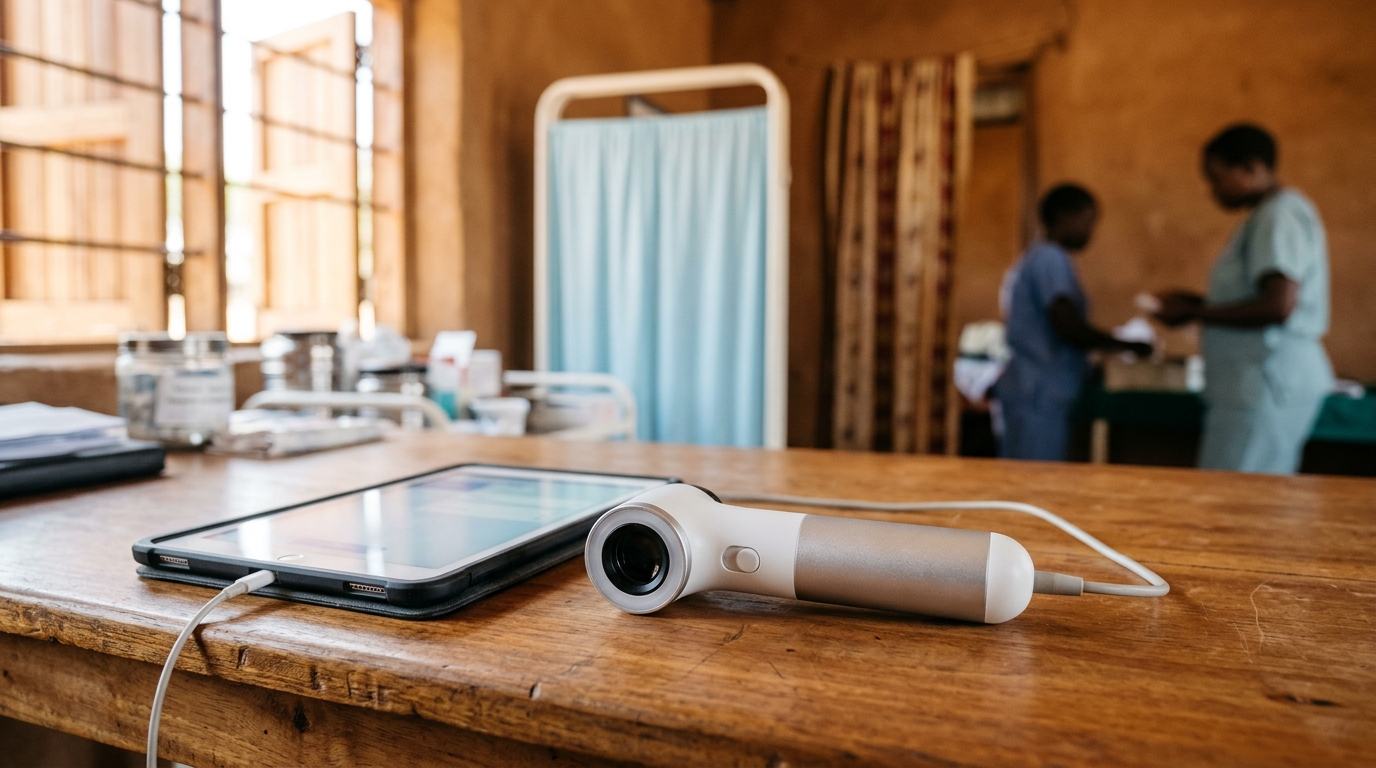
The study, published in the British Journal of Cancer, enrolled HPV-positive women living with HIV across six HIV care clinics in Kisumu between November 2022 and June 2023. Unlike a standard colposcope, which sits outside the patient and demands high-end optics, the Pocket Colposcope is inserted through a speculum and positioned about three centimeters from the cervix, a short working distance that removes the need for expensive magnification systems. It captures white-light and green-light images, and the developers report image quality comparable to standard colposcopes. The device has previously been tested in more than six countries, but this trial was designed to evaluate it as a triage tool specifically among women receiving HIV care in western Kenya, a population with high rates of HPV and precancerous lesions.
The design was straightforward and deliberately pragmatic. During routine clinic visits, women living with HIV were offered HPV testing using self-collected cervical samples processed on the Ampfire platform at Lumumba sub-county hospital. Those aged 25 to 65 who tested positive and planned to undergo treatment at the clinic were eligible; pregnant women, women with a history of cervical cancer, and those with suspected infection or invasive cancer were excluded. Of 2,794 women screened, 503, or 18 percent, tested HPV-positive, and 404 of them enrolled and were randomized, stratified by clinic, to either the standard-of-care VIA arm or the Pocket Colposcope arm. A technical error in the randomization scheme left a slight imbalance, with 208 women assigned to VIA and 196 to the Pocket arm.
In both arms, providers applied acetic acid to the cervix and, after sixty seconds, looked for aceto-white epithelium, recording a positive or negative visual diagnosis. Providers in the VIA arm performed the exam unaided, while those in the Pocket arm captured images before and after acetic acid application using both white and green light, though only white-light images were used for diagnosis. Critically, biopsies were taken in both arms either from aceto-white areas or, when none were visible, from two random locations, and every participant’s histopathology served as the diagnostic gold standard. This design matters: many earlier studies of VIA performed biopsies only in women whose visual exam was positive, a verification bias that can inflate sensitivity and make specificity impossible to calculate. HPV-positive women eligible for ablative treatment received it regardless of the visual diagnosis, following WHO recommendations, while women with large lesions or suspected invasive carcinoma were referred for advanced care.
The headline numbers showed the two methods performing similarly on most measures. Positive visual exam rates were 17.3 percent in the VIA arm and 14.3 percent in the Pocket arm, a difference that was not statistically significant. The overall rate of CIN2/3, the moderate and severe precancerous lesions confirmed by pathology, was 15.5 percent across the study, split as 12.2 percent in the VIA arm and 18.8 percent in the Pocket arm. Sensitivity for detecting CIN2+ lesions, which included CIN2, CIN3, squamous cell carcinoma, and atypical glandular cells, was nearly identical at 25.0 percent for the Pocket and 26.3 percent for VIA. Specificity was 4.9 percentage points higher in the Pocket arm at 88.9 percent versus 84 percent, while the negative predictive value was 4.2 points lower at 82.9 percent versus 87.1 percent. The most striking difference was the positive predictive value: 37 percent for the Pocket against 20.6 percent for VIA, nearly double, though the authors note this difference was not statistically significant given the number of outcome cases.
That PPV gap carries real clinical weight. A positive visual exam in the VIA arm was confirmed as disease by pathology only about one time in five, meaning most women flagged for treatment had no precancerous lesion on biopsy. In the Pocket arm, roughly one in three positive exams corresponded to confirmed disease. The trial also found a high rate of CIN3 among the lesions detected, at 17.3 percent of Pocket cases and 9.6 percent of VIA cases, and most biopsies in both arms were histologically negative, at 75.9 percent in the Pocket arm and 80.2 percent in the VIA arm. The distribution of biopsy results did not differ significantly between the arms.
The experience data painted an encouraging picture for implementation. Fourteen providers, medical officers and nurses delivering general outpatient and HIV-specific care in government clinics, carried out both exam types based on patient randomization, and most reported no challenges, at 96.0 percent for Pocket exams and 97.1 percent for VIA exams. Fewer than 1 percent reported issues with the device itself, such as internet access, recording patient information, or perceived patient discomfort, and difficulty visualizing the cervix was noted in 2.5 percent of Pocket exams versus 0.5 percent of VIA exams. Providers completed exams and made diagnoses 100 percent of the time in both arms. On the patient side, 190 women in the Pocket arm and 197 in the VIA arm completed surveys. Most participants reported little or no prior knowledge of cervical cancer prevention, but roughly four in five said their knowledge increased after the exam. Nearly all reported little or no pain, expressed confidence in their provider’s assessment, and said they would recommend the exam, with no significant adverse events associated with either device.
The trial’s authors are candid about its limits. Despite the overall sample size of 404, the number of CIN2+ cases that formed the outcome was lower than anticipated, which limited the study’s power to detect statistically significant differences in diagnostic accuracy. The randomization imbalance, caused by non-stratified randomization of the last 25 participants, could have introduced bias. Provider turnover and varying levels of expertise with cervical cancer screening methods, encountered because the team deliberately tested the device in a real-world setting, likely contributed to the low sensitivity observed in both arms, and the authors emphasize that methods to standardize training are required when introducing new technologies. Image quality is another concern: blur and glare can obstruct lesions and affect diagnosis, and a companion analysis found that clinical experts’ confidence in identifying lesions was significantly higher for clear images than for blurry ones. The authors plan to incorporate real-time image quality feedback into future deployments and see automated correction algorithms as a path to improving accuracy.
Context from the broader literature helps explain why these results matter. Meta-analyses of VIA screening in low- and middle-income countries have reported widely varying sensitivities, from 44 to 83 percent, and specificities from 76 to 91 percent for detecting CIN2+. Studies of VIA specifically as a triage step for HPV-positive women are scarcer, with reported sensitivities ranging from 28 to 82 percent. In this trial, with histopathology on every participant, the specificity of VIA alone, 84 percent, was comparable to prior estimates, while its sensitivity of about 26 percent was on the low end, consistent with a study by Mekuria and colleagues that also biopsied all participants regardless of visual result. The authors also point to the automated visual evaluation algorithm, trained on a database of more than 150,000 cervical images and evaluated across five countries, which showed superior sensitivity to standard VIA with a moderate loss in specificity, as evidence that pairing image-capturing devices with diagnostic algorithms could further improve performance where colposcopy expertise is scarce.
The conclusion the authors draw is measured. The Pocket Colposcope was superior at identifying CIN2+ among HPV-positive women living with HIV in western Kenya, they write, though with no significant differences in sensitivity or specificity in this small sample, and the device merits study in larger settings. They position it as an adjunct to VIA that could facilitate biopsy confirmation, support provider training and patient education, and enable remote diagnosis through image transfer, with future work needed on costs and technology requirements before widespread implementation.
Subject of Research: A randomized clinical trial comparing Pocket Colposcopy with visual inspection with acetic acid for triage of HPV-positive women living with HIV in Kisumu, Kenya
Article Title: A randomized clinical trial comparing visual inspection with acetic acid (VIA) to Pocket Colposcopy for the triage of HPV+ women living with HIV in Kisumu, Kenya
Article References: Santos, M. O., Dotson, M. E., Steinberg, E., Ambaka, J., Huchko, M., & Ramanujam, N. (2026). A randomized clinical trial comparing visual inspection with acetic acid (VIA) to Pocket Colposcopy for the triage of HPV+ women living with HIV in Kisumu, Kenya. British Journal of Cancer. https://doi.org/10.1038/s41416-026-03609-5
Image Credits: AI Generated
DOI: 10.1038/s41416-026-03609-5
Keywords: cervical cancer, HPV, HIV, Pocket Colposcope, VIA, triage, Kenya, colposcopy, CIN2+, randomized trial, histopathology, screening
News Source: Nathaniel Bowman. (November 6, 2026). Pocket colposcope triages HPV-positive women with HIV in Kenya trial. Scienmag.