Drug delivery researchers are turning to an unlikely source for next-generation oral medicines: the sticky gum of Christ’s thorn jujube, a spiny tree that thrives in the arid and semi-arid regions of Africa, the Middle East and South Asia. A review published in Clinical Phytoscience examines how gum harvested from Ziziphus spina-christi, a medicinal plant in the Rhamnaceae family better known as the Sidr tree, could be blended with sodium alginate to build composite hydrogel beads capable of releasing drugs slowly and steadily over long periods. The analysis, led by Abhay Pratap Singh, Ritesh Kumar Tiwari and Shashi Verma, brings together formulation strategies, characterization methods and potential applications for this natural polymer pairing, arguing that it offers a sustainable and biocompatible alternative to synthetic excipients in multiparticulate sustained-release systems.
The problem the authors set out to address is a familiar one in pharmaceutics. Conventional oral dosage forms such as tablets often fail to hold drug concentrations in the blood within the therapeutic window. Plasma levels oscillate, dipping below effective thresholds and then spiking above safe ones, which forces patients to re-dose frequently and raises the risk of side effects or toxicity. Sustained-release multiparticulate systems, including hydrogel beads, microspheres and pellets, are designed to smooth out these peaks and valleys. Because they are small particles rather than monolithic blocks, they distribute more evenly through the gastrointestinal tract, which reduces variability in drug absorption between patients and lowers the chance of dose dumping, the unintended release of a large fraction of drug at once.
Sodium alginate, a naturally occurring anionic polysaccharide extracted from brown seaweeds, has long been a favourite matrix material for such beads. Its chain is built from β-D-mannuronic acid and α-L-guluronic acid residues arranged in homopolymeric and heteropolymeric blocks. When alginate meets divalent cations such as calcium, the ions coordinate with the guluronic acid blocks in the well-established egg-box model, knitting a three-dimensional hydrogel under mild aqueous conditions. That gentle gelation, combined with high biocompatibility, makes alginate an excellent carrier for fragile cargo including drugs, proteins, enzymes and probiotics, and its beads can shield encapsulated compounds from enzymatic degradation and acidic conditions in the gut.
Pure alginate, however, has well-documented weaknesses. Beads made from alginate alone tend to be mechanically fragile, swell excessively in physiological media and release a large burst of drug in the initial stages as ions exchange and water rushes in. To counter these flaws, formulators often blend alginate with a second natural polymer. The review proposes Ziziphus spina-christi gum as that partner. The gum, obtained from the plant’s stem, branches, fruit pulp, seeds or surface exudates, is a complex polysaccharide rich in arabinose, galactose, rhamnose and uronic acid residues. It brings emulsifying, binding, thickening, stabilizing and mucoadhesive properties to the mixture, and earlier studies have already found it suitable for matrix systems, solid dispersions and film-forming formulations.
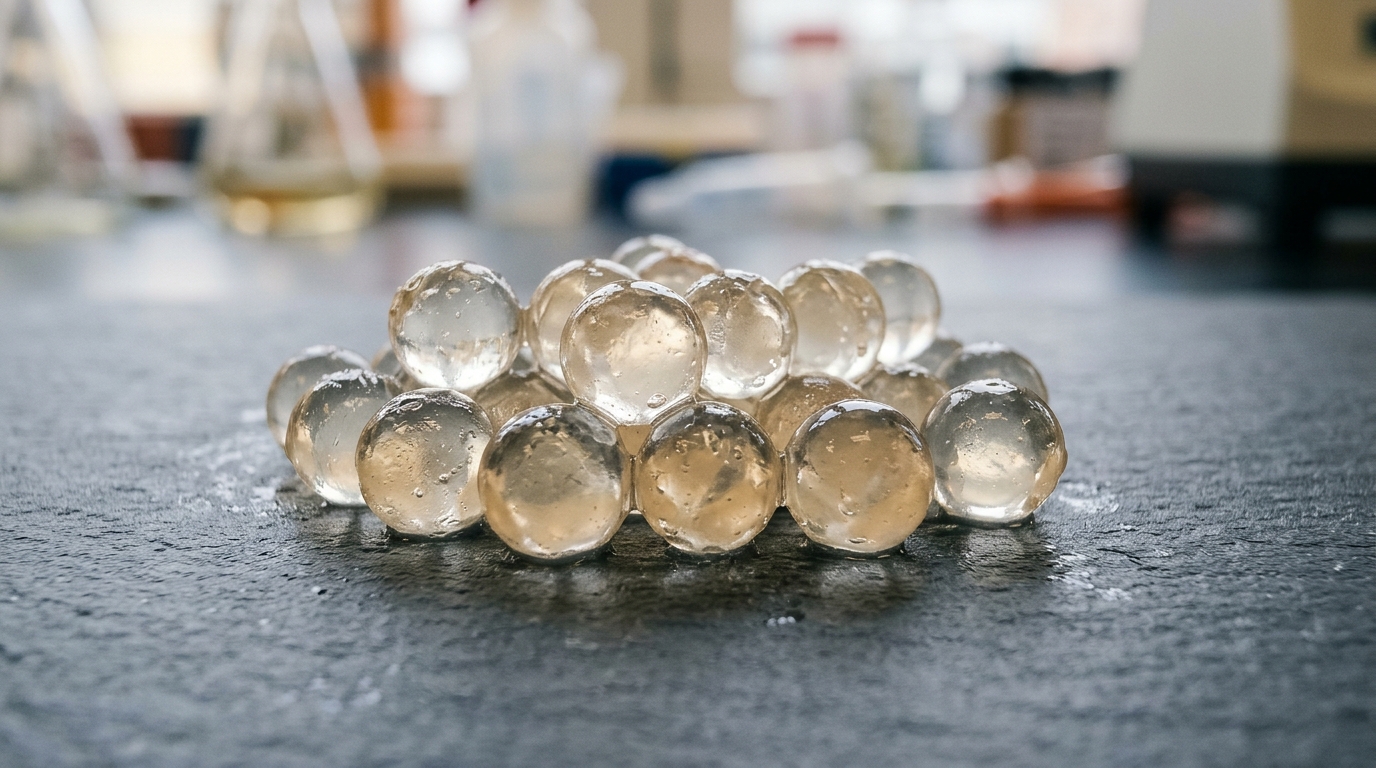
When the two polymers are combined, the authors describe the formation of an interpenetrating polymer network, or IPN. Alginate contributes ionic cross-links through calcium, while ZSC gum contributes hydrogen bonding and chain entanglement with the matrix. These polymer-polymer and polymer-drug interactions densify the gel, increase the tortuosity of the diffusion path and reduce the burst release that plagues single-polymer systems. The review suggests that incorporating the gum can potentially improve the viscosity and mucoadhesive properties of alginate matrices, strengthen bead integrity, raise drug entrapment efficiency and produce a more sustained release pattern. Because both polymers are biodegradable, non-toxic, renewable and inexpensive compared with synthetic alternatives, the composite also aligns with the growing push toward greener pharmaceutical materials.
Extraction of the gum is straightforward. Fresh fruits are washed and crushed, then soaked in distilled water for 24 to 72 hours so the mucilage dissolves. The mixture is filtered to remove insoluble plant material, the dissolved mucilage is precipitated with ethanol or acetone, and the recovered gum is dried at 40 to 50 degrees Celsius and milled into a fine powder. Processing conditions matter: the review highlights reported optimum conditions of a 1:7 sample-to-water ratio, a 60 degree Celsius extraction temperature and a 1:3 ethanol-to-extract ratio, which yield gum with strong water-holding capacity, good oil absorption and high viscosity comparable to established hydrocolloids such as xanthan and guar gums. Solvent ratios, extraction temperature and the choice of precipitation solvent all influence yield, viscosity and overall extraction effectiveness.
Formulation of the composite beads typically relies on ionotropic gelation, either external or internal. In external gelation, a homogeneous mixture of drug and polymer is dropped into a calcium chloride solution; calcium ions diffuse into the alginate droplets and cross-link the guluronic blocks into stable beads. In internal gelation, an insoluble calcium source such as calcium carbonate or calcium sulphate is dispersed within the polymeric mixture, and acidification slowly releases calcium ions throughout the droplet, producing more uniform cross-linking, higher encapsulation efficiency and greater structural homogeneity. The review notes that formulation parameters shape the final product: higher alginate concentration increases bead density, reduces porosity and lengthens drug release, while the ZSC gum ratio influences swelling and diffusion behaviour, calcium chloride concentration sets cross-linking density and stiffness, and stirring speed and curing time govern bead size distribution, surface morphology and entrapment efficiency.
Characterization of the finished beads draws on a standard toolkit. Particle size, which strongly affects release kinetics, swelling and dosing uniformity, is measured by optical microscopy, laser diffraction or dynamic light scattering, with higher polymer concentrations tending to raise viscosity, reduce droplet breakage during gelation and produce larger beads. Entrapment efficiency, the percentage of drug retained in the network, is usually quantified by UV-visible spectrophotometry or HPLC after dissolving beads in sodium citrate or phosphate buffer. Scanning electron microscopy reveals whether beads are smooth, spherical and densely packed, which favours slow diffusion, or rough and porous, which accelerates release. Swelling experiments in buffers at pH 1.2, 6.8 and 7.4 model gastrointestinal conditions, and in vitro release studies in USP Type II paddle apparatus are fitted to zero-order, Higuchi and Korsmeyer-Peppas kinetic models to probe the release mechanism. Fourier transform infrared spectroscopy, differential scanning calorimetry and X-ray diffraction confirm compatibility and molecular interactions between the two polymers.
The release mechanism itself unfolds in phases. As beads contact the dissolution medium, water penetrates and the alginate-ZSC gum network swells, forming hydrated channels through which drug molecules diffuse gradually. Early release is diffusion-controlled, but as dissolution proceeds, polymer relaxation and surface erosion increasingly contribute, and the gradual breakdown of the hydrated matrix sustains a predictable, near-constant release rate. The mucoadhesive character of ZSC gum may also prolong the residence time of the dosage form in the gastrointestinal tract, which the authors suggest could enhance localized absorption, making the system a candidate for oral and colon-targeted delivery where retention and site-specific release can improve drug effects while reducing systemic exposure.
Important caveats temper the enthusiasm. The review is a synthesis of the literature rather than a clinical study, and much of its case for the composite rests on potential and analogy: the authors note that no direct studies of ZSC gum in such bead systems have yet been conducted, that no exact molecular weight for the native gum is reported in available literature, and that no specific ionic cross-linking protocols exist for ZSC gum itself, with insights drawn instead from analogous plant gums such as carboxymethyl guar and sesbania gum. The authors call for future work on in vivo pharmacokinetic behaviour, long-term stability and the feasibility of large-scale production before practical use can be confirmed. They also point to design of experiments and response surface methodology for optimizing polymer ratios, cross-linking density and curing time, and to emerging computational modelling and artificial intelligence tools for predicting release behaviour. Beyond oral delivery, they envision plant-derived polymers extending into wound dressings, transdermal systems and tissue engineering scaffolds carrying antioxidants or antimicrobial agents, positioning the humble jujube gum as part of a broader shift toward sustainable biomaterials in pharmaceutical design.
Subject of Research: Sustained-release drug delivery using composite hydrogel beads made from Ziziphus spina-christi gum and sodium alginate
Article Title: A comprehensive review on Ziziphus spina-christi gum–alginate composite beads: from physicochemical properties to advanced sustained-release applications
Article References: Singh, A. P., Tiwari, R. K., & Verma, S. (2026). A comprehensive review on Ziziphus spina-christi gum–alginate composite beads: from physicochemical properties to advanced sustained-release applications. Clinical Phytoscience, 12(1), Article 10. https://doi.org/10.1186/s40816-026-00424-6
Image Credits: AI Generated
DOI: 10.1186/s40816-026-00424-6
Keywords: Ziziphus spina-christi gum, sodium alginate, hydrogel beads, sustained-release drug delivery, interpenetrating polymer network, ionotropic gelation, natural polymers, mucoadhesion, drug encapsulation, pharmaceutical excipients, controlled release, biodegradable polymers
News Source: Ophelia Keating. (November 6, 2026). Christ’s thorn jujube gum blended with alginate shows promise for sustained-release drug beads. Scienmag.