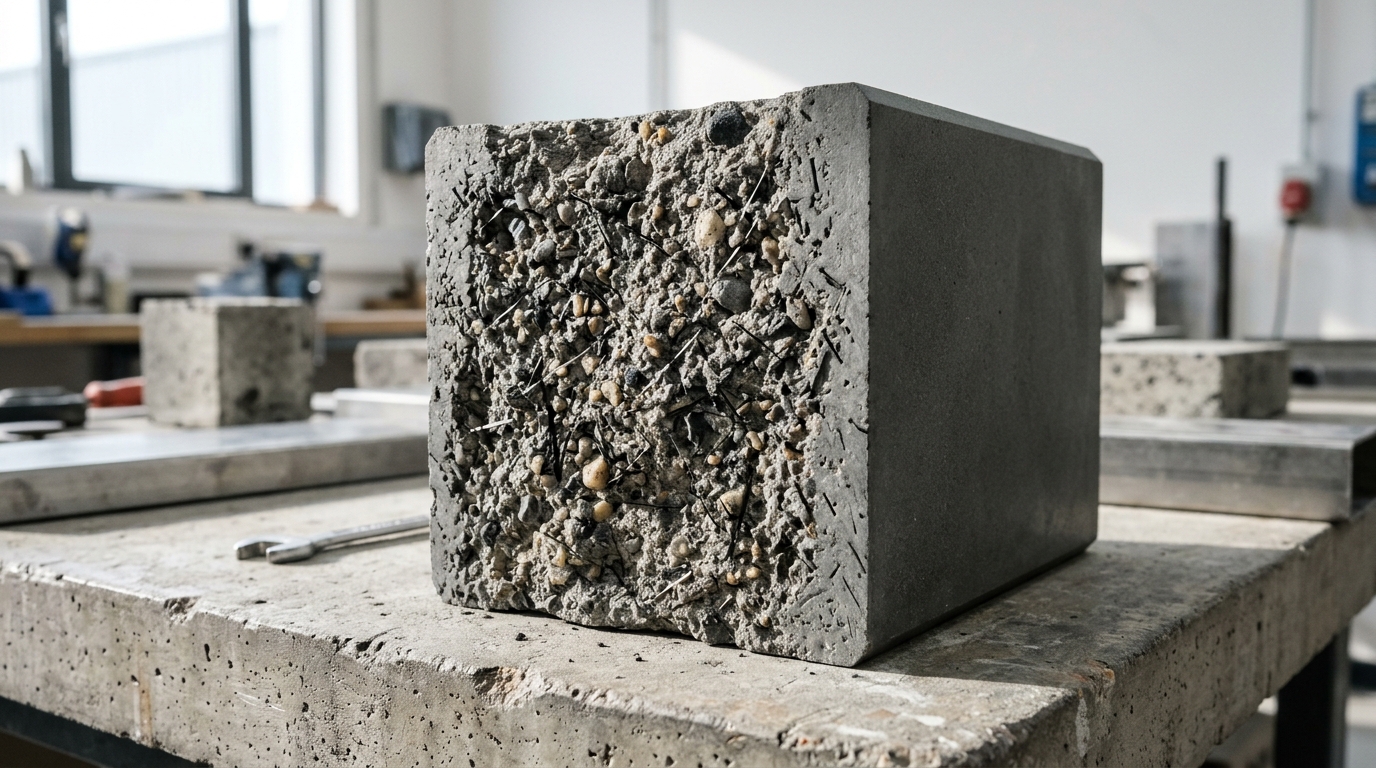
Fibre-reinforced polymer concrete is emerging as one of the most versatile high-performance materials in modern construction, capable of delivering improved strength, durability and structural efficiency, according to a comprehensive state-of-the-art review published in Discover Concrete and Cement. The review, led by Vinotha Jenifer John and colleagues, synthesises decades of research on how adding natural, synthetic, metallic and hybrid fibres transforms polymer concrete, a composite in which polymer binders replace conventional lime-type cement. The authors examine how fibre addition influences mechanical performance and microstructural evolution, from toughness and crack resistance to durability under aggressive conditions such as elevated temperatures and sulphate environments.
The historical arc traced in the review is striking. Polymers entered concrete practice in the 1920s, with major gains by the 1950s, when latex added to concrete enhanced tensile strength and reduced permeability. By the 1970s, polymer-impregnated concrete showed increased durability through in situ polymerisation of monomers within hardened concrete, and polymer-cement concrete was invented by mixing polymer dispersions with cement, creating materials with superior adhesion and flexibility for rehabilitation applications. Fibres were added in the 1980s and 1990s to produce fibre-reinforced polymer concrete with excellent mechanical characteristics and hardness, and in the 2000s polymer nanocomposites containing nano silica and carbon nanotubes improved mechanical and durability qualities. Recent years have emphasised eco-friendly polymers, biodegradable materials and smart polymers for self-healing concrete that can automatically heal cracks.
The review categorises fibres into natural, synthetic, metallic and nonmetallic miscellaneous types, each with distinct advantages. Natural fibres such as basalt, flax, coconut, sisal, ramie, jute, oil palm and bamboo are prized for economic viability, renewability and biodegradability. In epoxy polymer concrete, short ramie fibres at 0.36% loading raised flexural strength by 25.3%, while sisal fibres delivered a 10.4% increase, with compressive strength not reduced. However, reinforcement weakened at increasing fibre content because poor wetting of fibres by epoxy resin led to poor interfacial bonding. Synthetic fibres including polypropylene, polyvinyl alcohol and polyethylene have been investigated for fire spalling protection, shear capacity in beam-column junctions and interfacial bonding mechanisms studied through atomistic simulations and molecular dynamics. Metallic fibres show particularly strong results: amorphous metallic fibres at greater volume contents of 0.5% help increase spalling resistance of high-strength concrete at elevated temperatures, and steel fibres at 1–2% by volume considerably increase the compressive, splitting and flexural strength of polymer concrete.
Mechanically, the review finds consistent patterns. Short fibres such as carbon and polypropylene enhance load-carrying capacity of polymer concrete by approximately 24% and mitigate crack propagation, improving fracture properties. Polypropylene fibres markedly improve compressive strength, flexural strength and indirect tensile strength. Hybrid fibre-polymer concrete integrates polymer modification with fibre reinforcement, resulting in enhanced strength, stiffness and resistance to environmental factors such as sulfate attack, establishing it as a high-performance pavement material. Carbon fibre-reinforced variants exceed the performance of glass fibre-reinforced polymer concrete in compressive strength, though glass fibres are frequently regarded as the more practical option when technical and economic factors are weighed together. Basalt fibres enhance compressive, flexural, splitting tensile and impact strengths alongside thermal stability, while nanoclay particles enhance compressive, flexural and impact strength but may diminish tensile strength.
Stress-strain behaviour receives detailed attention because it reveals stiffness degradation, strain capacity, ductility enhancement and post-peak softening or hardening introduced by fibre bridging and polymer modification. Studies of unsaturated polyester polymer concrete under monotonic and cyclic loadings showed remarkable ductility, surpassing high-strength concrete’s peak by 150% and displaying a maximum strain three times greater than normal concrete. The review also surveys research on FRP-confined concrete columns, hybrid columns with PET FRP, concrete and high-strength steel, and design-oriented stress-strain models for FRP-confined lightweight aggregate concrete, all of which inform structural modelling, seismic considerations and performance-based design.
Crack propagation and fatigue behaviour emerge as areas where fibre reinforcement delivers decisive benefits. Polypropylene fibres at volumes of 0.2%, 0.35% and 0.5% improved mode I, mode II and mixed-mode fracture toughness, and at angles below 75° significantly reduced crack propagation. Short carbon and polypropylene fibres increased load-carrying capacity by an average of 24% and limited crack propagation, though benefits decreased at elevated temperatures reaching 250 °C, even while performance remained better than conventional cement concrete. Jute woven layers with varied orientations significantly affected fracture parameters such as energy release rate and stress intensity factor. In fatigue studies, externally bonded FRP laminates markedly improved the fatigue performance of large-scale reinforced concrete beams by alleviating stress on the reinforcing steel, postponing the onset of fatigue failure, and CFRP-strengthened beams endured millions of load cycles without notable performance degradation. Steel and polypropylene fibres enhanced the flexural fatigue behaviour of ultra-high-performance concrete under low cyclic fatigue conditions.
Microstructural mechanics underpin these macroscopic gains. The review highlights that interaction between fibres, polymer matrix and aggregates at the micro-level controls stress transfer efficiency, crack-bridging action, interfacial bonding, pore structure refinement and durability. Molecular dynamics simulations of interfacial shear strength between calcium-silicate-hydrate and polymer fibres explain bonding mechanisms within the fibre-matrix interface, and functional groups in polymer macromolecules modify adhesion energy by changing the C/S ratio of the C-S-H at the interface. SEM imaging showed uniform distribution of polymers in the fibre matrix, where polymer hardens on the surface of cement particles and generates a network action due to reduced water content. Metallic fibres exhibit strong interlocking ability with polymer matrices owing to surface roughness, synthetic fibres often require plasma treatment or chemical modification to increase adhesion, and natural fibres show good synergy after alkali treatment though moisture absorption and surface impurities reduce long-term bonding ability.
Fibre orientation and distribution prove equally critical. Aligned steel fibres in layered-casting ultra-high-performance concrete enhanced flexural and tensile strength, while production parameters including fibre diameter, volume fraction and mixture rheology correlated with the spatial distribution and orientation of steel fibres. In jute fibre composites, parallel orientation promoted debonding and adhesive wear, whereas normal orientation improved wear resistance. Preferred alignment of fibres along principal stress directions improved tensile and flexural strength, random orientation provided isotropic crack resistance, and uniform distribution minimised stress concentrations, while poor dispersion led to fibre agglomeration, increased pores and localised cracking. Casting procedures and mixture flowability were essential to achieve optimum orientation and distribution.
Applications span the construction industry, infrastructure projects and specialised domains. Optical fibres with various coatings have been embedded in concrete matrices to measure shrinkage deformations, functioning as sensors for monitoring deformation. Steel fibre concrete has been applied in the reconstruction of industrial floors, valued for cost-effectiveness and efficiency, and carbon fibre-reinforced polymer jackets markedly enhanced the strength and ductility of repaired recycled aggregate concrete columns. In infrastructure, FRPs offer improved durability, decreased construction time and superior structural performance for bridges, highways and marine structures, with reliability analysis showing FRP-pre-tensioned footbridges gain structural integrity, and FRP bars demonstrating corrosion resistance and long-term performance advantages in seawater sea sand concrete. Specialised applications include rehabilitation of historic timber structures using polymer concrete and FRP reinforcement, and wet sprayed concrete where fibre rebound and orientation affect performance.
The review also candidly identifies unresolved challenges. Although most studies reported consistent mechanical performance, disagreement remains regarding compressive strength enhancement with fibre integration: several reports testified to strength gain while some observed strength reduction due to fibre agglomeration, entrapped air and low workability, varying with fibre type, hybrid combinations, polymer type, aggregate and curing conditions. Standardised testing procedures are lacking, making direct comparison among studies difficult. The authors call for unified experimental standards for large-scale production, predictive models to optimise fibre dosage, orientation and polymer dosage simultaneously, and future research into sustainable polymer binders, recycled and bio-based fibres, nano-modified polymer concrete and advanced fibre surface treatments. Emerging technologies involving artificial intelligence and machine learning offer opportunities for optimising mix designs and accelerating development through data-driven design and modelling, pointing toward resilient, durable and sustainable construction materials for next-generation infrastructure.
Subject of Research: Mechanical and microstructural performance of fibre-reinforced polymer concrete
Article Title: Comprehensive state of the art review on mechanical and microstructure performance of fibre reinforced polymer concrete
Article References: John, V. J., Nagarajan, D., G, R., Thomas, B. S., & Keerthika, T. (2026). Comprehensive state of the art review on mechanical and microstructure performance of fibre reinforced polymer concrete. Discover Concrete and Cement, 2(1), Article 73. https://doi.org/10.1007/s44416-026-00107-y
Image Credits: AI Generated
DOI: 10.1007/s44416-026-00107-y
Keywords: fibre-reinforced polymer concrete, polymer concrete, mechanical properties, microstructure, crack propagation, fatigue behaviour, natural fibres, steel fibres, polypropylene fibres, FRP confinement, sustainable construction, infrastructure
News Source: Neil Sanderson. (November 6, 2026). Fibres Give Polymer Concrete a Tougher, Longer-Lasting Edge, Review Finds. Scienmag.