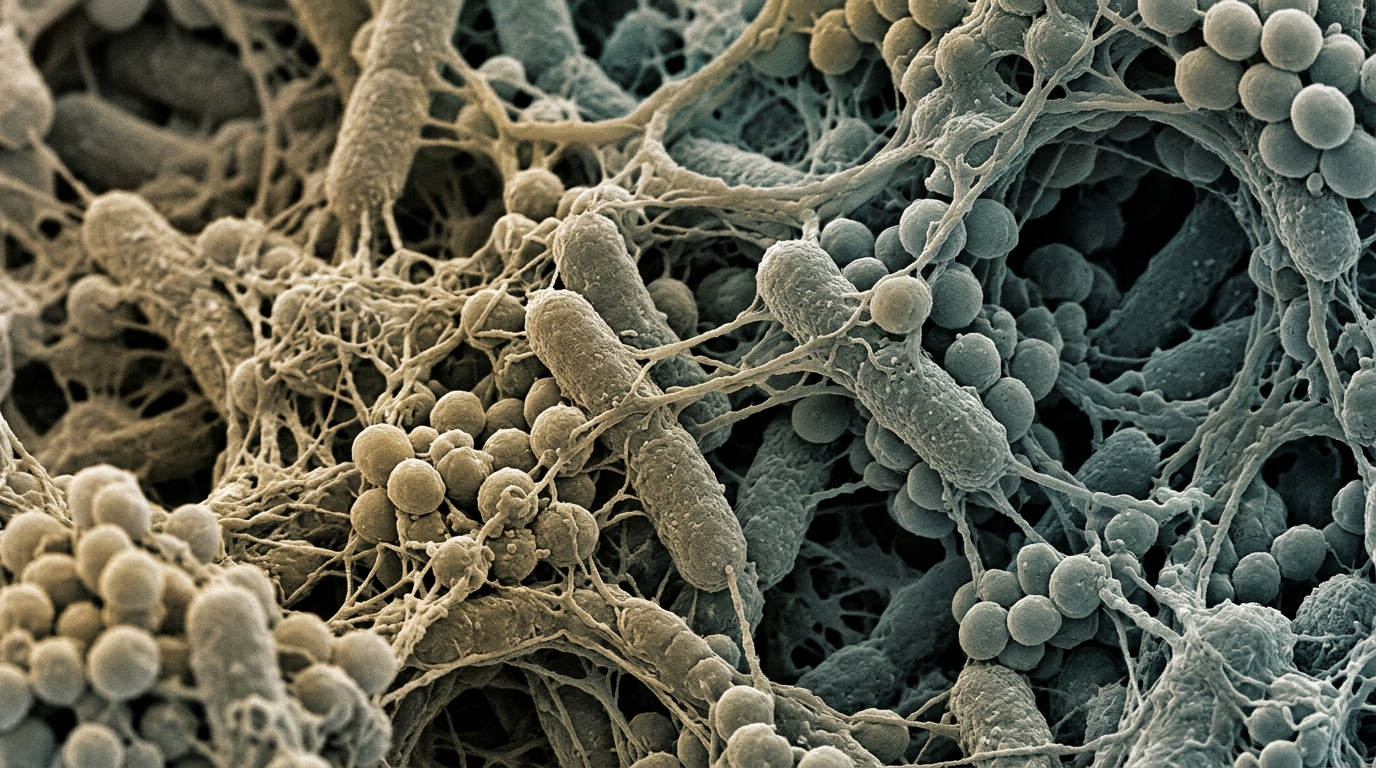
In natural, environmental, and clinical ecosystems, microbial populations rarely survive as isolated single-species colonies, instead assembling into dense, surface-attached polymicrobial communities shielded by self-produced extracellular polymeric substances. A comprehensive review published in Frontiers in Bacteriology by researchers Eswar Rao Tatta and Ranjith Kumavath examines how interspecies communication systems, termed quorum sensing, orchestrate the cooperative and competitive interactions that govern these complex biofilms. Over the past two decades, microbiological research has established that bacteria residing within structured biofilm communities behave fundamentally differently from their free-floating planktonic counterparts, exhibiting altered gene expression, enhanced metabolic resilience, and marked recalcitrance to standard antimicrobial interventions. These multi-species assemblages, which incorporate diverse strains of bacteria, fungi, and archaea, generate emergent ecological properties that cannot be predicted from studying individual microbes in isolation. As chronic clinical conditions such as cystic fibrosis lung infections, catheter-associated complications, periodontal lesions, and non-healing surgical wounds continue to evade conventional therapies, deciphering the molecular chatter operating across distinct microbial species has become a critical scientific objective.
The physical scaffolding of a polymicrobial biofilm relies heavily on an extracellular matrix composed of exopolysaccharides, structural proteins, and extracellular DNA, which establishes steep physiological microgradients of oxygen, pH, and essential nutrients across the community architecture. Microbes occupying deeper strata encounter oxygen-depleted and nutritionally scarce microenvironments, shifting into stationary metabolic states that confer profound tolerance against antimicrobials designed to disrupt actively dividing cells. Beyond providing a physical barrier against immune clearance and chemical penetration, the matrix acts as an active biological crossroads that facilitates persistent cell-to-cell contact and protects extracellular nucleic acids from enzymatic degradation. Consequently, polymicrobial biofilms serve as primary hotspots for horizontal gene transfer, allowing resistance determinants to circulate across distinct bacterial genera through conjugative plasmid exchange, natural transformation, and bacteriophage transduction. By maintaining stable spatial proximities, these polymeric clusters permit individual microbial populations to retain their unique genotypes and phenotypes while simultaneously participating in high-level community behaviors that preserve the viability of the entire consortium during sustained environmental challenges.
Central to this community coordination is quorum sensing, a cell-density-dependent signaling mechanism wherein microbes produce, release, and detect specialized chemical messengers known as autoinducers. When microbial replication drives signal concentrations above a critical threshold, these autoinducers bind cognate intra- or extracellular receptors to trigger synchronized transcriptional alterations across the population. In classic single-species models, quorum-sensing pathways regulate cellular motility, competence, sporulation, and the biosynthesis of collective public goods including digestive exoenzymes, protective biosurfactants, and iron-chelating siderophores. In polymicrobial environments, however, signaling molecules transcend species barriers to mediate elaborate interspecies and interkingdom communication networks. Signaling architectures coordinate metabolic specializations and synchronized resource scavenging, enabling cohabiting microbes to determine whether their collective density justifies the metabolic expense of launching joint physiological programs. Decades of biochemical investigations have traced these signaling cascades from their historical discovery in bioluminescent marine organisms to their widespread clinical presence, establishing quorum sensing as the definitive regulatory language governing polymicrobial biofilm maturation, stability, and pathogenesis.
Different microbial kingdoms and bacterial taxa utilize distinct chemical classes of signaling molecules to coordinate their communal activities within polymicrobial consortia. Gram-negative bacteria predominantly synthesize N-acyl homoserine lactones via enzymes belonging to the LuxI family, which feature a conserved homoserine lactone ring linked to variable acyl side chains that dictate binding specificity for LuxR-type transcriptional regulators. Conversely, Gram-positive pathogens communicate primarily through ribosomally synthesized autoinducing peptides that undergo post-translational modifications before being exported into the extracellular space by specialized ATP-binding cassette transporters. Because these charged peptides cannot diffuse across bacterial membranes, they are detected by surface-bound histidine kinase receptors that trigger adaptive intracellular responses via two-component regulatory systems. Beyond these phylum-restricted channels, autoinducer-2 represents a universal interspecies signal produced through the activated methyl cycle via LuxS-catalyzed synthesis from 4,5-dihydroxy-2,3-pentanedione. Following secretion, this precursor spontaneously cyclizes into active derivatives recognized by specialized receptor complexes like Lsr or LuxPQ, enabling metabolic coordination and mutual spatial patterning across phylogenetically distant Gram-positive and Gram-negative organisms.
Research into polymicrobial communities demonstrates that microbial cross-talk frequently operates through non-cognate receptor interactions, signal interception, and physical coaggregation. In coinfection models involving Pseudomonas aeruginosa and Burkholderia multivorans, the transcriptional regulators RhlR and CepR exhibit remarkable promiscuity by binding heterologous acyl homoserine lactone signals synthesized by the neighboring partner species, thereby connecting distinct regulatory circuits to amplify collective pathogenicity. In synthetic multi-species communities, C4-homoserine lactone produced by Pseudomonas fluorescens is intercepted by Shewanella baltica and Acinetobacter johnsonii, modulating their oxidative stress tolerances, iron acquisition pathways, and spatial colonization dynamics. Similarly, autoinducer-2 pathways mediated by the LsrK kinase regulate biofilm development in co-cultures of Staphylococcus aureus and Pseudomonas aeruginosa. Interkingdom communication is equally evident in oral biofilms, where initial bacterial coaggregation triggers autoinducer-2 signaling, as well as in mixed Candida albicans and Enterococcus faecalis biofilms, where bacterial metabolic byproducts alter environmental pH and quorum-sensing signals to repress the morphological transition of fungal yeast cells into invasive hyphal filaments.
Rather than functioning solely as an autonomous genetic trait of individual pathogens, antimicrobial resistance operates within biofilms as an emergent community-level phenomenon shaped by ecological and social interactions. Interspecies metabolite exchange and public goods sharing allow resistant subpopulations to protect vulnerable neighbors from lethal antibiotic concentrations without necessitating direct genetic modification. For instance, indole molecules released by Escherichia coli function as interspecies extracellular cues that stimulate stress-response pathways and upregulate multidrug efflux pump systems in cohabiting Pseudomonas putida and Salmonella enterica serovar Typhimurium, elevating their phenotypic tolerance against ampicillin exposure. Similarly, siderophore-mediated cross-protection occurs when iron-scavenging pyoverdine molecules secreted by cefiderocol-resistant Pseudomonas aeruginosa sequester extracellular iron, shielding surrounding susceptible Gram-negative strains by impeding antibiotic uptake. Furthermore, cyclic di-GMP second-messenger systems integrate external environmental inputs with quorum-sensing circuits to regulate the transition between planktonic motility and sessile biofilm lifestyles, controlling diguanylate cyclases and phosphodiesterases that govern adhesin synthesis, microcolony architecture, and the emergence of non-growing persister cells that survive therapeutic treatment.
While cooperation preserves biofilm integrity, competitive and antagonistic interactions simultaneously shape the structural diversity, spatial succession, and niche differentiation of polymicrobial ecosystems. Within densely packed environments, coexisting microbes compete intensely for finite resources including oxygen, free iron, space, and carbon substrates, generating evolutionary pressures that govern microbial fitness and the emergence of resistant variants. To suppress metabolic rivals, bacteria deploy specialized contact-dependent inhibition systems, secrete toxic bacteriocins, and discharge lethal effector molecules through type VI secretion systems, as seen when Acinetobacter baumannii targets and lyses neighboring Escherichia coli cells. The resulting cellular destruction paradoxically releases genetic material and biomass into the extracellular space, potentially supplying raw DNA for horizontal gene acquisition among surviving community members. The dynamic equilibrium between antagonistic exclusion and synergistic metabolic cross-feeding dictates community succession, preventing any single species from entirely overwhelming the microenvironment while ensuring that the collective community maintains structural flexibility against host immune defenses and external chemical insults.
Investigating these intricate spatial signalling ecosystems has necessitated a decisive transition from conventional static microtiter assays toward advanced physiological platforms and high-resolution molecular technologies. Standard microtiter plates facilitate high-throughput pharmacological screening but fail to replicate the dynamic fluid shear, continuous nutrient flux, and stable concentration gradients characteristic of native in vivo biofilms. To overcome these deficiencies, researchers employ continuous flow cells, drip flow reactors, microfluidic channels, organ-on-a-chip devices, and patient-derived organoid cultures alongside standardized animal infection models. These physical platforms are increasingly paired with multi-omics methodologies, such as comparative metagenomics, dual RNA-sequencing, and tandem mass spectrometry, which simultaneously profile host-pathogen interactions, protein expression, and signaling metabolite turnover. Furthermore, advanced imaging platforms including confocal laser scanning microscopy, fluorescence in situ hybridization, Raman microspectroscopy, and imaging mass spectrometry permit non-destructive visualization of cellular arrangements, while single-cell transcriptomics and real-time biosensors reveal that genetically identical subpopulations exhibit profound phenotypic heterogeneity in virulence production and drug tolerance based entirely on their exact microenvironmental coordinates.
The deepening understanding of polymicrobial signaling has accelerated the development of novel anti-virulence interventions that aim to disarm biofilm defenses without applying the selective survival pressures that drive heritable drug resistance. Principal among these strategies are quorum-sensing inhibitors and quorum-quenching enzymes that disrupt bacterial communication networks before they trigger defensive biofilm programs. Small-molecule inhibitors, including synthetic acyl-homoserine lactone analogues and natural phytochemicals such as ajoene, brominated furanones, baicalin, and flavonoids, competitively block autoinducer receptors or suppress signal synthase enzymes, thereby attenuating virulence and restoring antibiotic sensitivity in polymicrobial mixtures of Pseudomonas aeruginosa, Staphylococcus aureus, and Candida albicans. Concurrently, catalytic quorum-quenching enzymes, including bacterial acylases, lactonases, oxidoreductases, and autoinducer-2 modifying proteins, enzymatically cleave signaling molecules within the extracellular space. When combined with conventional antibiotic regimens, these communication-disrupting agents break down the coordinated social behaviors of bacterial consortia, impair matrix production, and significantly enhance the clearance of recalcitrant infections in experimental settings.
Despite these encouraging experimental discoveries, translating anti-quorum-sensing interventions into routine clinical practice faces substantial biological and pharmacological hurdles that necessitate mechanism-guided, multi-targeted strategies. A primary obstacle is the extensive functional redundancy inherent to microbial communication networks; most clinical pathogens encode multiple parallel regulatory systems that readily compensate when a single signaling pathway is pharmacologically blocked. Furthermore, synthetic inhibitors frequently suffer from inadequate penetration through the dense exopolysaccharide matrix, rapid metabolic degradation inside host tissues, unpredictable off-target cytotoxicity, and a lack of standardized in vivo pharmacokinetics. To bypass these limitations, emerging therapeutic paradigms combine communication inhibitors with matrix-degrading enzymes such as DNase I, dispersin B, and alginate lyase, or deploy multifunctional nanocarriers, bacteriophage depolymerases, and engineered probiotics designed to sense pathogen cues and locally deliver disruptive molecules. Moving forward, integrating artificial intelligence modeling, spatial multi-omics, and patient-derived polymicrobial infection platforms will be essential to rationally design targeted treatments that dismantle pathological biofilms while safeguarding protective commensal microbiomes.
Subject of Research: Quorum-sensing mechanisms and therapeutic strategies in polymicrobial biofilms
Article Title: Polymicrobial biofilms: quorum-sensing mechanisms and therapeutic strategies
Article References: Tatta, E. R., & Kumavath, R. (2026). Polymicrobial biofilms: quorum-sensing mechanisms and therapeutic strategies. Frontiers in Bacteriology, 5, Article 1925408. https://doi.org/10.3389/fbrio.2026.1925408
Image Credits: AI Generated
DOI: 10.3389/fbrio.2026.1925408
Keywords: polymicrobial biofilms, quorum sensing, antimicrobial resistance, autoinducers, quorum quenching, microbial ecology, infectious diseases, extracellular polymeric substances, Polymicrobial, biofilms, quorum-sensing, mechanisms
News Source: Morgan Morrow. (November 6, 2026). Bacterial Crosstalk in Polymicrobial Biofilms Drives Resistance and Inspires New Therapies. Scienmag.