Scientists in Nigeria have traced the microbial communities living in gluten-free bread, biscuits and cake made from a blend of sweet potato, maize and pigeon pea flour, and their findings carry a practical message for anyone baking without wheat: fermenting the raw ingredients first appears to leave the finished products with fewer microbes. The study, published in Frontiers in Industrial Microbiology, combined old-fashioned plate counting with DNA sequencing to identify exactly which bacteria and fungi were present in the ready-to-eat baked goods, offering one of the more complete microbiological portraits of composite-flour baking to date.
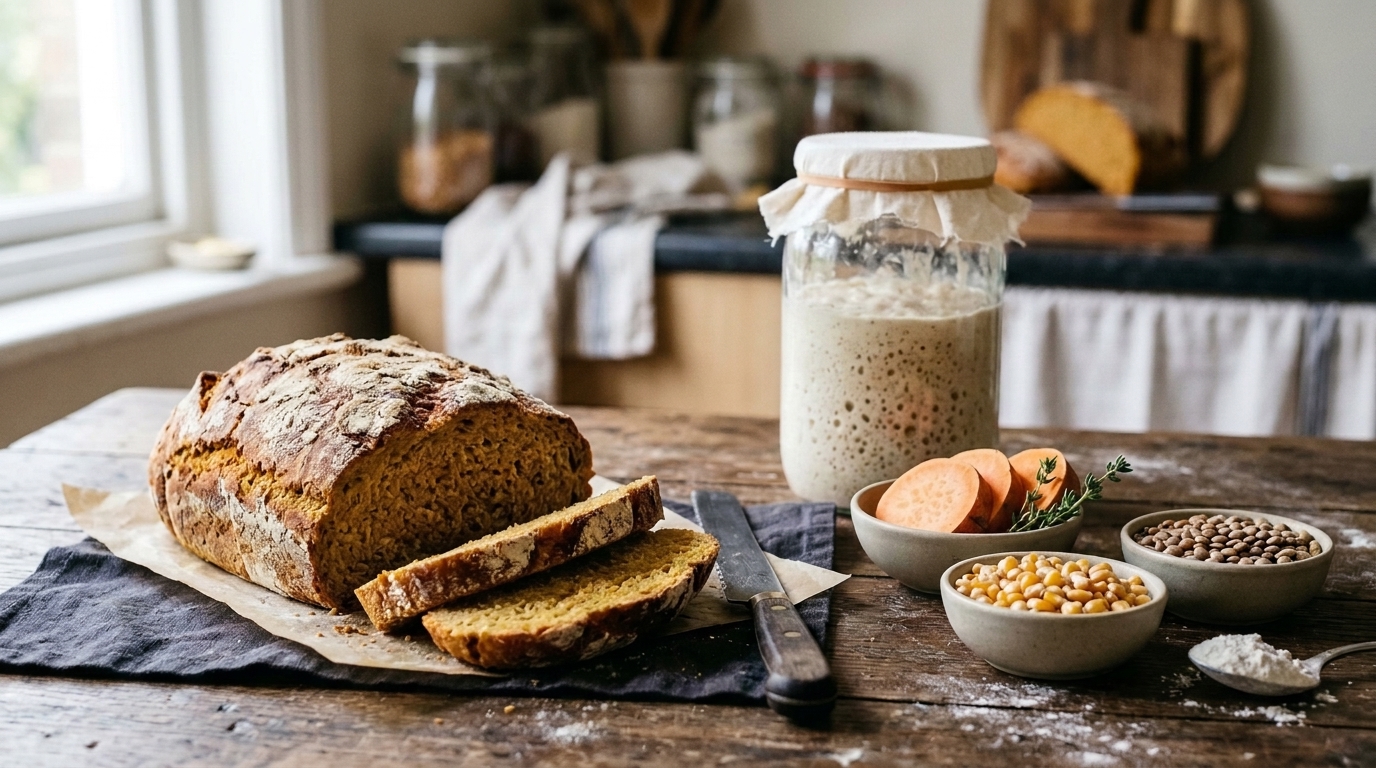
The research team, led by Peace Omoikhudu Oleghe of Edo State University, Iyamho, worked with three botanicals bought from food merchants in Auchi, a market town in Edo State in southern Nigeria. Yellow-fleshed sweet potato tubers, yellow maize grains and pigeon pea seeds were each split into two batches. One batch was steeped in clean water and allowed to ferment spontaneously at 28 degrees Celsius for 72 hours, with no starter culture added, before being drained, dried and milled. The other batch skipped the fermentation step entirely and was processed in parallel, serving as the unfermented control. Both sets of flours were oven-dried at 60 degrees Celsius for 48 hours before grinding.
The blend itself was not chosen on a whim. The ratio of sweet potato to pigeon pea to maize, fixed at 67.70:20.00:12.30, had been optimized and experimentally validated in an earlier companion study using a D-optimal mixture design in Design-Expert software, with candidate formulations judged on proximate composition, antinutrient content and sensory acceptability. That earlier work identified this particular ternary mixture as the best performer, so the researchers adopted it as the fixed formulation for all three baked products in the current study. Bread, biscuits and cake were then prepared from both the fermented and unfermented flours using modified mixing and creaming methods, with control samples made from 100 percent wheat flour.
To assess microbial load, the team used the pour plating technique standardized by the American Public Health Association. One gram of each baked sample was homogenized in peptone water, serially diluted tenfold, and plated onto nutrient agar for total heterotrophic bacteria, MacConkey agar for coliforms, and potato dextrose agar supplemented with chloramphenicol for fungi. Bacterial plates were incubated at 37 degrees Celsius for 18 to 24 hours, fungal plates at 25 degrees Celsius for 72 to 96 hours. Colony counts were multiplied by the dilution factor to yield colony-forming units per gram, and all analyses were run in triplicate with results expressed as means plus or minus standard deviations.
The numbers told a consistent story. Bacterial counts across the products ranged from 7.32 to 7.60 Log10 CFU per gram, with the pre-fermented versions consistently carrying more bacteria than their post-fermented counterparts. Among the pre-fermented products, counts spanned 7.35 to 7.60 Log10 CFU per gram, with biscuits highest and bread lowest. The post-fermented products ranged from 7.32 to 7.43 Log10 CFU per gram, with cake highest and bread again the least. Fungal loads followed the same pattern: pre-fermented products ranged from 2.7 to 4.5 Log10 CFU per gram, while post-fermented products ranged from 1.1 to 4.4 Log10 CFU per gram. Bread had the lowest fungal count in both groups and cake the highest.
Identifying what was actually there required molecular tools. Bacterial isolates were characterized using standard biochemical tests referenced against Bergey’s Manual of Systematic Bacteriology, then confirmed genetically by amplifying the 16S rRNA gene with primers 27F and 1492R. Fungal isolates were examined macroscopically and microscopically for colony color, hyphal structure, conidia and spore arrangement, then identified by sequencing the internal transcribed spacer region with ITS1-F and ITS4-R primers. Sequences were compared against the NCBI database using BLASTN, aligned with ClustalX, and phylogenetic trees were constructed using the Neighbor-Joining method in MEGA X, involving 22 bacterial and 8 fungal nucleotide sequences.
The bacterial results were strikingly uniform: every isolate belonged to the spore-forming genus Bacillus. Four species were identified with 100 percent sequence similarity to reference strains in the NCBI database: Bacillus velezensis, Bacillus licheniformis, Bacillus tequilensis and Bacillus subtilis. Accession numbers for the sequences, ranging from OR244018 to OR244030, are publicly available on GenBank. On the fungal side, four molds were identified, also with 100 percent similarity: Xylaria feejeensis, Aspergillus niger, Talaromyces islandicus and Cladosporium oxysporum, with accession numbers OR244318 through OR244321. Distribution tables showed that all eight microbial types were present in both fermented and unfermented cake, while some were absent from the bread and biscuit samples depending on fermentation status.
Why would fermentation reduce microbial load in the finished product? The authors point to a well-known mechanism: fermentation is typically driven by acid-tolerant bacteria, yeasts or molds whose metabolic activity lowers the pH of the substrate, restricting the proliferation of spoilage organisms. The study did not measure pH or organic acid content directly, so this remains a plausible explanation rather than a demonstrated one, but it aligns with established food science. The researchers also note that some fermenting microorganisms can confer benefits such as probiotic production or improved digestibility, though those properties were not tested here. The higher fungal load in pre-fermented products may reflect the fact that fungi proliferate readily in moist environments, or the possible absence in post-fermented products of antimicrobial by-products such as organic acids that accumulate during fermentation.
Several of the identified organisms have documented industrial or ecological roles that the authors discuss at length. Bacillus velezensis occurs in soil, plant roots, water and fermented foods, and some isolates carry genes for probiotic functionality and enzyme production. Bacillus subtilis has been assessed as safe for use in food and diet supplements. Bacillus licheniformis has been found in protein-based fermented soybean paste and shows potential for producing biotechnologically useful proteins. Bacillus tequilensis exudes extracellular protease enzymes and shows antibacterial and antifungal activity. Among the fungi, Xylaria feejeensis is an endophyte antagonistic to plant pathogens, Aspergillus niger is ubiquitous and used industrially for enzymes and organic acids though it spoils foodstuffs, Talaromyces islandicus produces heat-resistant ascospores linked to spoilage of fruit-based products, and Cladosporium oxysporum is an airborne saprophytic mold associated with human cutaneous infections and allergic disease.
The authors conclude that fermenting the raw botanicals improves the microbiological quality of the resulting gluten-free baked products, and they suggest the isolated genera could be harnessed for bio-preservation. They also caution that most of these microorganisms are normal flora of plants, soil and the environment, so adherence to current Good Manufacturing Practice during flour processing and product preparation remains essential. Importantly, the study did not perform pathogen-specific testing or shelf-life evaluation, and the authors recommend comprehensive consumer safety assessments including those steps as follow-up work. Establishing these products as functional foods would also require quantifying nutritional components such as dietary fiber and vitamin content, which fell outside the scope of this microbiological investigation. For now, the study offers a detailed microbial baseline for a growing category of non-wheat baked staples, one that could inform better preparation protocols in regions where sweet potato, maize and pigeon pea are abundant but wheat is not.
Subject of Research: Microbial profiling of gluten-free baked products made from fermented composite flours of sweet potato, maize and pigeon pea
Article Title: Genotypic profiling of the microbial community of functional ready-to-eat baked products from gluten-free composite flour
Article References: Oleghe, P. O., Akharaiyi, F. C., & Ehis-Eriakha, C. B. (2026). Genotypic profiling of the microbial community of functional ready-to-eat baked products from gluten-free composite flour. Frontiers in Industrial Microbiology, 4, Article 1967470. https://doi.org/10.3389/finmi.2026.1967470
Image Credits: AI Generated
DOI: 10.3389/finmi.2026.1967470
Keywords: gluten-free, composite flour, fermentation, microbiology, Bacillus, food safety, baked products, sweet potato, pigeon pea, maize, 16S rRNA, ITS sequencing
News Source: Alan Morgan. (November 6, 2026). Fermentation Cuts Microbial Load in Gluten-Free Sweet Potato, Maize and Pigeon Pea Baked Goods. Scienmag.