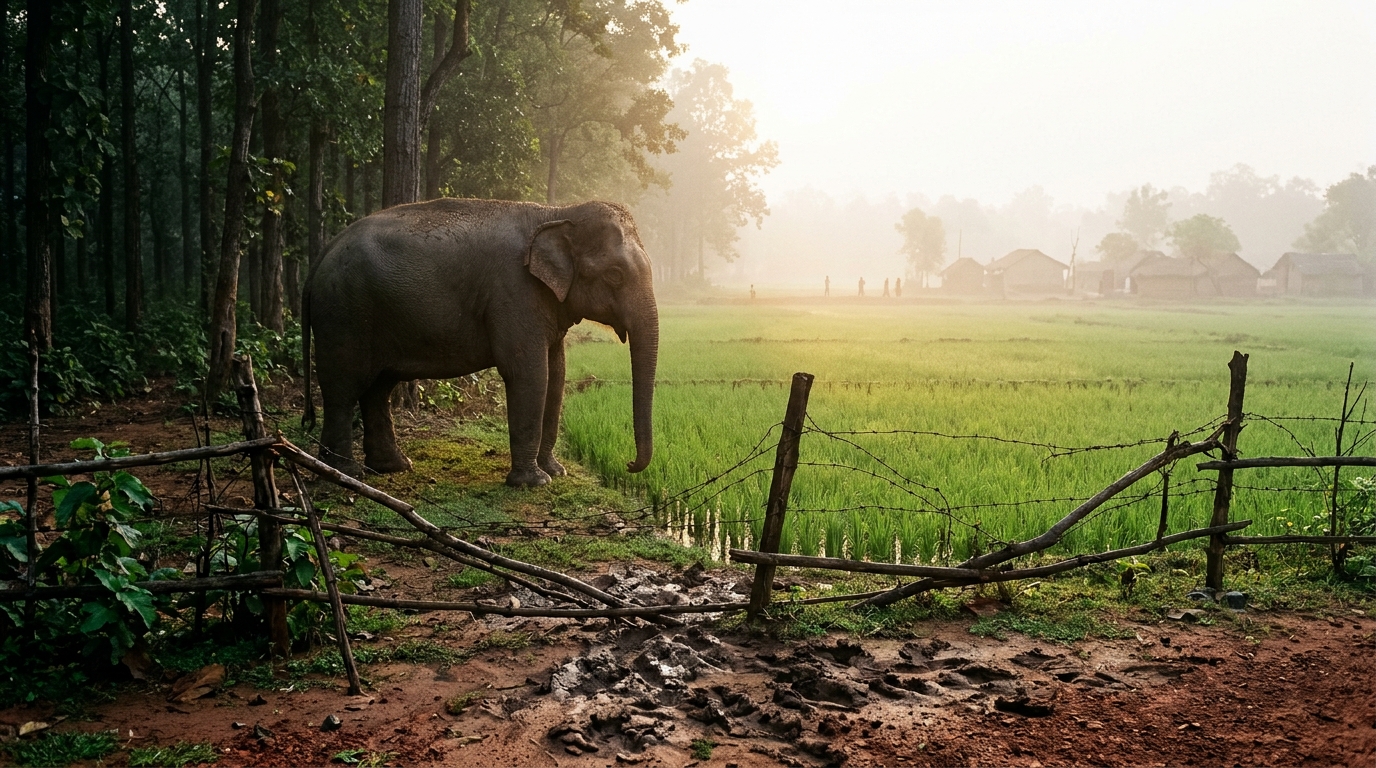
Human-elephant conflict has become one of the most pressing conservation and governance challenges in the Indian state of Odisha, where large elephant populations live alongside expanding human activity. A new policy and practice review, published in Frontiers in Conservation Science, examines the ecological, socio-economic, legal and governance dimensions of this conflict, with particular attention to how compensation mechanisms and mitigation frameworks perform in practice. The study, led by researchers at the Institute of Law, Nirma University in Ahmedabad, argues that the state’s largely reactive, compensation-based approach is failing to deliver long-term coexistence, and that a shift toward integrated, coexistence-oriented conservation governance is needed.
The research adopts a qualitative and doctrinal methodology, drawing primarily on secondary data including government reports, policy documents, wildlife literature, census records and conservation studies. Through this interdisciplinary analysis, the authors identify a cluster of drivers intensifying conflict in Odisha: habitat fragmentation, land-use change, mining activities, infrastructure expansion, climate variability and socio-economic vulnerabilities. Increasing human-elephant interactions have resulted in rising human fatalities, elephant deaths, crop loss, habitat fragmentation, and livelihood insecurity.
The study further evaluates the effectiveness and implementation challenges associated with compensation mechanisms and existing mitigation frameworks. The findings indicate that although Odisha possesses a comparatively structured compensation framework alongside several conservation initiatives, persistent governance problems continue to undermine its effectiveness. Compensation disbursement is frequently delayed, institutional coordination remains fragmented, habitat governance is weak, and community participation is inadequate.
The study situates Odisha’s experience within a broader comparative analysis of selected elephant-range regions and countries. This comparison highlights the growing importance of coexistence-oriented governance approaches that integrate habitat connectivity, scientific monitoring, community participation, land-use planning and localized mitigation strategies.
The authors contend that sustainable mitigation of human-elephant conflict in Odisha requires moving beyond reactive compensation toward a governance model that embeds ecological considerations within developmental planning. Strengthening habitat protection, improving compensation administration, enhancing institutional coordination and promoting community-based conservation strategies are identified as essential steps for reducing conflict intensity and fostering long-term coexistence.
The authors conclude that without reforms to compensation administration, habitat governance and community engagement, Odisha’s existing frameworks will continue to fall short of reducing conflict, even as the state retains a comparatively structured set of policies on paper.
Subject of Research: Human-elephant conflict, its drivers, impacts and compensation mechanisms in Odisha, India
Article Title: Navigating human-elephant conflict in Odisha, India: unraveling the causes, impacts, and compensation paradigm
Article References: Hota, D. R., Behera, A. K., Kumar, R., & Sharma, I. (2026). Navigating human-elephant conflict in Odisha, India: unraveling the causes, impacts, and compensation paradigm. Frontiers in Conservation Science, 7, Article 1839149. https://doi.org/10.3389/fcosc.2026.1839149
Image Credits: AI Generated
DOI: 10.3389/fcosc.2026.1839149
Keywords: human-elephant conflict, Odisha, compensation mechanisms, habitat fragmentation, conservation governance, wildlife conservation, coexistence, India, land-use change, community participation, Navigating, human-elephant
News Source: Margaret Porter. (November 6, 2026). Human-Elephant Conflict in Odisha: Study Maps Causes, Impacts and Compensation Failures. Scienmag.