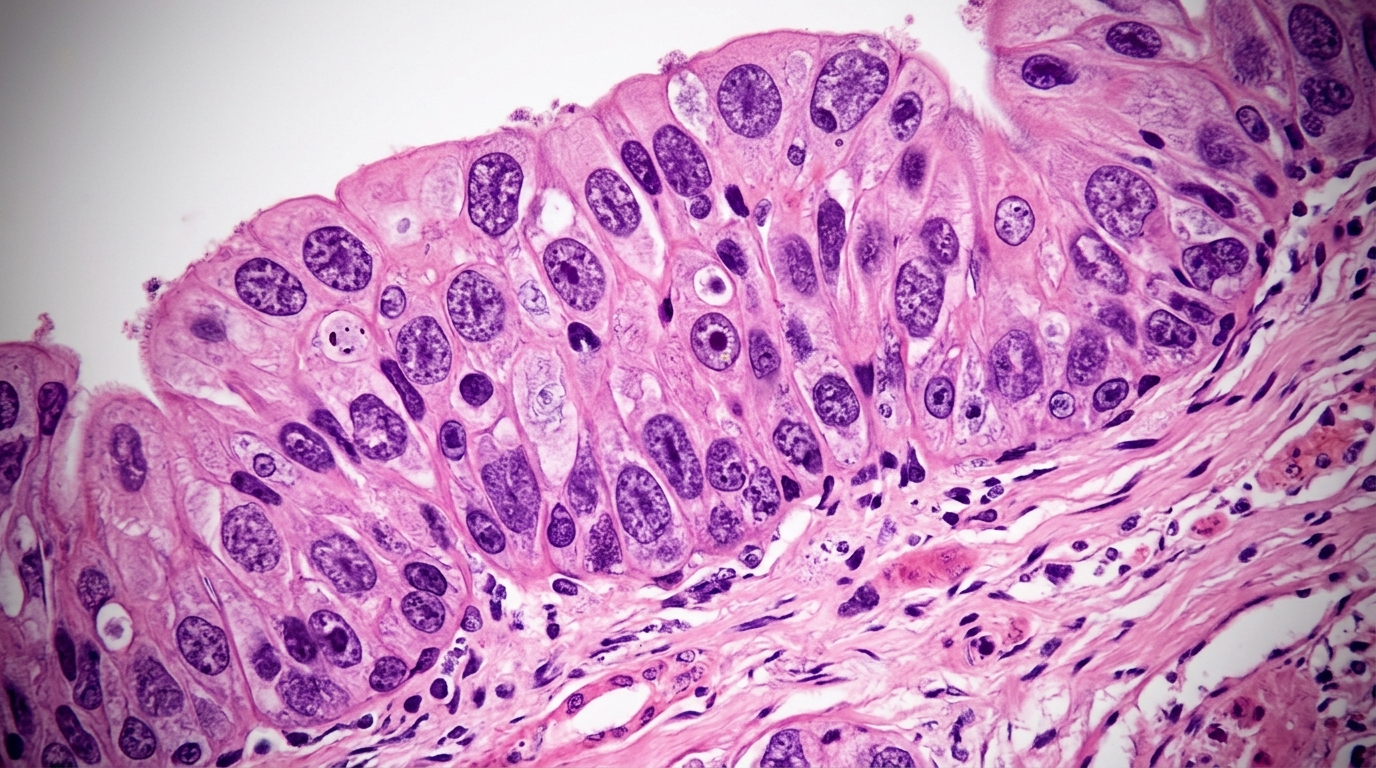
In a newly reported clinical case study, researchers identified a donor-derived high-grade invasive urothelial carcinoma originating in a two-time kidney transplant recipient with chronic JC polyomavirus infection, revealing an oncogenic convergence between chronic viral inflammation, persistent immunosuppression, and a donor-cell somatic mutation. Solid organ transplant recipients face an elevated risk of post-transplant malignancies due to lifelong immunosuppressive therapy and impaired viral immune surveillance, with donor-derived tumors representing an informative biological model wherein engrafted donor cells act as tumor-initiating cells in the host environment.
The patient, a 59-year-old male with end-stage renal disease, initially received a renal transplant from a deceased male donor with an XY karyotype in 2006. Seven years following transplantation, he developed JC polyomavirus-associated nephropathy, which ultimately resulted in graft failure. In 2021, the patient underwent a second kidney transplantation using an allograft from a deceased female donor with an XX karyotype.
Following immunosuppressive regimen adjustment with everolimus, JC polyomavirus replication nonetheless persisted at high concentrations across plasma, urine, and cerebrospinal fluid compartments. Two years after the second transplant procedure, the patient presented with macrohematuria. Diagnostic evaluation documented an invasive high-grade urothelial carcinoma of the bladder that involved the left ureteral orifice, necessitating bilateral native and graft nephroureterectomy in conjunction with radical cystectomy.
To investigate the cellular origin and genomic drivers of the malignancy, clinicians harvested six fresh tissue specimens from native and transplanted anatomical structures. The diagnostic protocol incorporated multiplex quantitative fluorescent polymerase chain reaction short tandem repeat profiling using the Elucigene QST*Rplusv2 assay, primary in vitro tissue culture in Chang medium, and targeted next-generation sequencing across 67 cancer-related genes using the Archer VariantPlex Solid Tumor Kit on both neoplastic tissue and macroscopically normal structures.
Short tandem repeat analysis revealed that non-neoplastic native tissues, comprising the native bladder and native ureters, shared an identical recipient XY haplotype. In contrast, the left transplanted ureter and the hyperemic bladder carcinoma exhibited an XX donor genotype interspersed with recipient-derived allelic peaks, demonstrating localized cellular chimerism. Primary cells isolated from the hyperemic bladder region and the left transplanted ureter were propagated over five passages in vitro, acquiring an immortalized phenotype with a homogeneous XX donor karyotype.
Targeted next-generation sequencing detected a specific PIK3CA mutation, c.1571G>A (p.Arg524Lys), located within the helical domain of the PI3K/AKT/mTOR signaling pathway, in both the hyperemic bladder carcinoma and the macroscopically normal left transplanted ureter. No other pathogenic alterations were identified across the 67-gene testing panel.
Real-time polymerase chain reaction confirmed persistent JC polyomavirus DNA across all analyzed tissue specimens, with viral loads ranging between 3.2 × 10⁴ and 1.1 × 10⁵ copies/mL. Viral DNA was not detected in the expanded in vitro cellular pellets, excluding direct ongoing viral integration within the cultured neoplastic clone.
The study authors concluded that the concordant short tandem repeat profiles, the in vitro clonal expansion of female donor cells, and the presence of the identical PIK3CA mutation in both ureteral and bladder specimens support a donor-derived origin of the tumor-initiating cells, which likely migrated from the transplanted ureter to the bladder mucosa. The authors hypothesized that chronic JC polyomavirus infection contributed indirectly through a field-effect mechanism, causing severe localized cystitis and creating a permissive inflammatory microenvironment that, together with systemic immunosuppression, supported the engraftment and clonal expansion of the altered donor cells.
The authors underscored that this case serves as an informative living model of early carcinogenesis in vivo, contrasting sharply with conventional cancer sequencing investigations. Current sequencing approaches focus predominantly on late-stage neoplasms where the constituent malignant cells share a uniform collection of public mutations, an outcome of tumor evolution that obscures the original founding event of neoplastic transformation. Because the allograft recipient and donor cell populations were genomically distinguishable through karyotypic sex differences and short tandem repeat profiles, the authors had the opportunity to detect that founding transformation event in a clinical context where the neoplastic population emerged from an identifiable anatomical origin and defined chronology.
This genomic distinguishability demonstrates how molecular chimerism analysis can track the initiation of donor-derived malignancies from their earliest stages. Such tracking enables the potential identification and isolation of the earliest altered cells that silently pave the path toward clinical cancer long before morphological dysplasia becomes evident. Detecting the identical somatic PIK3CA mutation across both the hyperemic bladder carcinoma and the macroscopically normal transplanted ureter confirms that combining molecular chimerism assays with targeted genomic profiling of non-neoplastic tissues can monitor donor-derived oncogenesis directly within recipient tissues.
Based on these findings, the authors indicated that extending genomic surveillance beyond traditional post-transplant clinical timelines could enhance cancer risk stratification and support earlier tumor detection in solid organ transplant recipients.
Regarding procedural governance and research ethics, formal ethical review approval was not required because the report describes a single retrospective clinical case managed according to standard medical practice, without experimental interventions or deviations from routine clinical care. All diagnostic evaluations and molecular analyses were conducted on tissue specimens harvested strictly for therapeutic and diagnostic purposes, and the manuscript was prepared using fully anonymized patient data in compliance with institutional policies and local legislation. The patient provided written informed consent for study participation and the publication of potentially identifiable clinical data, and the datasets generated during the study are available from the corresponding author upon reasonable request.
Subject of Research: Donor-derived chimeric urothelial carcinoma and oncogenic drivers in a kidney transplant recipient
Article Title: A chimeric bladder tumor in a renal transplant recipient: the oncogenic convergence of JC virus and PIK3CA mutation
Article References: Ietto, G., Dalla Gasperina, D., Gritti, M., Brani, P., La Rosa, S., Furlan, D., Inversini, D., Balzano, G., Carcano, G., Pettinato, G., & Baj, A. (2026). A chimeric bladder tumor in a renal transplant recipient: the oncogenic convergence of JC virus and PIK3CA mutation. Transplant International, 39, Article 16897. https://doi.org/10.3389/ti.2026.16897
Image Credits: AI Generated
Keywords: kidney transplantation, urothelial carcinoma, JC polyomavirus, PIK3CA mutation, cellular chimerism, donor-derived tumors, oncogenesis, immunosuppression, chimeric, bladder, tumor, renal
News Source: Nathaniel Bowman. (November 6, 2026). Chimeric Bladder Tumor in Kidney Recipient Involves JC Virus and PIK3CA. Scienmag.