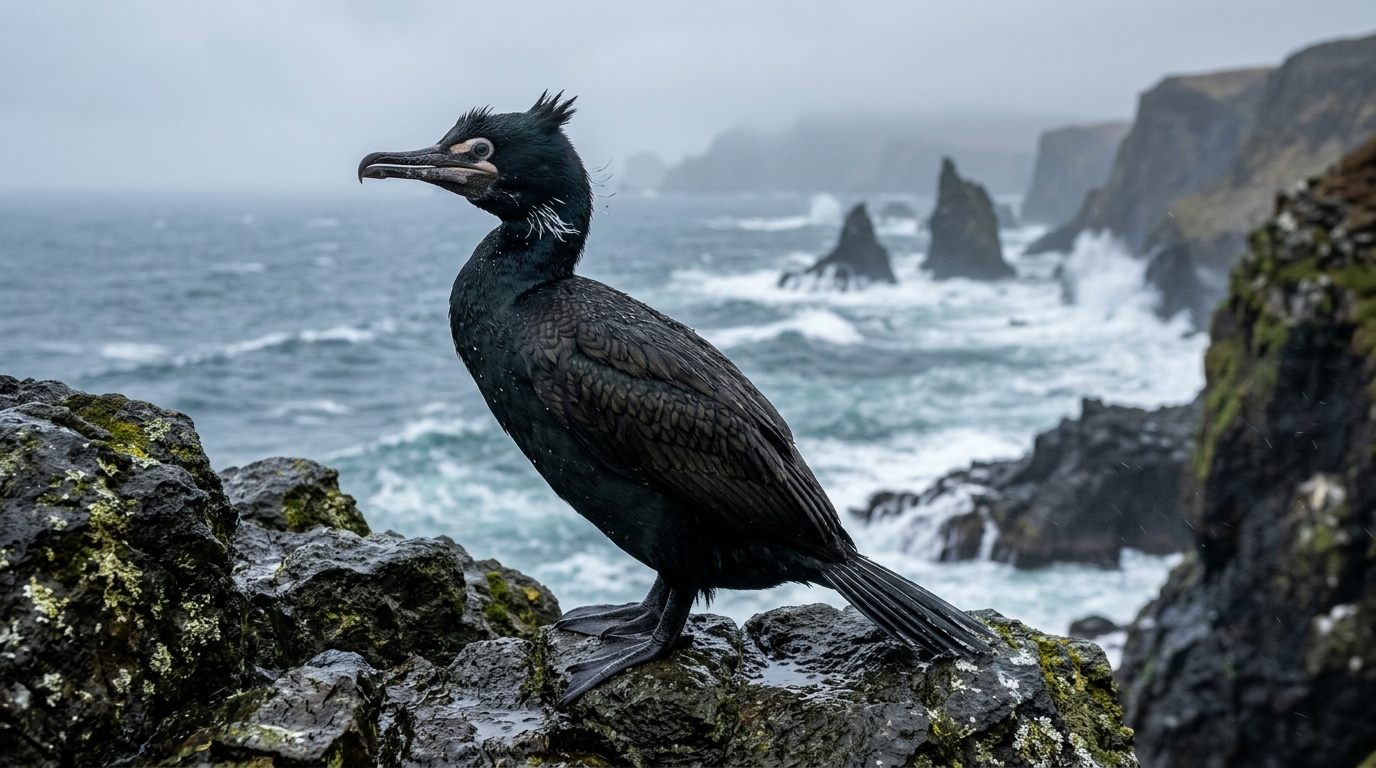
The spectacled cormorant (Urile perspicillatus), an extinct seabird from Bering Island in the Commander Islands, Russia, has yielded its first complete mitochondrial genomes. Researchers assembled two mitogenomes from historical specimens of the extinct species, one dated to 1510–1220 calibrated years before present and the other to 500–230 calibrated years before present. The work, published in BMC Ecology and Evolution, addresses a gap: until now, no published genetic information was available for this species, and its phylogenetic relationships were primarily based on morphological traits.
The spectacled cormorant was hunted to extinction by human activity in the mid-19th century. Before its disappearance, it served as an important source of animal protein for sailors, fur traders, and the permanent population of the Commander Islands. The new study addresses that gap directly by sequencing ancient DNA recovered from Bering Island specimens.
The assembled mitogenome measures 16,895 base pairs in length. Its gene content follows the standard avian mitochondrial layout, containing 13 protein-coding genes, two ribosomal RNA genes, and 22 transfer RNA genes. Base composition came out at 32.3 percent adenine, 31.3 percent cytosine, 22.8 percent thymine, and 13.6 percent guanine, a profile the authors describe as showing no significant bias toward GC.
To determine where the extinct bird sits on the cormorant tree, the team built phylogenies from two different portions of the mitochondrial data: the cytochrome c oxidase I gene, a workhorse of molecular taxonomy, and the full set of mitochondrial coding sequences. Both analyses returned the same key result. The spectacled cormorant belongs to the genus Urile, which forms a sister clade to the genus Phalacrocorax, confirming the sister relationship between the two groups.
The phylogenetic placement also identified the extinct species’ nearest living kin. Among extant cormorants, the spectacled cormorant’s closest living relative is the sympatric pelagic cormorant (U. pelagicus). The red-faced cormorant (U. urile) sits in the same neighborhood of the tree. The spectacled cormorant, the pelagic cormorant (U. pelagicus), and the red-faced cormorant (U. urile) shared the North Pacific Ocean coast as a place where their ranges overlapped.
The two specimens bracket a meaningful slice of time. The two specimens date to 1510–1220 cal BP and 500–230 cal BP, respectively, so the younger individual lived within a few centuries of the species' extinction in the mid-19th century. The researchers sequenced ancient DNA from the Bering Island specimens to reconstruct the complete mitochondrial genomes of the extinct species.
Phylogenetic analyses based on the COI gene and the mitochondrial coding sequences confirmed the sister relationship between the Phalacrocorax and Urile species. Before this study, the species' phylogenetic relationships were primarily based on morphological traits. The phylogenetic analyses based on the COI gene and the mtDNA coding sequences both confirmed the sister relationship between Phalacrocorax and Urile.
The analyses placed the spectacled cormorant in the genus Urile as the closest living relative of the sympatric pelagic cormorant (U. pelagicus), with the red-faced cormorant (U. urile) also in the genus. The spectacled cormorant was hunted to extinction due to human activity in the mid-19th century, while the pelagic and red-faced cormorants shared its North Pacific range. The two complete mitochondrial genomes provide published genetic data for a species for which no such information was previously available.
The study shows that complete mitochondrial genomes can be assembled and annotated from historical specimens of an extinct species. The assembled mitogenome is 16,895 base pairs long and contains 13 protein-coding genes, two ribosomal RNA genes, and 22 transfer RNA genes.
Subject of Research: Mitochondrial genome sequencing and phylogenetic placement of the extinct spectacled cormorant
Article Title: Mitogenomic phylogeny of the extinct spectacled cormorant (Urile perspicillatus) and other cormorant species
Article References: Sharko, F., Boulygina, E., Slobodova, N., Petrova, D., Samsonov, S., Krylovich, O., Fomin, S., Nakamura, T., Okuno, M., Mamaev, E. G., Savinetsky, A. B., & Nedoluzhko, A. (2026). Mitogenomic phylogeny of the extinct spectacled cormorant (Urile perspicillatus) and other cormorant species. BMC Ecology and Evolution. https://doi.org/10.1186/s12862-026-02585-x
Image Credits: AI Generated
DOI: 10.1186/s12862-026-02585-x
Keywords: spectacled cormorant, Urile perspicillatus, mitogenome, ancient DNA, phylogenetics, Phalacrocoracidae, Bering Island, extinct birds, COI gene, North Pacific, Mitogenomic, phylogeny
News Source: Juliet Wilcox. (November 6, 2026). Extinct spectacled cormorant genome reveals sister lineage of Phalacrocorax. Scienmag.